
Yes formed in London in 1968, as British rock was absorbing psychedelia, jazz, folk and classical music and the album was becoming an increasingly expansive space for composition. Their response was to build music based less on the individual solo than on interaction: bass, drums, guitar, keyboards and voice could move as autonomous parts of the same architecture.
This profile places Yes within The Great Rock and Roll History, tracing the movement from psychedelia and symphonic rock toward one of the most elaborate forms of British progressive rock, where virtuosity, arrangement and duration become tools for rethinking the structure of the rock song itself.
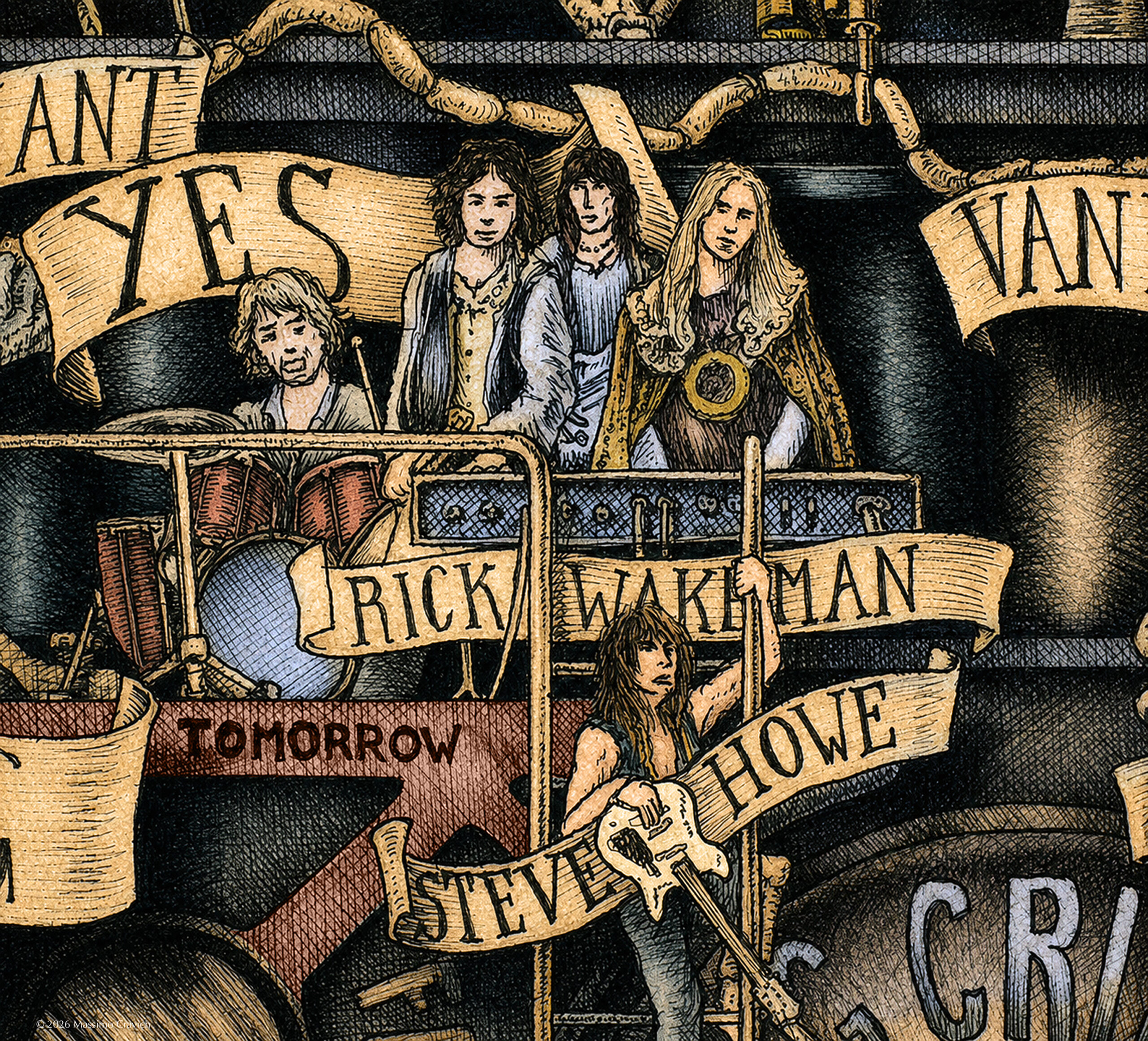
Rock Icons: Yes
Five instruments in motion

British progressive rock band built around virtuosity, cosmic harmonies and monumental sonic architecture.
From The Yes Album and Fragile to Close to the Edge, Yes combined rock, classical music, jazz, folk and new electronic possibilities in extended compositions shaped by Chris Squire’s melodic bass, Jon Anderson’s voice and the interaction of Steve Howe, Rick Wakeman and Bill Bruford.
Founded: London, England — 1968
Status: Active
Classic Core: Jon Anderson, Chris Squire, Steve Howe, Rick Wakeman, Bill Bruford, Alan White
Genres: progressive rock, art rock, symphonic rock
ARTIST OFFICIAL SITE: yesworld.com
LISTEN
More to discover…
The song becomes architecture: from psychedelic rock to large-scale progressive form
The early Yes grew from the meeting of Jon Anderson and Chris Squire and from a shared ambition: to move beyond the limits of the conventional pop group without abandoning the energy of rock. Anderson brought a high voice and lyrics more evocative than narrative; Squire treated bass as a foreground melodic instrument. With Steve Howe and then Rick Wakeman joining, while Bill Bruford developed mobile and unconventional rhythmic patterns, the band found a balance among unusually strong musical personalities.
It was also a difficult balance: perfectionism, musical arguments and repeated lineup changes accompanied music that often sounded almost geometrically designed.
Progressive rock transformed into a sonic cathedral
On The Yes Album, compositions grow longer while retaining recognizable riffs and sections; Fragile emphasizes virtuosity and individual color; Close to the Edge extends the method into large-scale form, connecting themes, variations, dynamic contrasts and recurring motifs across an entire album side. Wakeman’s Mellotron, organ and synthesizers are not merely symphonic decoration; Howe’s guitar moves between rock, folk and near-classical techniques; Squire’s bass occupies frequencies and functions usually assigned to guitar. Complexity therefore emerges above all from the distribution and interaction of parts.
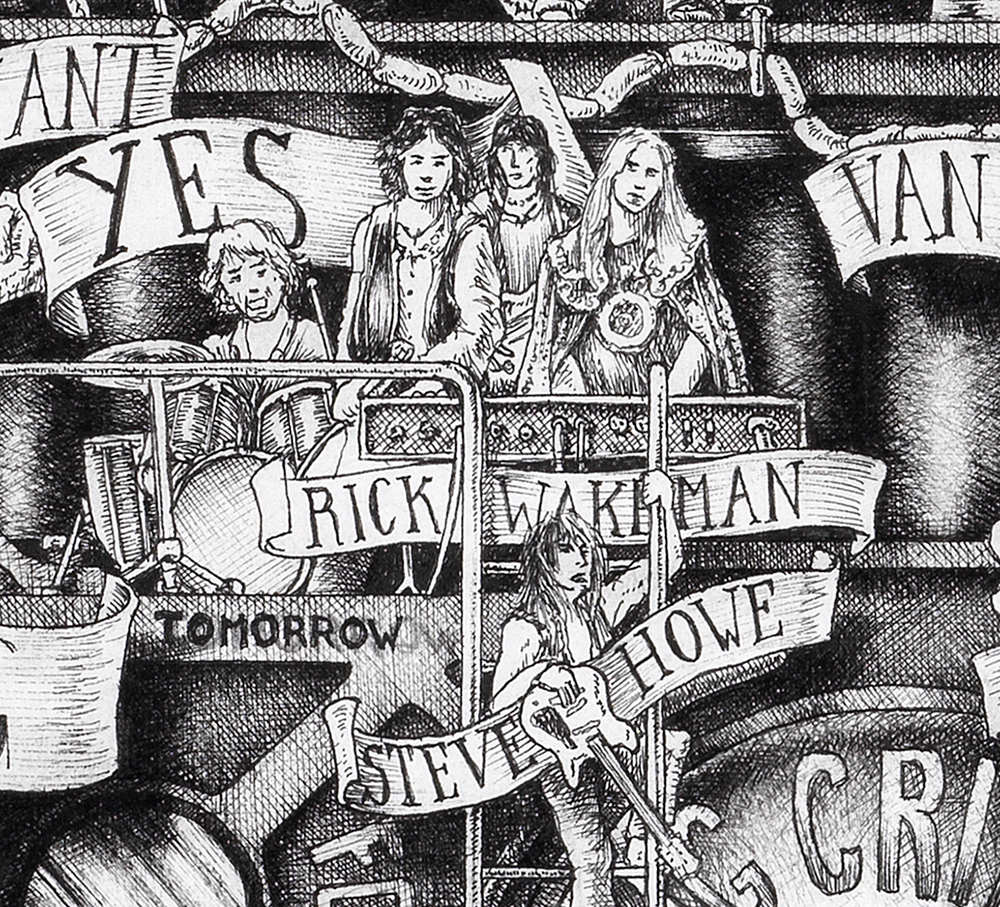
Progressive rock as collective architecture
Genealogically, Yes represent one of the fullest expansions of the idea that rock can sustain long, articulated structures without surrendering its electric identity. Psychedelia, jazz, folk, classical music and keyboard technology are integrated into a recognizable grammar that would influence progressive rock, symphonic rock and later progressive metal. Yet the ambition of extended form also contains the genre’s future tensions: virtuosity, monumentality and increasing distance from pop concision. The line can be read as psychedelia + symphonic rock + jazz/folk/classical music -> Yes -> mature progressive rock -> symphonic prog and later forms of technical rock and progressive metal.
Albums such as Fragile and Close to the Edge show how Yes transformed virtuosity, melodic bass, electronic keyboards and extended composition into a collective language central to 1970s progressive rock.
Within The Great Rock and Roll History, Yes belong to the moment when the album increasingly replaced the single as the measure of rock’s artistic ambition. Their success shows how, in the early 1970s, complex music largely detached from radio-song form could reach a wide audience, before that very scale and complexity becamethe object of critical and generational reaction.
Influenced by
- The Beatles
- European classical music
- Modern jazz
- Simon & Garfunkel
- The Byrds
Influent For
- Dream Theater
- Marillion
- Porcupine Tree
- Rush
- Neo-progressive rock
Related Artists
- King Crimson
- Genesis
- Emerson Lake & Palmer
- Rick Wakeman
- Asia
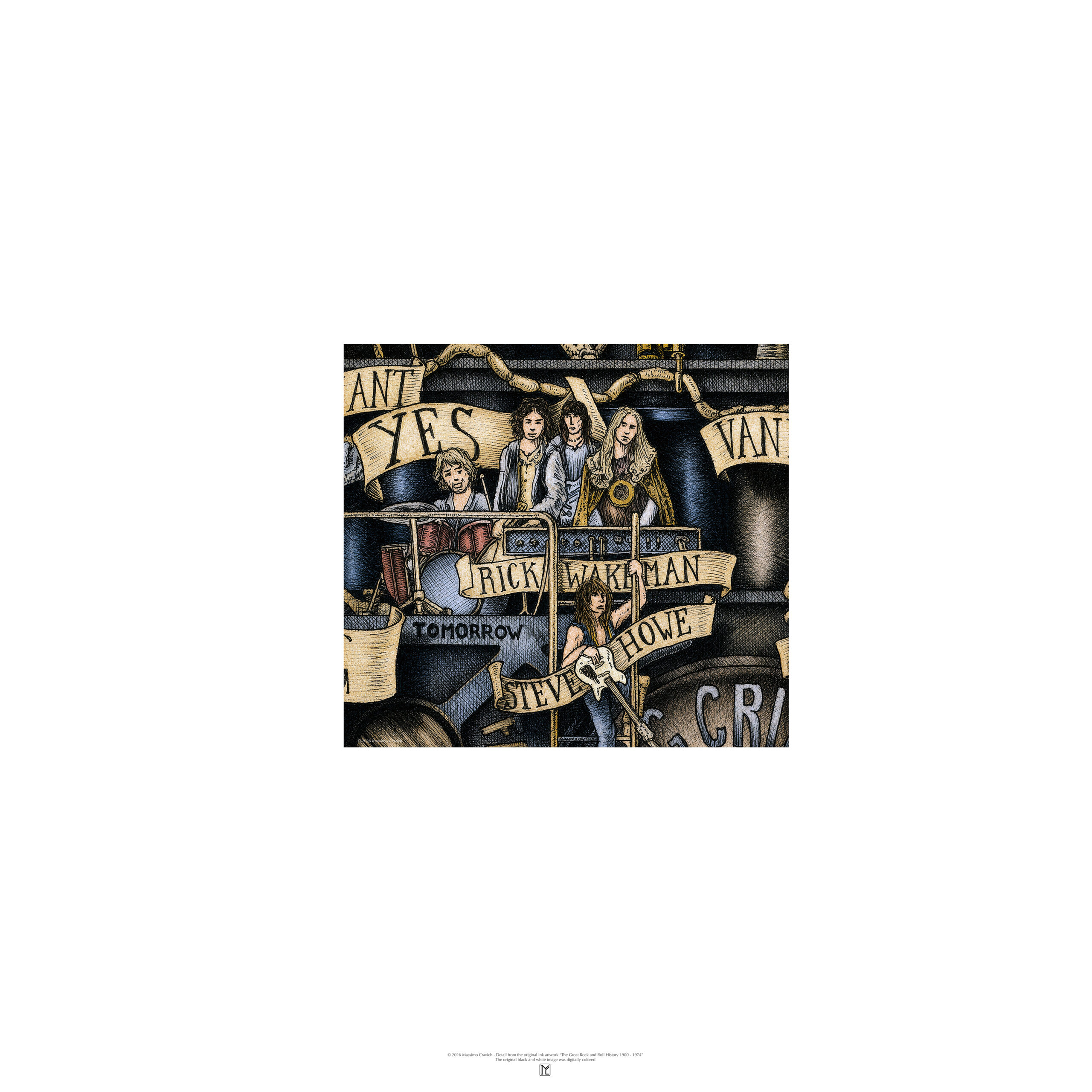
Get Your Rock Icon
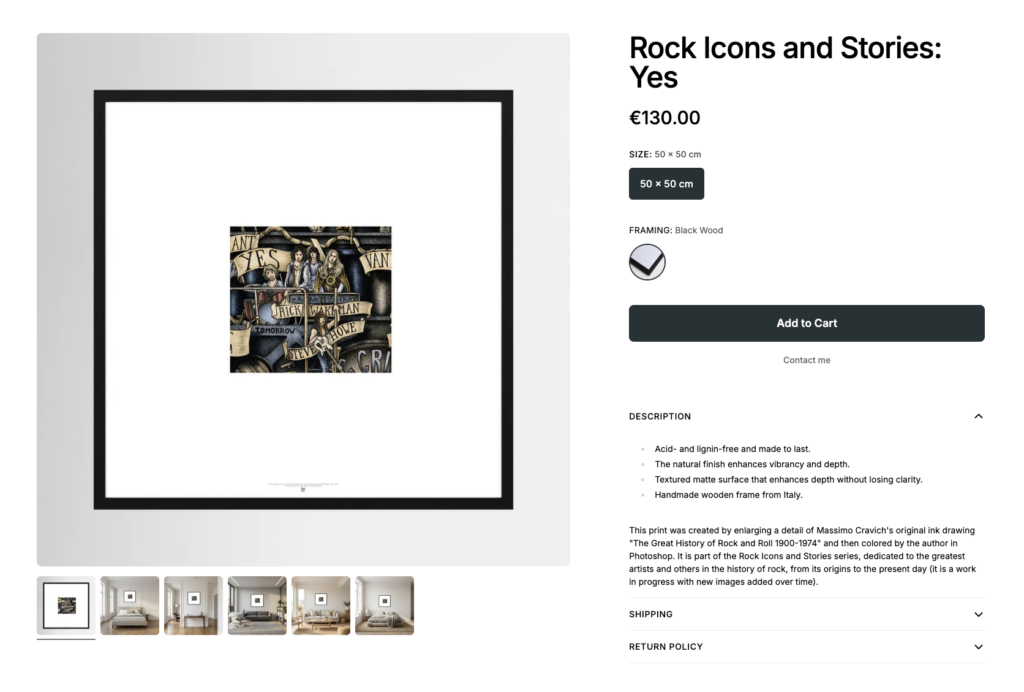
Selected artworks from Rock Icons and Stories are available as high-quality framed art prints. Printed on premium 230 gsm matte paper with excellent detail and colour reproduction, each print is professionally framed and delivered ready to hang.A carefully selected, high-quality alternative to the museum-grade Fine Art Giclée editions, offering an accessible way to own and display a reproduction of the original artwork. Printing, framing and worldwide fulfilment are handled by our specialist printing partner.
SOURCES
Rock and Roll Hall of Fame
Prog Archives
In rock genealogy, Yes push the idea of the band as a compositional organism to an extreme. Their music does not depend on one dominant instrument: it grows from overlapping autonomous lines, precise interaction and the ability to develop themes and dynamics across extended durations. The same ambition that makes them central to progressive rock also exposes the genre’s contradictions, while leaving a decisive model for later rock concerned with technique, structure and complexity.