
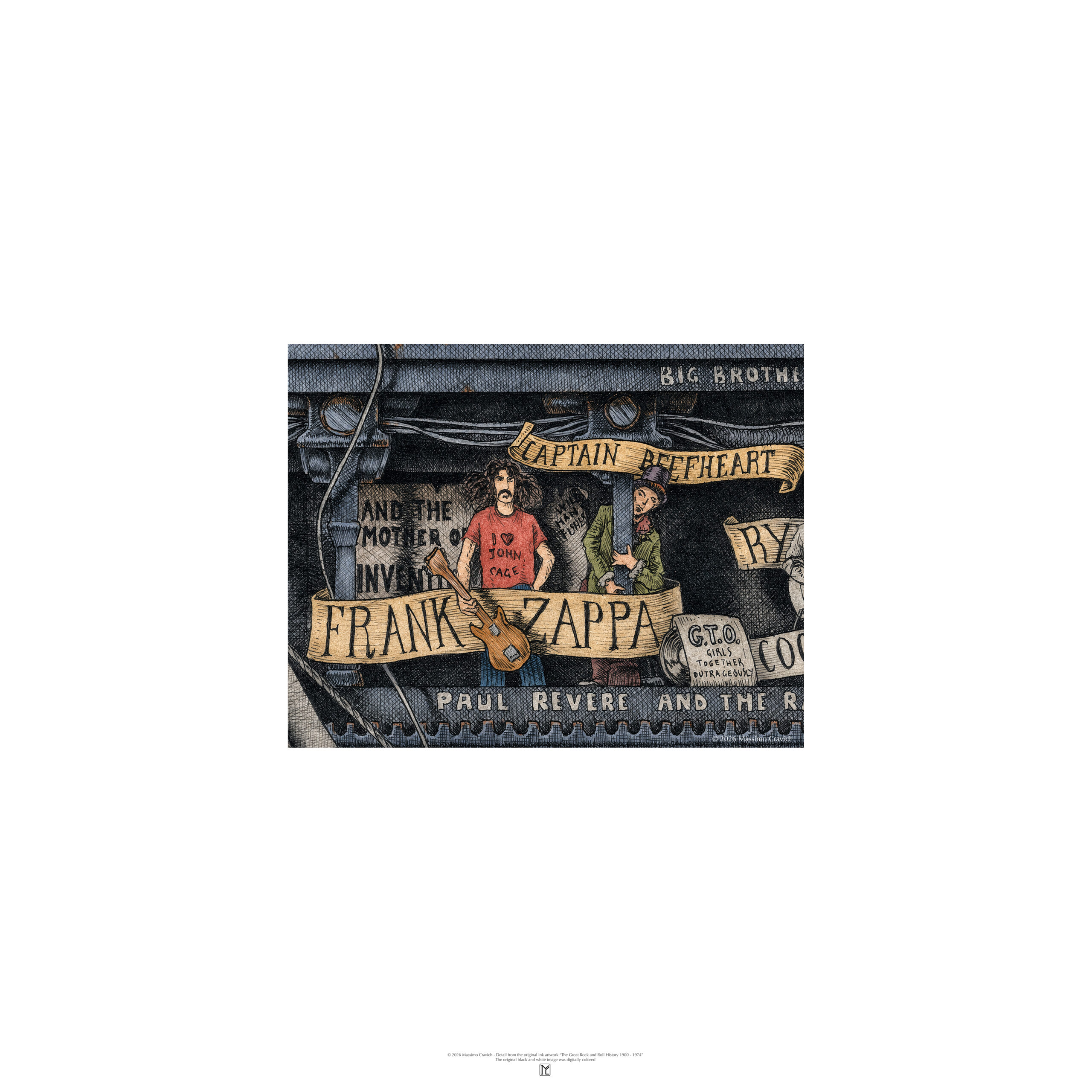
Frank Zappa was a composer, guitarist, producer, bandleader and satirist: a figure almost impossible to contain within a single genre, capable of bringing rock, doo-wop, rhythm & blues, jazz, contemporary classical music, improvisation and studio experimentation into the same musical world.
This illustrated profile explores Frank Zappa’s musical roots, compositional method and enormous influence within The Great Rock and Roll History, where he represents one of the most radical connections between popular culture and twentieth-century avant-garde music.
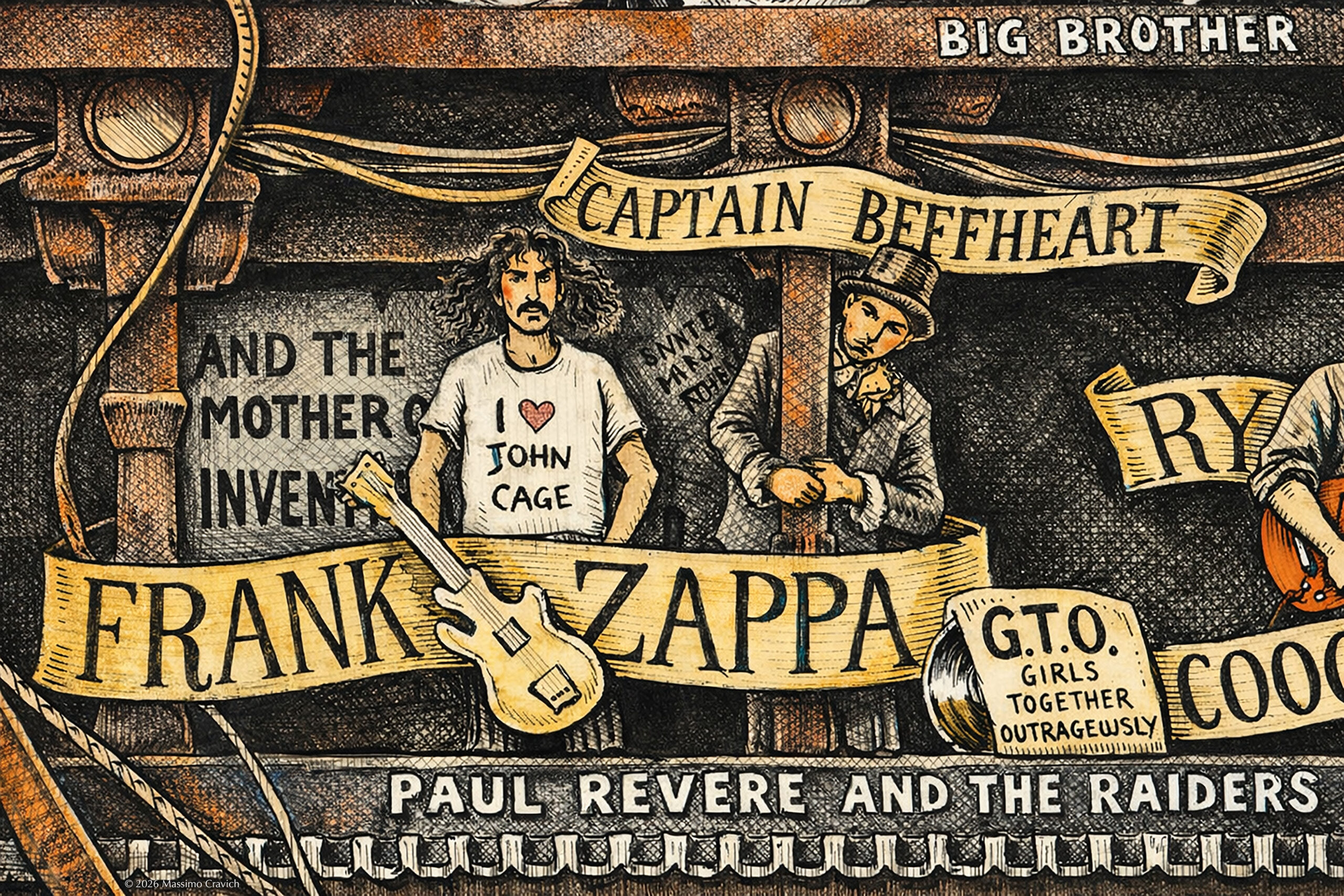
Rock Icons: Frank Zappa
The man who placed Varèse, Stravinsky, doo-wop, blues, jazz, rock and satire inside one musical universe, refusing any hierarchy between high and low culture.
From the Mothers of Invention’s debut Freak Out! to the jazz-rock breakthrough of Hot Rats, and onward to orchestral composition and later electronic work, Frank Zappa built one of the most independent, complex and stylistically wide-ranging bodies of work in twentieth-century music.

Name: Frank Vincent Zappa
Birth: December 21, 1940 — Baltimore, USA
Death: December 4, 1993 — Los Angeles, USA
Main band: The Mothers of Invention
Genres: Art Rock, Fusion, Progressive Rock, Experimental
ARTIST OFFICIAL SITE: www.zappa.com
LISTEN
Lets Make the Water Turn Black
More to discover…
One musical universe, without hierarchies
To understand Frank Zappa, it is essential to begin with the fact that genre divisions meant very little to him. As a teenager he could be fascinated by Edgard Varèse’s percussion music and Stravinsky’s rhythmic complexity while loving rhythm & blues, blues and doo-wop vocal groups. He never abandoned any of these passions: he made them coexist. A passage might evoke contemporary composition, turn into a blues riff, slide into a doo-wop parody and open into improvisation. To Zappa this was not contamination between styles; it was simply music.
With the Mothers of Invention, this idea entered rock explosively. Freak Out!, released in 1966, was an unusual debut even by psychedelic-era standards: a double album mixing R&B;, doo-wop, orchestration, sound collage, social criticism and electronic experimentation. Absolutely Free and We’re Only in It for the Money extended both the attack on American conformity and the complexity of the writing.
Yet Zappa was far more than a conceptual provocateur. Uncle Meat and especially Hot Rats revealed a composer-arranger and guitarist moving toward jazz-rock with a precision that anticipated much later fusion. Successive versions of the Mothers became laboratories for exceptional musicians expected to execute difficult written material while retaining room for improvisation.
The deeper continuity of Zappa’s work lies in the idea he called the ‘Project/Object’: albums, concerts, characters, musical phrases and jokes could reappear years apart as elements of one enormous construction. The studio itself was a compositional instrument; editing, overdubbing, tape manipulation and later the Synclavier allowed him to realize ideas beyond the limits of a conventional rock band. In parallel, he defended artistic autonomy and publicly opposed music censorship. His legacy is therefore not a genre called ‘Zappa’, but the proposition that a rock musician can simultaneously be a rigorous composer, improviser, producer, satirist and architect of an entirely personal universe.
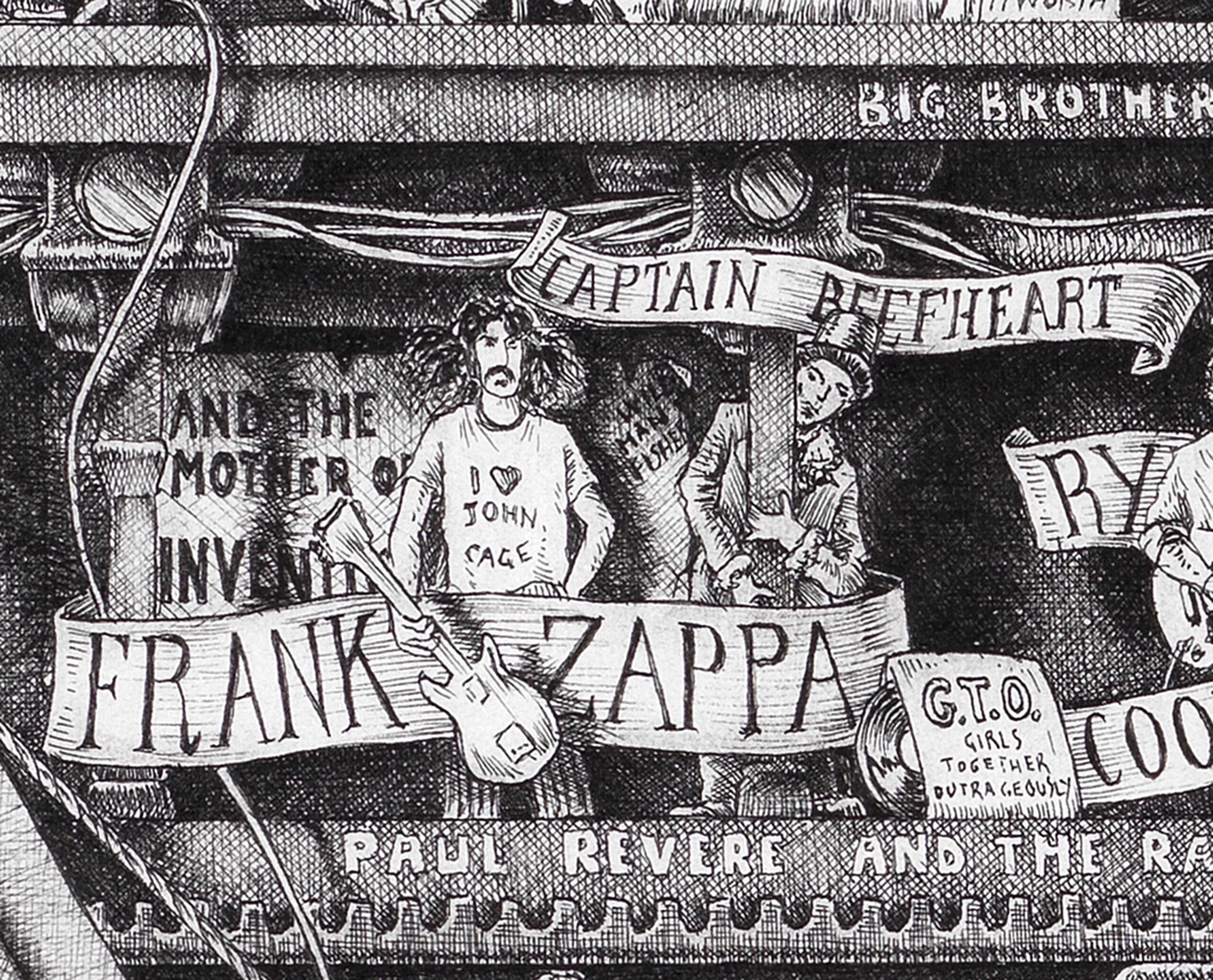
Albums including Freak Out!, We’re Only in It for the Money, Uncle Meat, Hot Rats and One Size Fits All reveal the breadth of Frank Zappa’s language, from experimental rock and satire to jazz-rock, contemporary composition and studio production.
Within The Great Rock and Roll History, Frank Zappa forms an almost unique crossroads: 1950s doo-wop and R&B; meet blues, psychedelic rock, free jazz, fusion and the European avant-garde, while his approach to the studio, virtuosity and composition opens paths toward progressive rock, art rock and later experimental rock.
Influenced by
- Edgar Varese
- Igor Stravinsky
- Johnny ‘Guitar’ Watson
- Howlin’ Wolf
- Doo-wop and 1950s R&B;s
Influent For
- Phish
- Primus
- The Residents
- Elio e le Storie Tese
- Alice Cooper
Related Artists
- Phish
- Primus
- The Residents
- The Mothers of Invention
- Captain Beefheart
- George Duke
- Jean-Luc Ponty
- Don Preston
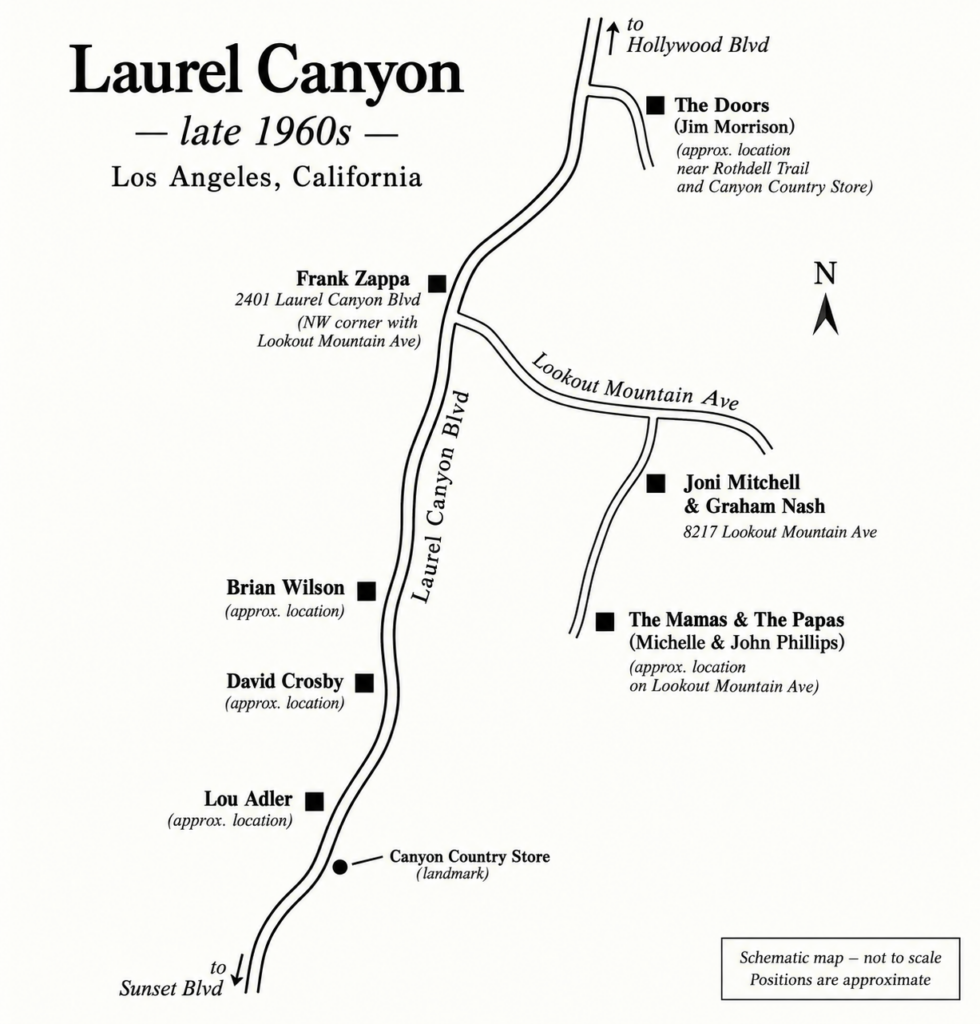
Know Your Neighborhood…
Essential Timeline
- 1950’s – Discovery of Varèse, Stravinsky and doo-wop.
- 1964 – Joins the Mothers of Invention.
- 1966 – Freak Out!, first conceptual double rock LP.
- 1967–69 – Satirical trilogy.
- 1971 – Montreux casino fire and Rainbow Theatre accident.
- 1970s – Peak productivity and large ensembles.
- 1980s – Synclavier and anti-censorship battles.
- 1993 – The Yellow Shark and death.
- 1993 – The Yellow Shark and death.
Get Your Rock Icon
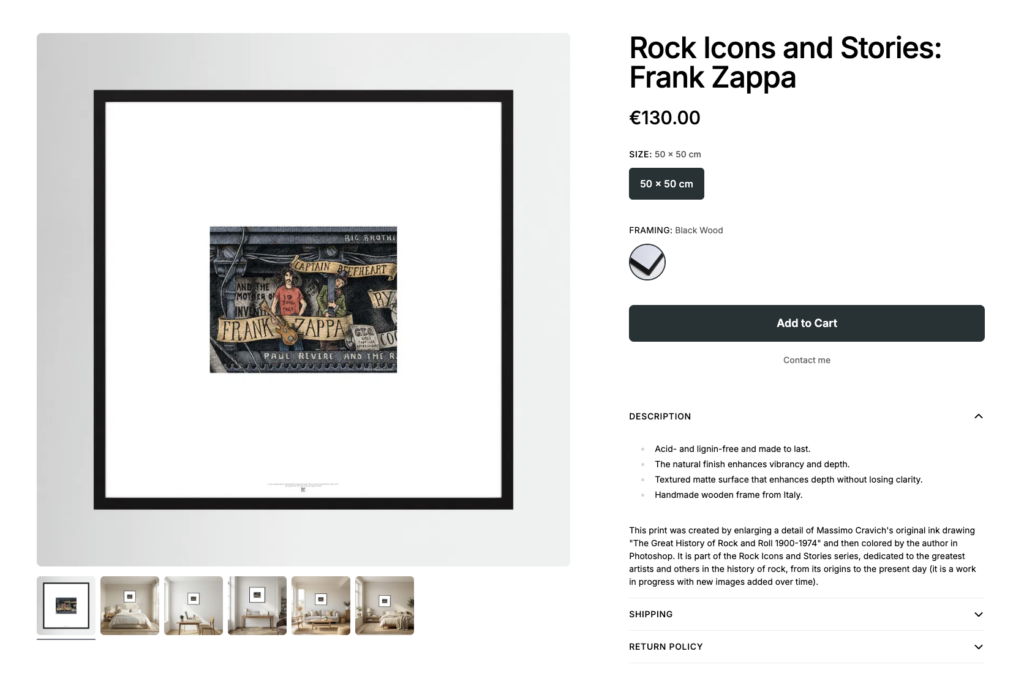
Selected artworks from Rock Icons and Stories are available as high-quality framed art prints. Printed on premium 230 gsm matte paper with excellent detail and colour reproduction, each print is professionally framed and delivered ready to hang.A carefully selected, high-quality alternative to the museum-grade Fine Art Giclée editions, offering an accessible way to own and display a reproduction of the original artwork. Printing, framing and worldwide fulfilment are handled by our specialist printing partner.
SOURCES
• Frank Zappa – official website and archive: zappa.com• Rock & Roll Hall of Fame – Frank Zappa, inducted 1995
• Frank Zappa with Peter Occhiogrosso, The Real Frank Zappa Book, 1989.
• Barry Miles, Zappa: A Biography, 2004.
• Library of Congress – Frank Zappa archival and National Recording Registry materials.
In the history of rock, Frank Zappa occupies a position unlike anyone else: he began with rhythm & blues, doo-wop and blues but incorporated avant-garde composition, jazz, orchestral music, technology and satire into one continuous project. His work demonstrated that rock could possess formal complexity, improvisational freedom and intellectual ambition without losing humor, energy or its connection to popular culture.