
Simon & Garfunkel brought a distinctive combination of folk revival, vocal harmony and urban songwriting into 1960s pop. Paul Simon built songs around careful form and language; Art Garfunkel’s voice added a second melodic dimension that turned often intimate material into an immediately recognizable sound. Their music developed within a New York shaped by Greenwich Village folk, a new youth culture and the decade’s rapid social changes.
This profile places Simon & Garfunkel within The Great Rock and Roll History, (a large-scale illustrated timeline of modern music), tracing the movement from acoustic folk into folk rock and then toward a more elaborate conception of pop songwriting, in which harmony, arrangement and the recording studio assumed increasing importance.
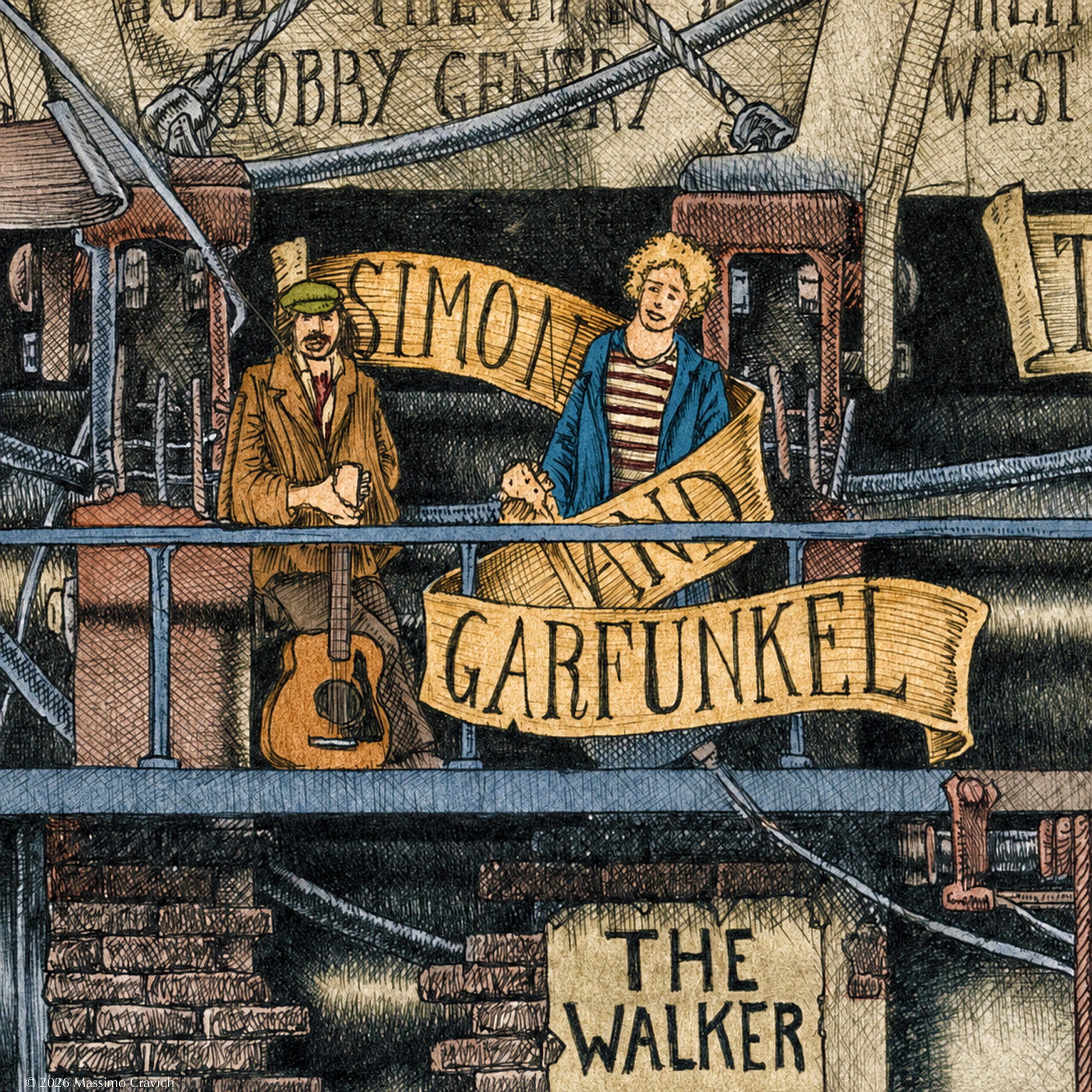
Rock Icons: Simon and Garfunkel
Two voices and restless songwriting

Urban poets suspended between perfect harmonies, modern alienation and American melancholy.
From The Sound of Silence and Parsley, Sage, Rosemary and Thyme through Bookends and Bridge over Troubled Water, Simon & Garfunkel transformed folk, vocal harmony and songwriting into increasingly sophisticated pop, connecting the folk revival with album culture and the singer-songwriter era of the 1970s.
Formed: Queens, New York, USA — 1956
Status: disbanded in 1970
Members: Paul Simon, Art Garfunkel
Genres: folk rock, folk pop, soft rock, singer-songwriter
ARTIST OFFICIAL SITE: simonandgarfunkel.com
LISTEN
More to discover…
From folk revival to songwriter culture: intimacy, harmony and studio
Simon and Garfunkel met as boys in Queens and were already recording as Tom & Jerry in the 1950s: rock and roll, doo-wop and especially the Everly Brothers’ harmony model therefore lie behind them even before the folk revival. When they reunited in the 1960s, Paul Simon brought songwriting shaped by traditional folk and the Greenwich Village scene, while Art Garfunkel concentrated on timbre, balance and the interaction of their voices.
On a human level, the duo also lived through the tension inside that complementarity: friendship, differing ambitions and unequal creative roles gradually made fragile the very balance that sounded so natural in the music.
Folk enters the modern urban world
The breakthrough of The Sound of Silence almost encapsulates its historical moment: producer Tom Wilson electrified the originally acoustic recording without the duo present, and its success suddenly placed them inside the folk-rock movement opened by Dylan and the Byrds. Simon & Garfunkel did not simply repeat that formula. Parsley, Sage, Rosemary and Thyme refined vocal counterpoint and arrangement; Bookends used the studio to construct a more unified album while examining alienation, memory and American life; Bridge over Troubled Water widened the field again toward gospel, orchestral pop and Latin American influences.

The melancholic harmonies of modern America
No other duo managed to transform urban alienation, generational anxiety and emotional fragility into something so elegant and universally recognizable. Their harmonies sounded almost supernatural: two radically different voices blending with spiritual precision. Yet behind that beauty existed enormous psychological tension.
Paul Simon possessed obsessive artistic ambition and perfectionism, while Art Garfunkel embodied the duo’s more ethereal and contemplative dimension. Together they created some of the most poetic and melancholic songs of the twentiethcentury.
Genealogically, the duo occupy the passage between the folk revival and the growing centrality of the songwriter in popular music. Their harmonic precision derives from earlier traditions but is applied to increasingly introspective lyrics and production less constrained by ideas of acoustic authenticity. Their trajectory also shows how folk rock could evolve without necessarily becoming more electric: it could instead absorb studio craft, orchestration and international languages.
The line can be read as traditional folk + Everly Brothers/doo-wop + folk revival -> Simon & Garfunkel -> folk rock and songwriter pop -> singer-songwriters, soft rock and increasingly sophisticated 1970s pop.

Songs such as The Sound of Silence, America, Mrs. Robinson and Bridge over Troubled Water trace Simon & Garfunkel’s movement from acoustic folk toward pop songwriting that uses vocal harmony, arrangement and production as parts of the narrative. Albums such as Bridge Over Troubled Water and Bookends remain among the absolute peaks of American folk rock.
Within The Great Rock and Roll History, Simon & Garfunkel also reflect a shift in 1960s American sensibility: from the communal confidence of the folk revival toward more private, urban and ambivalent writing, as the pop songincreasingly became a space for observing loneliness, generations and social change.
Influenced by
- Traditional American folk
- Everly Brothers
- Beat generation
- Bob Dylan
- Classical choral music
Influent For
- Modern singer-songwriters
- Sophisticated folk pop
- Elliott Smith
- Iron & Wine
- Contemporary indie folk
Related Artists
The Everly Brothers
Joni Mitchell
James Taylor
Nick Drake
Get Your Rock Icon
Selected artworks from Rock Icons and Stories are available as high-quality framed art prints. Printed on premium 230 gsm matte paper with excellent detail and colour reproduction, each print is professionally framed and delivered ready to hang.A carefully selected, high-quality alternative to the museum-grade Fine Art Giclée editions, offering an accessible way to own and display a reproduction of the original artwork. Printing, framing and worldwide fulfilment are handled by our specialist printing partner.

SOURCES
Official Paul Simon archives
American folk rock archives1960s songwriter archives
Bridge Over Troubled Water historical archives
In rock genealogy, Simon & Garfunkel show that the expansion of 1960s music did not occur only through volume and electric experimentation. Two voices, a guitar and precise songwriting could gradually open toward studio craft, orchestration and more complex forms without losing their original intimacy.
Their balance, musically effective yet personally fragile, accompanies the transition from the folk revival toward songwriter culture and a more adult, sophisticated conception of the pop song.