
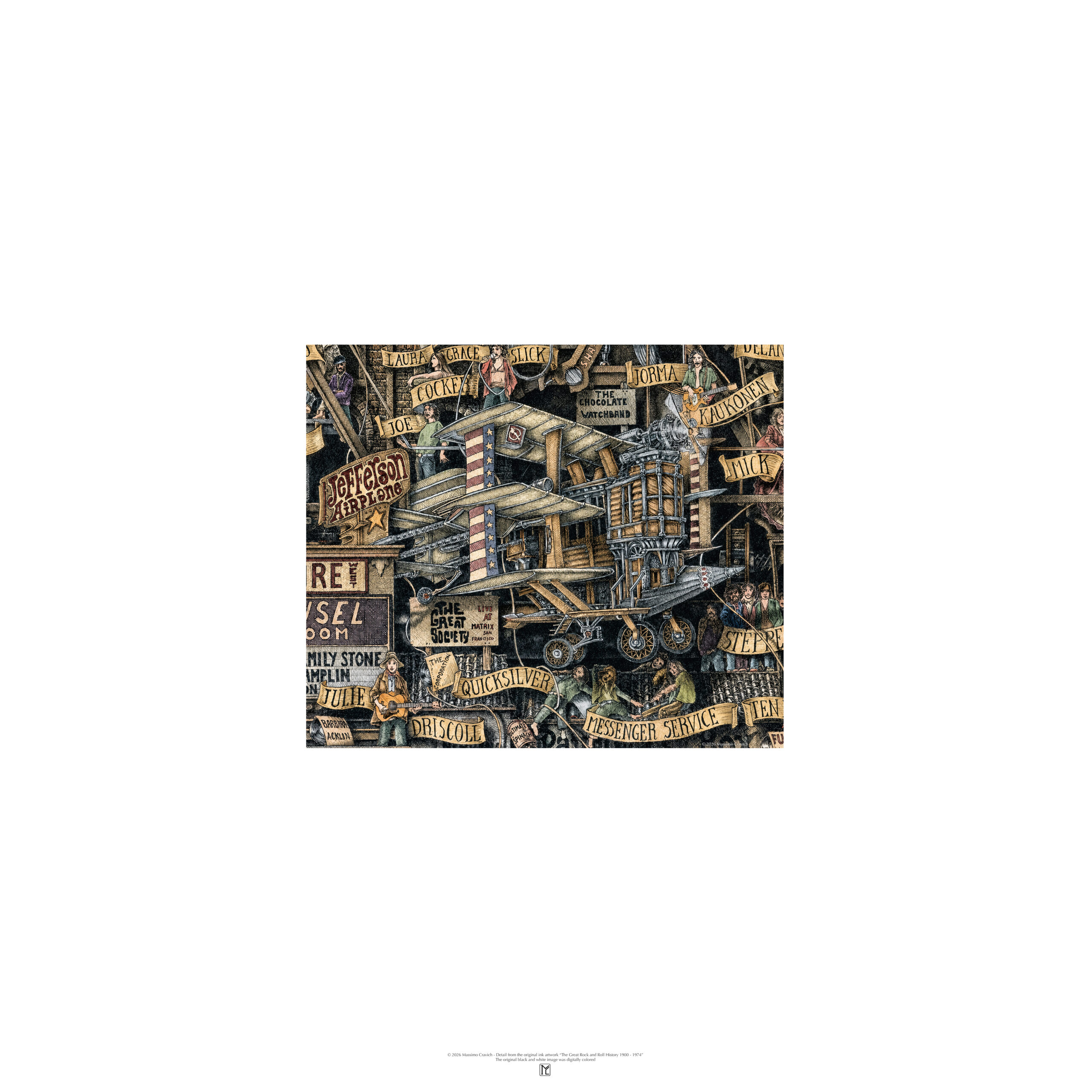
Jefferson Airplane were one of the defining bands of San Francisco psychedelia, combining folk-rock roots, electric experimentation, political tension and extraordinary vocal interplay at the center of the 1960s counterculture. This illustrated profile explores Jefferson Airplane’s musical evolution, psychedelic language and cultural impact within The Great Rock and Roll History, a large-scale illustrated timeline of modern music.
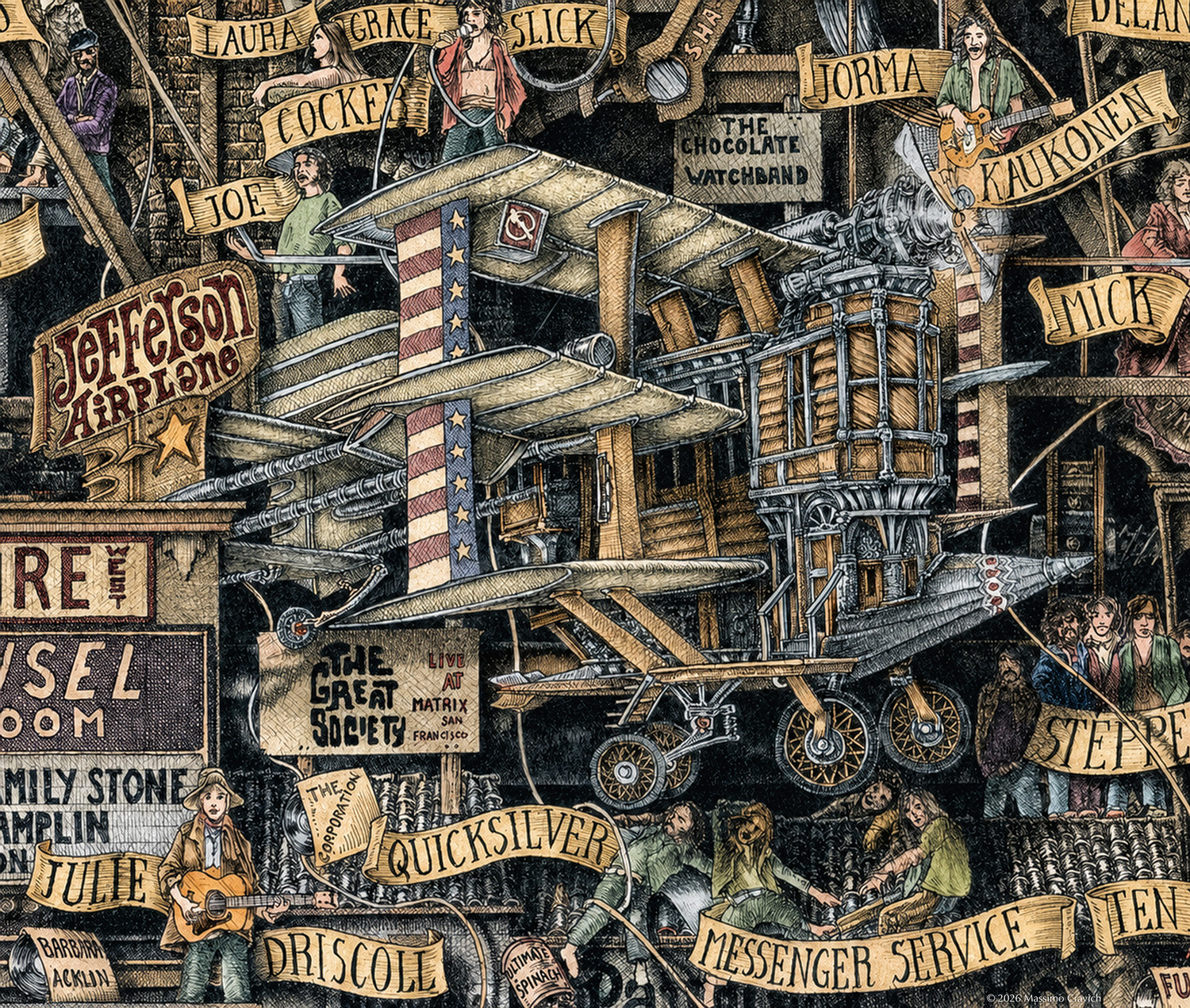
Rock Icons: Jefferson Airplane
The voices of psychedelic San Francisco: folk roots, electric freedom, counterculture and the unmistakable collision of Grace Slick, Marty Balin and Paul Kantner.
From the San Francisco folk scene and the breakthrough of Surrealistic Pillow to increasingly experimental and politically charged albums, Jefferson Airplane became one of the essential groups connecting American folk rock with psychedelia and the radical culture surrounding the Summer of Love.

Founded: 1965, San Francisco Bay Area (California, USA)
Classic core: Marty Balin, Paul Kantner, Grace Slick, Jorma Kaukonen, Jack Casady, Spencer Dryden
Status Disbanded in 1972; brief reunion in 1989
Genres: Psychedelic rock, folk rock, acid rock, blues rock
ARTIST OFFICIAL SITE: https://jeffersonairplane.com/
LISTEN
More to discover…
When San Francisco folk music entered the psychedelic storm
Jefferson Airplane began at the meeting point between the American folk revival and a rapidly changing San Francisco. Marty Balin helped assemble the group around a vision of amplified folk music, but the band soon developed into something much less easily contained. Paul Kantner brought a strong rhythmic and compositional identity; Jorma Kaukonen and Jack Casady created one of the most adventurous guitar-and-bass relationships of the era; Spencer Dryden supplied a flexible rhythmic foundation.
The decisive arrival of Grace Slick in 1966 added a commanding voice, a striking public presence and two songs brought from her previous band, the Great Society: ‘Somebody to Love’ and ‘White Rabbit’. Surrealistic Pillow made Jefferson Airplane one of the principal musical symbols of the Summer of Love, yet their importance goes well beyond those two famous singles. The group’s vocal architecture was unusually rich: Slick’s cutting authority, Balin’s emotional clarity and Kantner’s more austere tone could combine or oppose one another, creating a collective personality rather than a single dominant frontman. Instrumentally, Casady’s highly mobile bassand Kaukonen’s increasingly blues-based electric guitar pushed the music away from conventional folk rock toward a denser, more improvisational form of psychedelia.
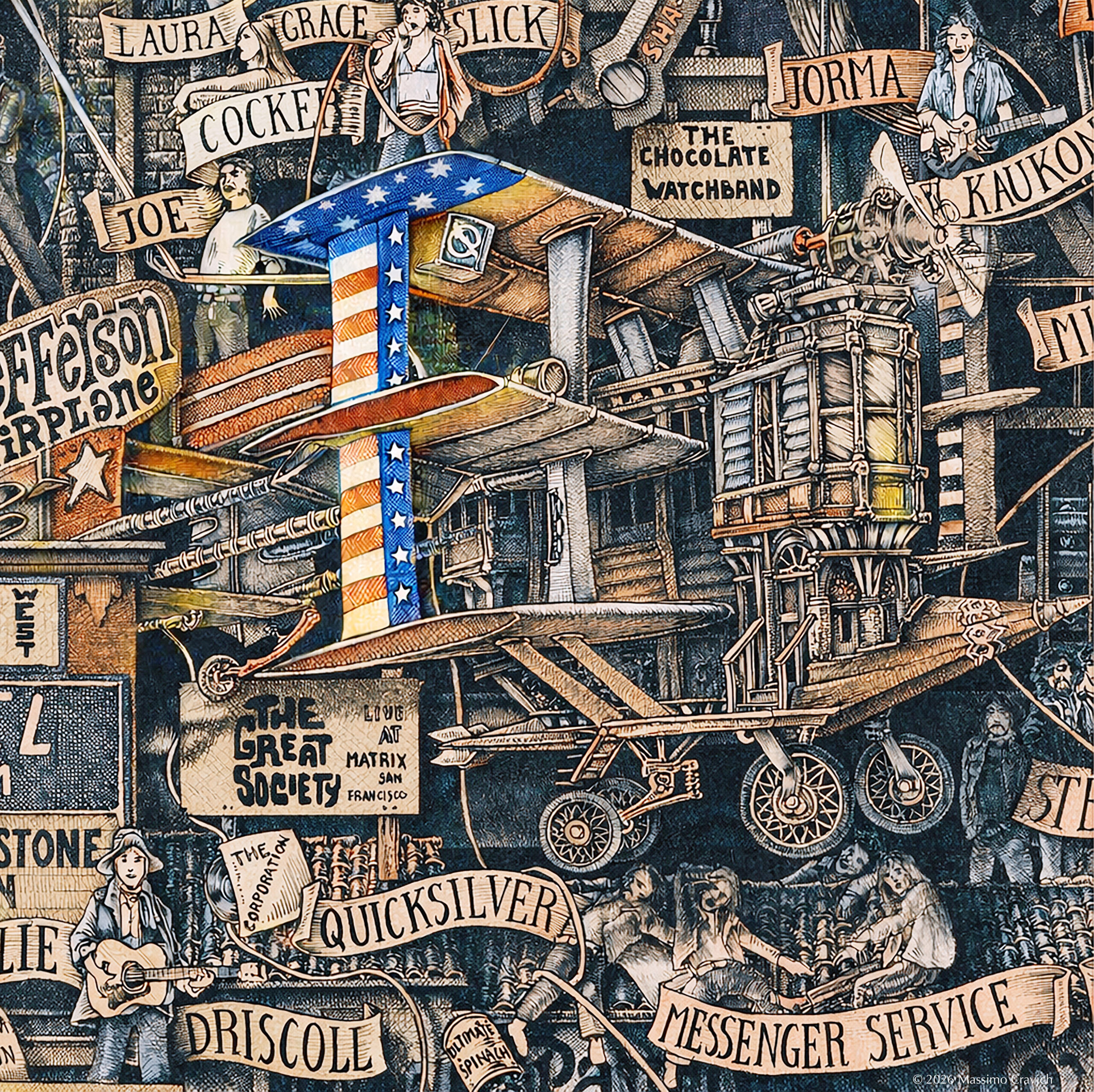
As the optimism of 1967 darkened, the Airplane changed with it. Albums such as After Bathing at Baxter’s, Crown of Creation and Volunteers became more experimental, abrasive and politically explicit. The band performed at Monterey Pop, Woodstock and Altamont, placing them inside three of the era’s most symbolic mass gatherings, while internal tensions reflected the fragmentation of the counterculture itself. From their dissolution emerged Hot Tuna and, through Kantner and Slick, the lineage that led to Jefferson Starship. Jefferson Airplane therefore stand not merely as a psychedelic period piece, but as a crucial bridge between folk-based San Francisco idealism, acid-rock experimentation and the harder political mood that closed the 1960s.
Albums such as Surrealistic Pillow, After Bathing at Baxter’s, Crown of Creation and Volunteers made Jefferson Airplane a central reference point for psychedelic rock, acid rock and the musical identity of the San Francisco counterculture.
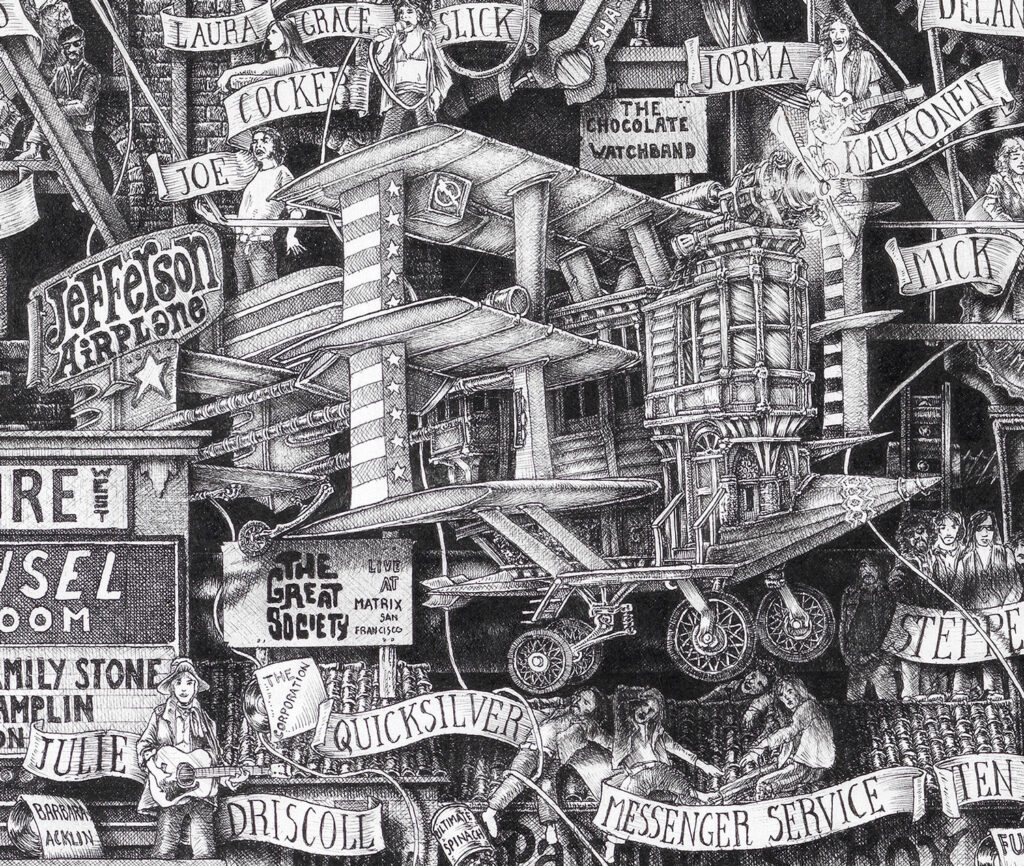
Within The Great Rock and Roll History, Jefferson Airplane occupy a decisive position in the transformation of folk rock into psychedelia: American folk sensibility meets amplified improvisation, political radicalization and the communal culture of San Francisco, while later branches lead toward Hot Tuna and Jefferson Starship.
Influenced by
- Folk Revival
- Electric Blues
- Beat Culture
- Early psychedelia
- The Byrds
- Bob Dylan
- The Beatles
- Muddy Waters
- John Coltrane
Influent For
- West Coast rock
- Psychedelic mainstream
- Jam Culture
- Political Rock
- Jefferson Starship
- Hot Tuna
- Patti Smith
- Siouxsie and the Banshees
- The Brian Jonestown Massacre
Related Artists
Quicksilver Messenger Service
Big Brother and the Holding Company
The Great Society
Hot Tuna
Get Your Rock Icon
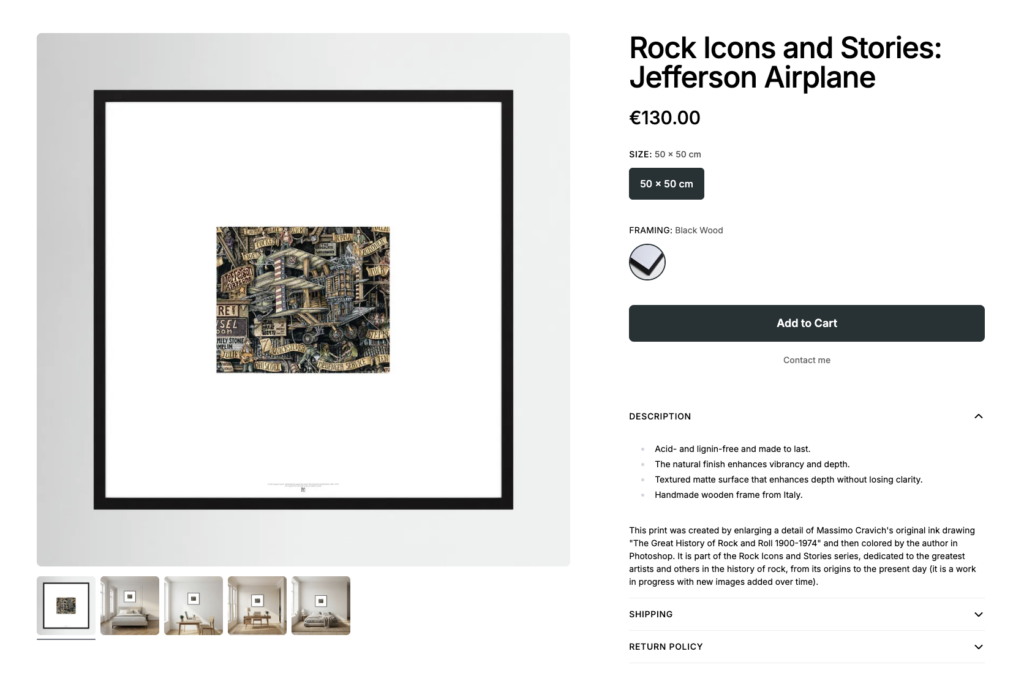
Selected artworks from Rock Icons and Stories are available as high-quality framed art prints. Printed on premium 230 gsm matte paper with excellent detail and colour reproduction, each print is professionally framed and delivered ready to hang.A carefully selected, high-quality alternative to the museum-grade Fine Art Giclée editions, offering an accessible way to own and display a reproduction of the original artwork. Printing, framing and worldwide fulfilment are handled by our specialist printing partner.
SOURCES
• Jefferson Airplane – official/archive website: jeffersonairplane.com
• Rock & Roll Hall of Fame – Jefferson Airplane inductee profile: rockhall.com/inductees/jefferson-airplane/
• Jeff Tamarkin, Got a Revolution! The Turbulent Flight of Jefferson Airplane, Atria Books, 2003.
• Grace Slick, Somebody to Love?, Warner Books, 1998.
• Jorma Kaukonen, Been So Long: My Life and Music, St. Martin’s Press, 2018.
Within the broader history of rock music, Jefferson Airplane represent one of the clearest transformations of folk rock into psychedelic and politically charged electric music. Their vocal identity, instrumental freedom and central role in the San Francisco scene made them both protagonists of the Summer of Love and witnesses to the counterculture’s rapid movement from utopian possibility toward conflict, fragmentation and a new, harder rock language.