
Grace Slick became one of the most recognizable voices of San Francisco psychedelic rock, but her role extended far beyond the image of a rebellious singer. From the Great Society to Jefferson Airplane, she brought songwriting, irony and a stage presence that turned private tensions and generational conflict into music. This profile in The Great Rock and Roll History (a large-scale illustrated timeline of modern music) follows her human and musical journey from electric folk to psychedelia and the later transformations of Jefferson Starship.
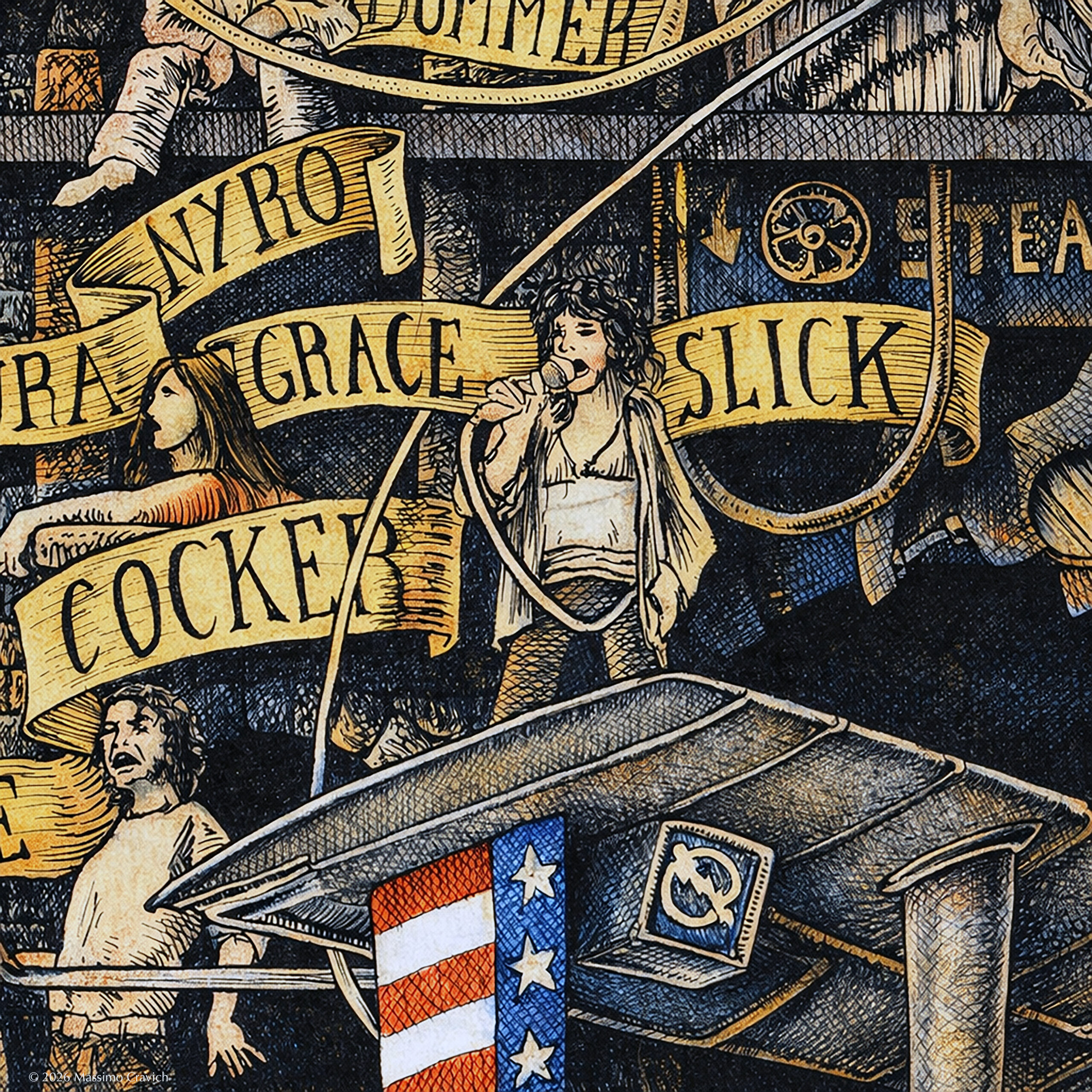
Rock Icons: Grace Slick
The Undisputed Queen of Psychedelia

American psychedelic rock singer known for powerful vocals, countercultural imagery and artistic experimentation. By combining powerful vocal expression, surreal imagery and psychedelic experimentation, Grace Slick helped redefine the role of women in rock music. With White Rabbit and Somebody to Love, Grace Slick helped define Jefferson Airplane’s sound, combining folk rock, psychedelia, incisive singing and the imagery of the counterculture.
Name: Grace Barnett Wing
Birth: October 30, 1939 Highland Park(Illinois, U.S.A.))
Active: 1960–Today (as a painter)
Genres: Psychedelic Rock, Blues Rock, Rock
Groups: The Great Society; Jefferson Airplane; Jefferson Starship; Starship
Key Period: 1965–1974: Great Society, Jefferson Airplane and early Jefferson Starship
ARTIST OFFICIAL SITE: graceslick.com
LISTEN
More to discover…
An uncompromising voice: irony, unease and freedom in psychedelic San Francisco.
From conventional expectations to the Great Society
Grace Wing grew up in a relatively comfortable family and moved through art studies, jobs and marriage to filmmaker Jerry Slick before finding her path in music. Forming the Great Society in 1965 was more than a professional choice: in a changing San Francisco, performing also meant escaping expectations placed on young women. Grace brought an imagination shaped by literature and visual art. She wrote White Rabbit, inspired by Alice in Wonderland and Ravel’s Boléro; her brother-in-law Darby Slick wrote Somebody to Love. The two songs differ greatly, but both benefit from a singer who refuses to soften their meaning.
Jefferson Airplane: joining a band, changing its balance
When Slick joined Jefferson Airplane in 1966, replacing Signe Toly Anderson, she brought both songs with her. Surrealistic Pillow turned them into hits and placed the band at the center of California’s emerging scene. Yet the encounter was also personal: Marty Balin, Paul Kantner, Jorma Kaukonen, Jack Casady and Spencer Dryden brought different temperaments and ambitions. Balin’s and Slick’s voices did not always blend comfortably; they could challenge each other, making friction part of the band’s identity. Grace became a counterculture symbol without comfortably accepting the role of spokesperson. Her sarcasm and rejection of convention complicated the romantic image of the hippie era.

Success, personal relationships and contradictions
Across After Bathing at Baxter’s, Crown of Creation and Volunteers, Jefferson Airplane moved beyond hit-single structures toward harsher, more collective compositions. Slick contributed songs including Lather, which confronts adulthood and the loss of innocence with unease. Her confidence onstage seemed absolute; offstage, communal living, romantic relationships, alcohol and drug use, and the pressure of fame made that freedom harder to sustain.
Her relationship with Paul Kantner became both personal and creative. Woodstock and Altamont exposed two sides of counterculture: the possibility of community and the collapse of some of its illusions. Slick’s story is therefore not simply a celebration of an era; it also reveals its costs and fractures.
After the Airplane: continuity, change and an independent voice
Jefferson Airplane’s gradual dissolution opened other paths. Slick worked with Kantner on Blows Against the Empire and released Manhole, then joined Jefferson Starship as psychedelic improvisation increasingly gave way to more structured, accessible rock. In the 1980s, Starship’s pop success took her far from the context in which she emerged, revealing how difficult it can be to reconcile personal continuity with the music industry. After retiring from music, she concentrated mainly on visual art. In rock genealogy, her voice connects electric folk to San Francisco psychedelia and later arena rock; personally, her career tells a story of maintaining autonomy amid changing bands, relationships and public images.
From White Rabbit to Lather, Grace Slick used a powerful voice and literary imagination to bring unease, irony and social criticism into American folk rock and psychedelia.
Within The Great Rock and Roll History, Grace Slick also illuminates women’s changing roles in rock: not merely an interpreter but a songwriter and central figure in a scene that claimed to reject convention while retaining many contradictions of its own.
Influenced by
- Judy Henske
- Janis Joplin
- The Beatles
- Maurice Ravel
- Lewis Carroll
Influent For
- Patti Smith
- Stevie Nicks
- Siouxsie Sioux
- Ann Wilson
- Shirley Manson
Related Artists
- Jefferson Airplane
- The Great Society
- Marty Balin
- Paul Kantner
- Janis Joplin
Key sources
Jefferson Airplane discography
Jefferson Starship discography,
Jefferson Airplane official: https://www.jeffersonairplane.com/
Rock & Roll Hall of Fame, Jefferson Airplane: https://rockhall.com/inductees/jefferson-airplane/
Grace Slick, Somebody to Love? (memoir, 1998)
Jeff Tamarkin, Got a Revolution! The Turbulent Flight of Jefferson Airplane
In rock history, Grace Slick represents the meeting of symbolic songwriting, electric folk and San Francisco psychedelia. The force of White Rabbit and the tension of her performances cannot be separated from her independent character, creative relationships and the contradictions of a woman who became an icon while retaining an ironic distance from icons themselves.