
Daevid Allen was an Australian musician, poet, performer and psychedelic instigator, a crucial figure in the birth of Soft Machine, Gong and a vital part of the Canterbury, space-rock and European progressive imagination.
This illustrated profile explores his musical vision, cosmic theatre and influence within The Great Rock and Roll History, a large-scale illustrated timeline of modern music.

Rock Icons: Daevid Allen
Australian beat poet, glissando guitarist, visionary founder of Soft Machine and Gong, a living bridge between Canterbury, Paris, psychedelia and cosmic progressive rock
Through Soft Machine, Gong, the Radio Gnome Invisible trilogy and an astonishing number of side projects, Daevid Allen helped define a form of psychedelic progressive rock in which jazz, improvisation, beat poetry, anarchic humour and alternative spirituality became one language.

Name: Christopher David Allen
Birth: 13 January 1938, Melbourne, Australia
Died: Died 13 March 2015 in Australia; artistically active from 1960 to 2015
Main instruments: Vocals, guitar, glissando guitar, occasional bass, tape loops, performance poetry
Genres:
Canterbury Scene, psychedelic rock, space rock, progressive rock, jazz-rock, psychedelic folk,
performance poetry, improvisation
ARTIST OFFICIAL SITE: www.daevidallen.net
LISTEN
• Soft Machine – Love Makes Sweet Music – The historical starting point: the Soft Machine cell before the Gong explosion.
• Gong – Radio Gnome Invisible – A gateway into the mythology: comic, initiatory and psychedelic.
• Gong – Flying Teapot – The manifesto of the flying teapot and of the cosmic-comic side of the project.
• Gong – Master Builder – The hypnotic, almost ritual side of the Gong machine at full tension.
• Daevid Allen – Memories – His more fragile, poetic and song-based side, far from pure cosmic carnival.
More to discover…
The cosmic jester who turned progressive rock into a usable mythology
Daevid Allen was not merely a musician within progressive rock: he was one of the rare artists able to build an entire narrative, sonic and spiritual ecosystem around his music.
His path begins in Australia, passes through the beat and jazz circles of early-1960s London, enters the Canterbury Scene through Soft Machine, explodes in post-1968 Paris with Gong, and then continues through a constellation of smaller bands, reincarnations, communes, collectives and adventures that often resist classification.
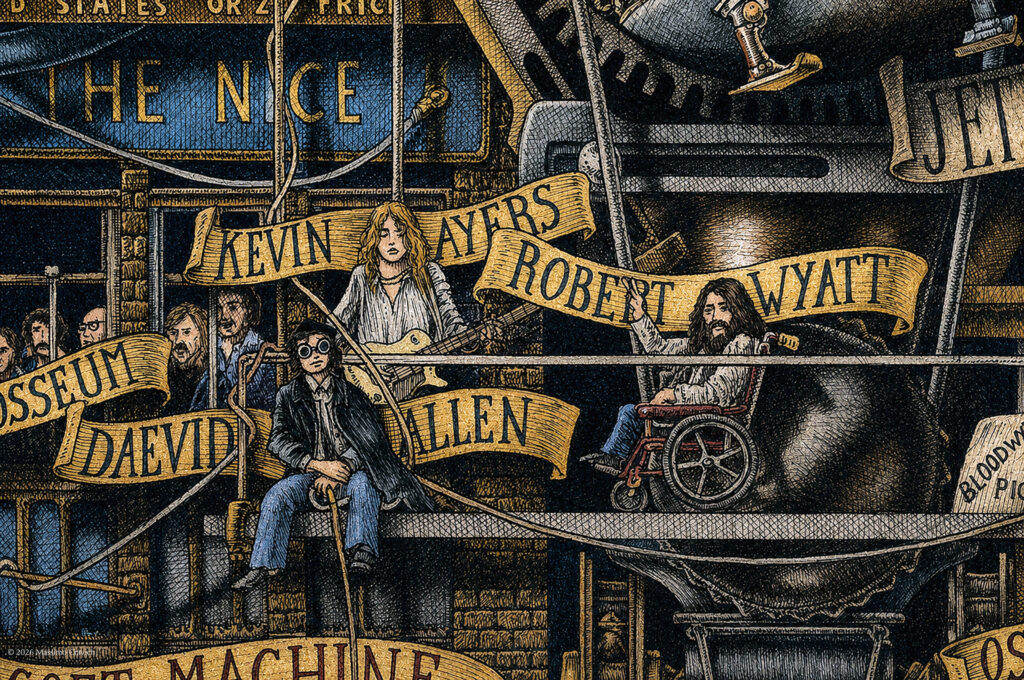
His central intuition was to treat rock not simply as song, but as a vehicle for storytelling, trance, satire, ritual, cosmic comic-book theatre and community. In Gong, Allen invented a universe populated by Pot Head Pixies, Radio Gnomes, Octave Doctors, flying teapots and deliberately ridiculous initiatory figures. The strength of the project lies not in taking everything solemnly, but in allowing spiritual seriousness and childish comedy, virtuosity and mockery, jazz-rock and nonsense to coexist.
This is why Allen matters so much for a future Canterbury/Progressive superpage: he represents the divergent, anti-academic, libertarian and psychedelic line of progressive music. If one branch of prog tends toward monumental suites, learned references and classical structures, Allen opens the branch of hippie science fiction, dadaist theatre, collective improvisation and do-it-yourself mythology.
Albums such as Camembert Electrique, Flying Teapot, Angels Egg and You became essential reference points for understanding the intersection between Canterbury Sound, space rock, European psychedelia and unconventional progressive rock.
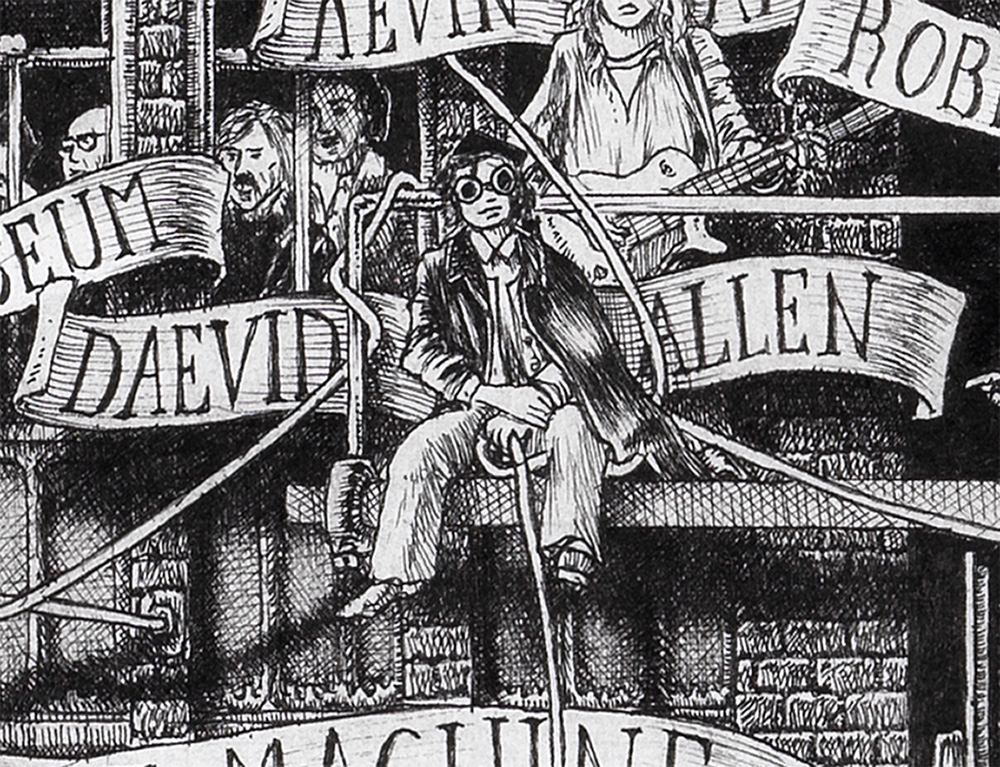
His music occupies a central position within the broader visual narrative of The Great Rock and Roll History.
Influenced by
- The Beat Generation, especially William S. Burroughs and beat literary culture.
- Sun Ra and the idea of music as an alternative cosmology.
- Free jazz, modern jazz and collective improvisation in the early 1960s.
- London and Paris psychedelia, hippie culture and post-1968 communal experiments.
- Alfred Jarry, pataphysics, Dada, theatrical nonsense and personally filtered Eastern spirituality.
Influent For
- Gong, in its many incarnations and in the survival of the Gong Family.
- Steve Hillage and part of British and European progressive/space rock.
- Acid Mothers Temple and several Japanese and international psychedelic scenes.
- Ozric Tentacles, psychedelic space rock and European jam culture.
- Cardiacs, Knifeworld, Kavus Torabi and later musicians drawn to the surreal, collective and anti-orthodox line of prog.
Related Artists
- Gong
- Soft Machine
- Gilli Smith
- Mike Ratledge
- Steve Hillage
- Robert Wyatt
- Kevin Ayers
- Tim Blake
- University of Errors
LINKABLE SOURCES
• Planet Gong – Daevid Allen biography: https://www.planetgong.co.uk/archives/articles/daevid-allen-biography.shtml
• Planet Gong archive / current news: https://www.planetgong.co.uk/
• Calyx – Gong biography and Canterbury discographical context: https://www.calyx-canterbury.fr/gong/biog.html
• The Guardian – Daevid Allen remembered / obituary coverage: https://www.theguardian.com/music/musicblog/2015/mar/13/daevid-allen-gong-soft-machine-remembered
• Daevid Allen – Rock Icons profile | The Great Rock and Roll History Pag. 5• Pitchfork – Daevid Allen, founder of Gong and Soft Machine, dead at 77:
https://pitchfork.com/news/58386-daevid-allen-founder-of-gong-and-soft-machine-dead-at-77
• University of Errors archive: https://universityoferrors.com/annals.html
• Richie Unterberger – Daevid Allen interview: https://www.richieunterberger.com/allen.html
• AllMusic / Discogs / official release pages: useful for cross-checking discography and track choices.
Within the broader narrative of rock history, Daevid Allen represents one of the most radical transformations of psychedelia into progressive theatre, alternative community and sonic mythology.
His influence runs through Canterbury, space rock, European progressive music, jazz-rock, underground psychedelia and peripheral musical cultures, proving that rock could become not only a musical style, but a self-contained narrative universe.