
Gong emerged in the late 1960s around Australian musician Daevid Allen, who had been part of the Canterbury scene. Moving between France and Britain, the group transformed psychedelia, jazz, improvisation and electronics into a language in which music and theatrical imagination were inseparable. This profile traces Gong’s within The Great Rock and Roll History, their experimental rock genealogy, from European counterculture to space rock and jazz rock.
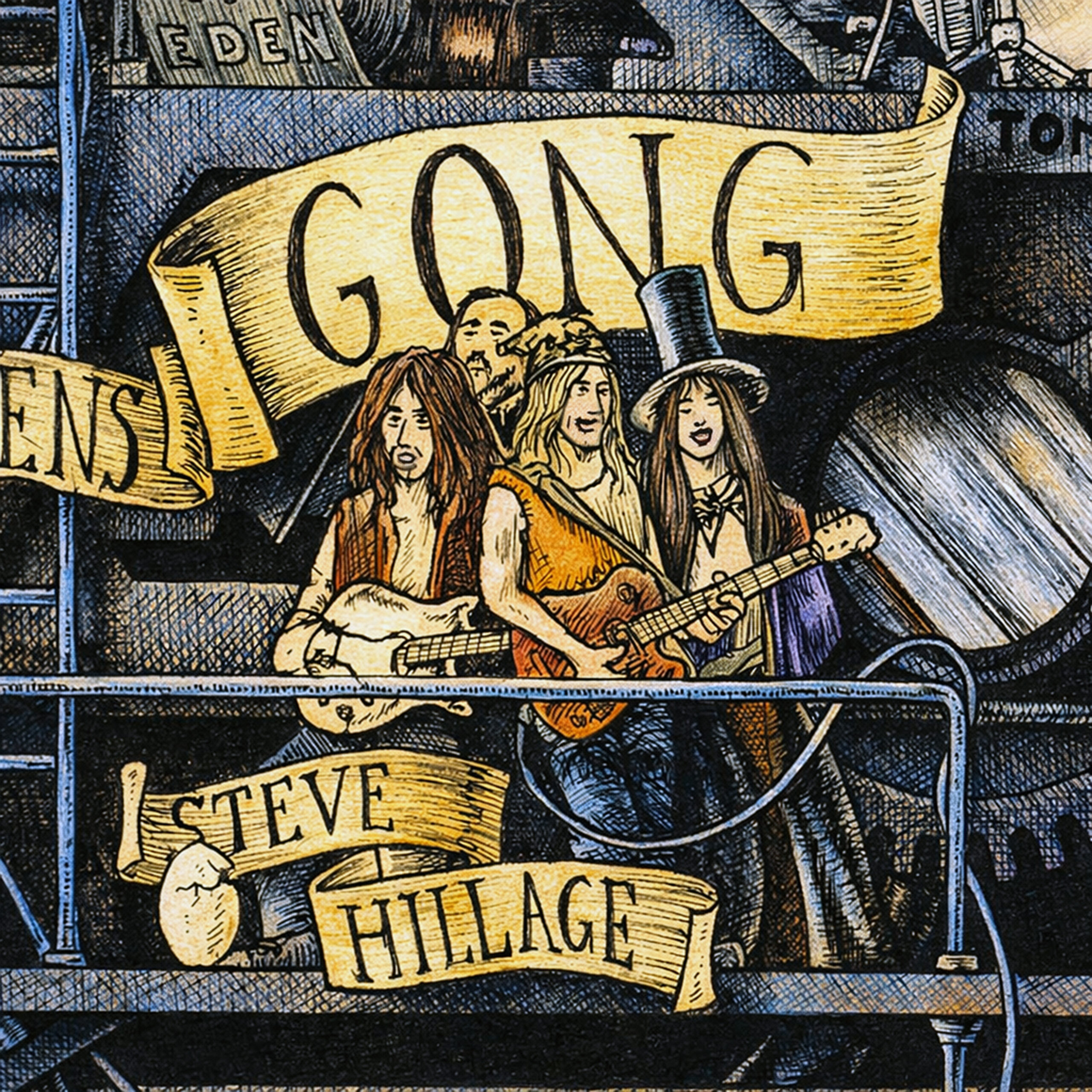
Rock Icons: Gong
From Canterbury to Planet Gong: psychedelia, humor and improvisation.

Founded: 1967–68 (Paris / England)
Status: Active, no members of historical groups
Varying core: Daevid Allen, Gilli Smyth, Didier Malherbe, Steve Hillage, Tim Blake, Pierre Moerlen, Miquette Giraudy, Mike Howlett
Core genres: Psychedelic rock, space rock, progressive, jazz-rock, avant-psych
ARTIST OFFICIAL SITE: www.gongband.com
LISTEN
More to discover…
Progressive rock without borders: from Canterbury into space
Rather than following traditional song structures, Gong developed a fluid and imaginative approach to music, blending improvisation, narrative and sound experimentation. Their work is deeply connected to an evolving mythology, featuring recurring characters, symbolic elements and surreal narratives that transform albums into interconnected conceptual worlds. This combination of musical exploration and storytelling places Gong at the intersection of progressive rock, psychedelic culture and avant-garde experimentation.
The band became a key reference within the Canterbury scene and the broader progressive rock movement.
Daevid Allen had played in the original Soft Machine lineup, but in 1967, after traveling to France, he was refused re-entry to Britain because of visa problems. That interruption encouraged a separate path: with Gilli Smyth, Allen built an open musical community in France, shaped by counterculture, collective experimentation and humor far removed from the solemnity of much progressive rock. Smyth’s whispered, theatrical voice, Allen’s guitars and a constantly changing lineup made Gong feel more like a laboratory than a conventional band.
When a Band Stops Being a Band
Gong never functions like a traditional band. There is no stable lineup, no closed identity, no “career” in the industrial sense of the term.
Rather, Gong is:
a transit zone.
a mobile community
a shared mythology
a meeting platform
Those who join Gong don’t enter a group, but a mental climate: a blend of freedom, improvisation, play, and organized chaos. The musicians aren’t “hired”: they are temporary guests of an idea. This makes the project incredibly fertile, but also structurally unstable. Each phase of Gong is different from the previous one, often incompatible with the next. It is a creature that regenerates through continuous mutation, more similar to an organism than an institution.
With Camembert Electrique and especially Flying Teapot, Angel’s Egg and You, the imaginary world of Radio Gnome Invisible also became a compositional method. Hypnotic rhythms, glissando guitar, synthesizers and improvisation alternated with eccentric songs and almost jazz-like passages. Musicians including Steve Hillage, Tim Blake, Didier Malherbe and Pierre Moerlen broadened the palette: the mythology of the Pot Head Pixies coexisted with increasingly sophisticated instrumental playing. Personal and artistic tensions led Allen to leave in 1975, while the Moerlen-led Gong moved further toward jazz fusion and percussion.
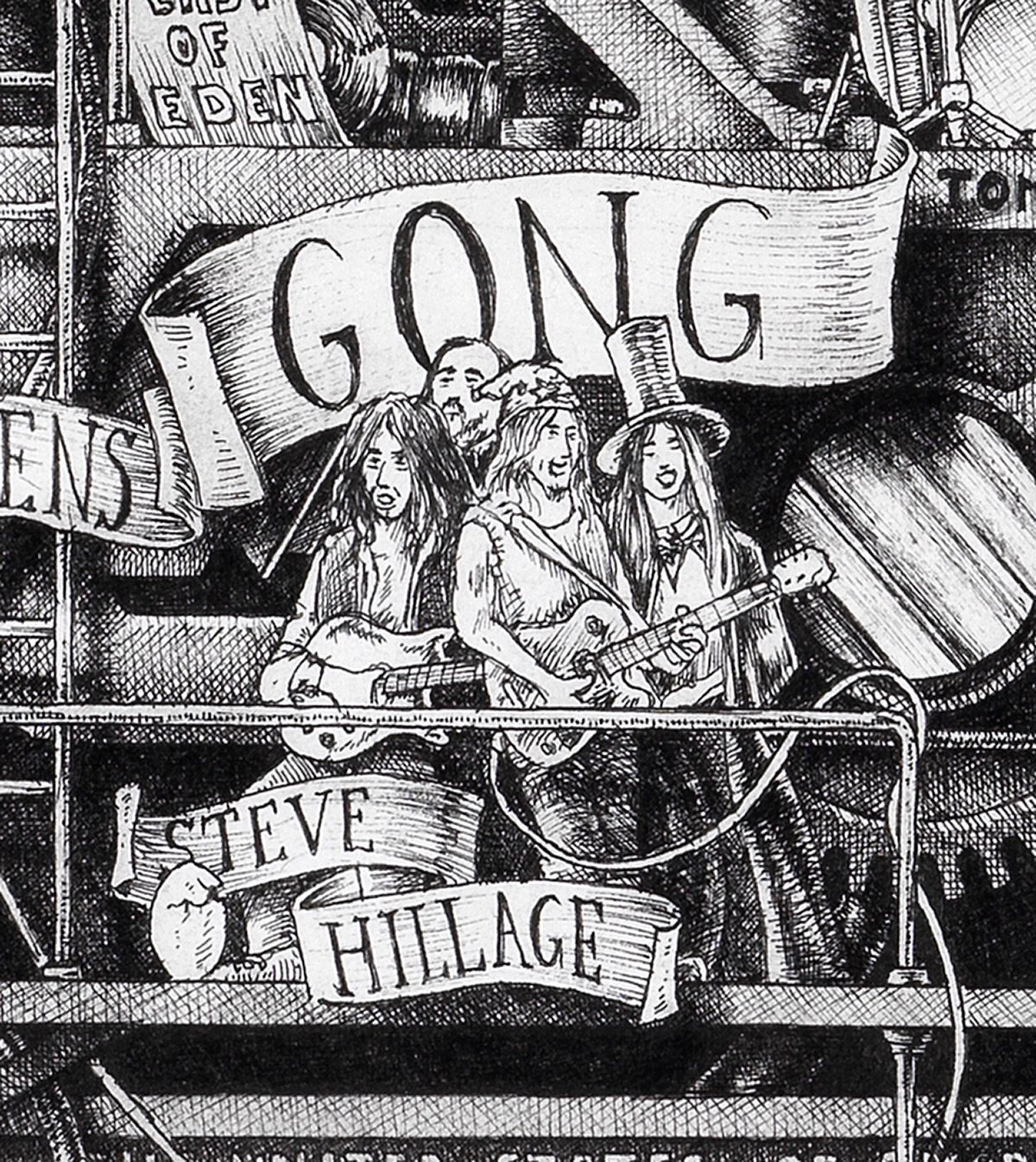
Gong’s genealogy therefore follows no single line. From Canterbury came harmonic freedom and irony; from psychedelia, extended forms and timbral exploration; from jazz, improvisation. Their path branched into space rock and fusion, leaving traces in electronic music, later psychedelic rock and less orthodox progressive forms: Canterbury + European psychedelia + jazz -> Gong -> space rock, experimental progressive rock and jazz fusion.
Albums such as Flying Teapot, Angel’s Egg and You show how Gong combined improvisation, synthesizers, glissando guitar and psychedelic storytelling in a distinctive form of progressive rock.
Within The Great Rock and Roll History, Gong illuminate the communal and transnational side of European counterculture: musicians from different backgrounds, communal living, festivals and recording studios became part of an experiment that rejected the rock band as a fixed institution.
Influenced by
- Beat Generation
- English Psychedelia
- Free Jazz
- Non-Dogmatic Eastern Spirituality
- Soft Machine
Influent For
- Space Rock
- Hawkwind
- European Jam Culture
- Psychedelic Revival
- Non-Linear Narrative Approaches
- Ozric Tentacles
The Gong Genealogy — Creative Diaspora
- Pierre Moerlen’s Gong
- Mother Gong
- New York Gong
- Gongzilla
- Daevid Allen Soloist
- Steve Hillage Soloist
- Countless Reincarnations and Collaborations
In progressive rock history, Gong offer an alternative to symphonic monumentality: music that can be complex without abandoning playfulness, improvisation or unpredictability. Their legacy lies both in a sound suspended between space rock and jazz fusion and in the idea of an open ensemble where theater, technology and collective experimentation can continually reshape what rock means.