
Kevin Ayers, a founding member of Soft Machine and a key figure in the Canterbury scene, developed a deeply individual form of experimental rock: psychedelia, jazz, French chanson and British humor coexisted with his seemingly nonchalant baritone. Within The Great Rock and Roll History, his path connects the early British underground to an approach to songwriting free from progressive rock conventions.

Rock Icons: Kevin Ayers
Psychedelic British dandy suspended between Canterbury, musical surrealism and bohemian disillusionment.

Canterbury’s reluctant star: between the avant-garde, melancholy and the freedom to belong nowhere.
By combining psychedelia, experimental folk, jazz and poetic sensitivity, Kevin Ayers helped redefine the boundaries of British alternative music during the 1960s and 1970s. From the original Soft Machine to Joy of a Toy, Shooting at the Moon and Whatevershebringswesing, Kevin Ayers turned Canterbury’s psychedelic legacy into unpredictable music poised between experimentation and song.
Name: Kevin ayers
Birth: August 16, 1944 — Herne Bay, England
Died: February 18, 2013 — Montolieu, France
Main instruments: vocals, bass, guitar
Genres: Psychedelic rock, Canterbury scene, progressive folk, art rock
ARTIST OFFICIAL SITE: kevinayers.org
LISTEN
Song From The Bottom Of A Well
More to discover…
The lazy poet of British psychedelia
Kevin Ayers occupies a uniquely strange position within British rock history. Although he helped pioneer the Canterbury scene and became admired by countless musicians, he often appeared almost uninterested in fame, discipline or even career-building itself. Yet that apparently lazy attitude became part of his fascination.
His music possesses relaxed surreal beauty filled with melancholy, humor and emotional fragility. Inside his songs coexist existential sadness, British irony and fluid psychedelic atmospheres. More than a conventional rock star, Kevin Ayers often seemed like a bohemian aristocrat accidentally trapped inside the chaos of the 1960s counterculture.
FROM CANTERBURY TO A FREEDOM OF HIS OWN
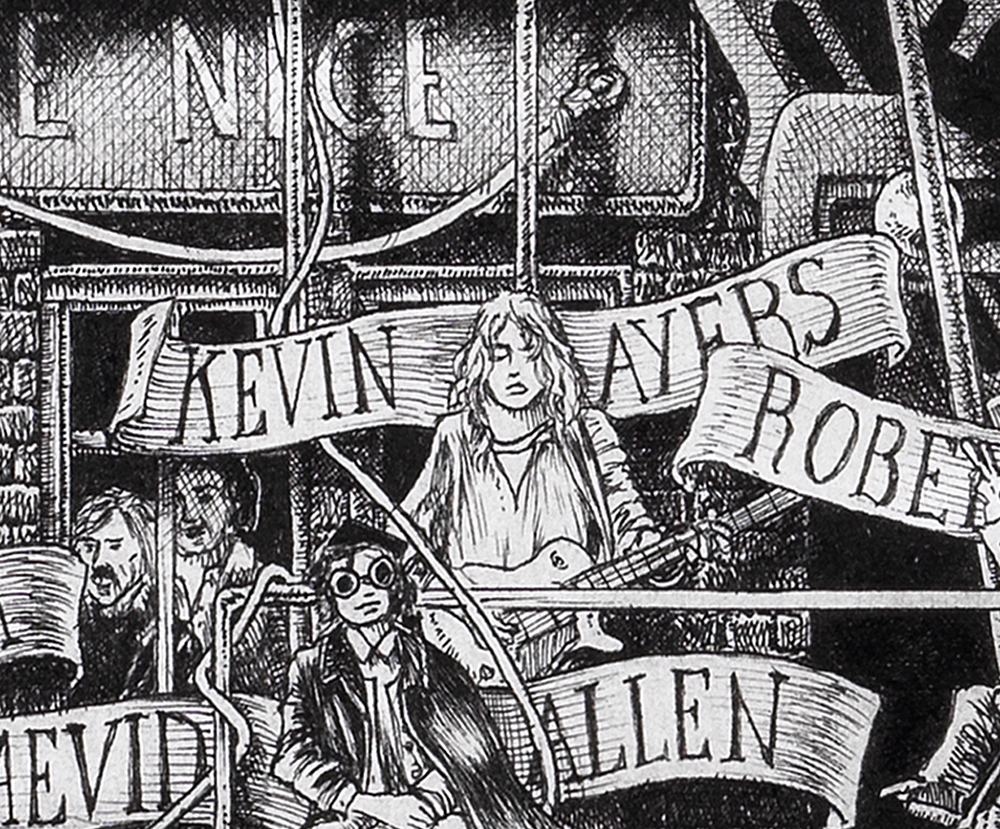
Kevin Ayers reached music by an unconventional route. A childhood spent partly in Malaya, his years in England and his encounters with Robert Wyatt, Mike Ratledge and Daevid Allen helped shape a sensibility resistant to categories. In 1966 he helped form Soft Machine, where his deep voice and taste for eccentric melodies coexisted with the other members’ jazz and experimental impulses. Yet touring, the demands of a rapidly changing band and his need to work at his own pace led him to leave after their debut album. Walking away from a group that would become a progressive-rock landmark already says much about Ayers: he valued creative independence over the discipline of a collective career.
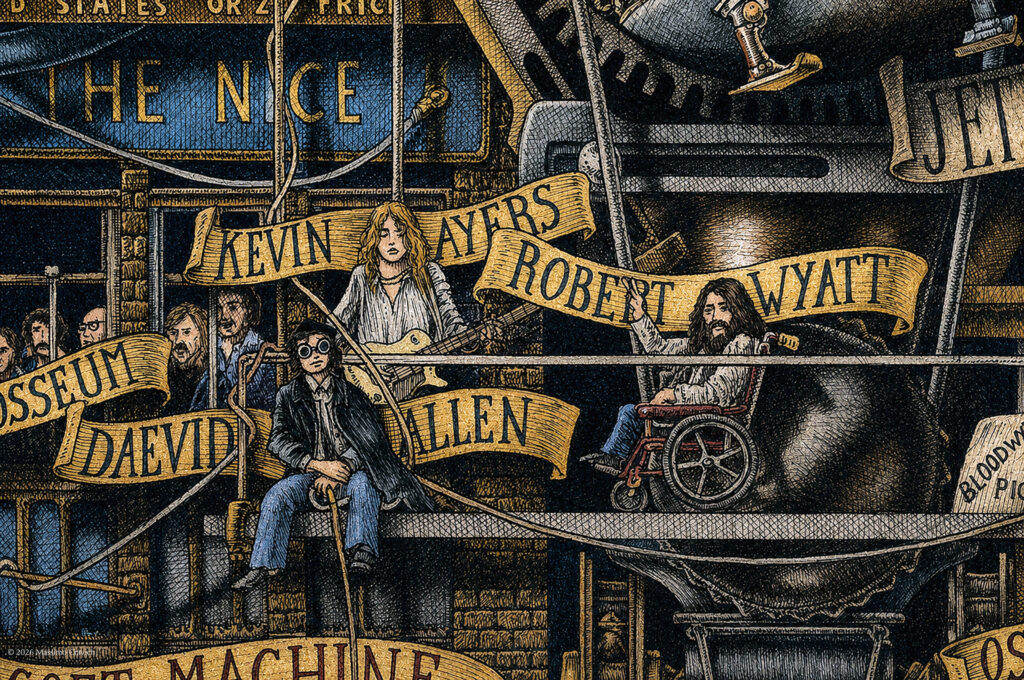
With Joy of a Toy and subsequent albums, he built a recognizable world of odd characters, humor, desire and a melancholy that often surfaces when the music sounds most carefree. Working with musicians including David Bedford, Mike Oldfield and Robert Wyatt allowed him to move from chamber-like arrangements to sudden electric outbursts without losing the songs at the center. Ayers might deliver a line in an almost conversational drawl, then give way to an unpredictable instrumental passage. His reluctance to play the rock-star role also created a productive tension: he enjoyed collaboration but repeatedly sought an escape from the structures it created.
His genealogy begins with British psychedelia and the Canterbury community but branches toward an unconventional, sophisticated songwriting style shaped by jazz, folk, pop and European sensibilities. The 1974 concert captured on June 1, 1974, with John Cale, Brian Eno and Nico, makes this network of affinities visible: very different artists connected by a refusal to settle for one musical identity. Soft Machine and Canterbury -> Kevin Ayers -> art rock and experimental songwriting: rather than founding a genre, Ayers showed that rock could remain adventurous even when it lowered its voice.
Albums including Joy of a Toy, Shooting at the Moon and Whatevershebringswesing document Kevin Ayers’s distinctive meeting of the Canterbury sound, psychedelic pop and art rock.
Within The Great Rock and Roll History, Kevin Ayers also represents a less competitive side of the British underground: friendships, intermittent collaborations and individual paths that resisted the race toward virtuosity and ever-larger stages.
Influenced by
- Beat generation
- Modern jazz
- Soft Machine
- British surrealism
- Contemporary poetry
Influent For
- Brian Eno
- Canterbury scene
- British art rock
- Alternative pop
- Independent experimental music
Related Artists
- Gong
- Soft Machine
- Brian Eno
- Robert Wyatt
- Daevid Allen
- Canterbury scene
SOURCES
Kevin Ayers archives
Canterbury scene historical archives
British psychedelic archives
Soft Machine archives
Within the broader history of British psychedelia, Kevin Ayers represents one of the most refined, eccentric and influential figures of European art rock. His work permanently reshaped the relationship between surrealism, psychedelic folk and alternative British musical sensitivity. Having helped found Soft Machine, he transformed Canterbury’s freedom into the language of an eccentric songwriter, combining psychedelia, refined arrangements and humor with an intimate streak. His influence rests less on an easily imitated sound than on the possibility he opened up: experimental music that still makes room for vulnerability, irony and the simplicity of a song.