
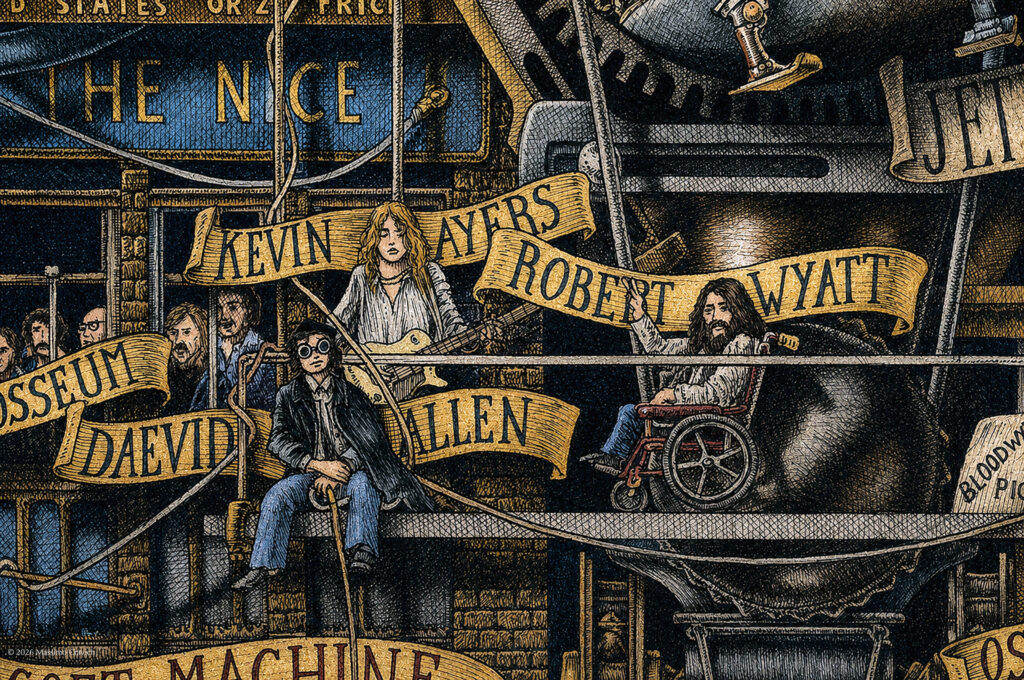
Robert Wyatt is an English musician, singer, drummer and composer, a central figure of the Canterbury Sound, a co-founder of Soft Machine and the author of one of the most singular, vulnerable and politically conscious solo careers in British music.
This illustrated profile explores his voice, writing, poetic world and influence within The Great Rock and Roll History, a large-scale illustrated timeline of modern music.

Rock Icons: Robert Wyatt

Fragile and otherworldly voice of the Canterbury Sound, between jazz-rock, psychedelia, political song and intimate progressive music By combining experimental drumming, childlike melodic imagination, jazz harmony, political conscience and a voice unlike anyone else in British rock, Robert Wyatt helped transform the Canterbury Sound from a regional scene into one of the most emotionally complex languages of progressive music. His story is a continuous deviation: from the acrobatic drumming of Soft Machine to the submerged melancholy of Rock Bottom, from the Dada logic of Matching Mole to civil song, from avant-garde practice to oblique pop.
Name: Robert Wyatt-Ellidge
Birth: 28 January 1945, Bristol, England
Status: retired from music; alive
Main instruments: voice, drums, percussion, keyboards, piano, organ, trumpet, cornet, bass, guitar, tape treatments and sound manipulation
Genres: Canterbury Sound, art rock, progressive rock, jazz-rock, avant-pop, progressive pop, political song, vocal experimentation
ARTIST OFFICIAL SITE: The almost authorised Robert Wyatt website: differenteverytime.com
LISTEN
Moon in June – Soft Machine: Wyatt s great statement inside Third, suspended between private confession, jazz-rock and progressive construction.
O Caroline – Matching Mole: tender pop bent into an unstable and transparent Canterbury grammar.
Sea Song – Rock Bottom: one of the highest emotional declarations in British progressive music.
I’m a Believer – The almost absurd single: a Monkees cover turned into something unmistakably Wyattian, popular and strange.
Shipbuilding – Political song as elegy: the Falklands, shipyards, labour, loss and dignity.
More to discover…
The secular saint of the Canterbury Sound: a drummer who fell to the bottom of the sea and resurfaced as the inner voice of progressive music
Robert Wyatt approached rock music not as a vehicle for virtuoso display, but as a porous organism in which jazz, nursery rhyme, surrealism, political grief and domestic tenderness could coexist. In Soft Machine he was the singing drummer who made the group sound less like a machine and more like a nervous system: elastic, comic, unstable, suddenly wounded.
In Matching Mole he turned that instability into a band of his own, already half song and half collapse. After the 1973 accident that left him paralysed from the waist down, Wyatt did not simply continue his career: he changed the meaning of continuation itself. Rock Bottom, recorded with a circle of friends and produced by Nick Mason, became a work in which disability, love, sea imagery, dream logic and post-psychedelic composition entered the same strange room.

Albums such as Rock Bottom, Ruth Is Stranger Than Richard and Shleep became defining landmarks of Canterbury-related left-wing politics, jazz, pop memory and radical intimacy.
His music occupies a central position within the broader visual narrative of The Great Rock and Roll History. The Great Rock and Roll History.
Influenced by
- Thelonious Monk, Charlie Parker and the language of modern jazz
- British beat, psychedelia and the London underground of the 1960s
- Daevid Allen, Kevin Ayers, Mike Ratledge and the Soft Machine/Wilde Flowers laboratory
- Alfreda Benge, a decisive artistic, poetic, visual and emotional presence
- Political song, British communism, anti-militarism and non-hierarchical listening to world music.
Influent For
- The Canterbury Sound and later Soft Machine-related music
- Henry Cow, Rock in Opposition and many forms of European avant-prog
- Brian Eno, Phil Manzanera and the more oblique side of British art rock
- Björk, Talk Talk, David Sylvian and artists drawn to fragility as expressive strength
- The modern idea of non-spectacular progressive music: chamber-like, political, domestic and vulnerable

Related Artists
- Daevid Allen
- Soft Machine
- Alfreda Benge
- Hugh Hopper
- Mike Ratledge
- Kevin Ayers
LINKABLE SOURCES
• Domino Music – Robert Wyatt catalogue: https://www.dominomusic.com/artists/robert-wyatt
• Marcus O Dair, Different Every Time: The Authorised Biography of Robert Wyatt, Profile Books, 2014
• BBC / radio and press interviews on Wyatt, Soft Machine and post-1973 career
• Soft Machine and Matching Mole discographies and archival releases
Within the broader narrative of rock history, Robert Wyatt represents one of the most profound transformations of the Canterbury Sound into a language of vulnerability, political conscience and progressive experimentation.
His influence extends across generations, shaping art rock, avant-pop, experimental song, politically aware music and every form of progressive music that prefers emotional truth to spectacle.