
Curtis Mayfield was one of the decisive figures in turning soul music into social consciousness. First with the Impressions and later as a solo artist, he joined gospel, vocal harmony, funk and political observation with unusual delicacy. Within Great Rock and Roll History, his story shows how African American music could become community testimony, a demand for dignity and sophisticated sonic invention at the same time.

Rock Icons: Curtis Mayfield
A gentle voice for pride, injustice and survival.

From the Impressions to Super Fly, Curtis Mayfield created a language in which soul, gospel and funk spoke directly about African American experience without sacrificing melody.
Full name Curtis Lee Mayfield
Born June 3, 1942, Chicago, Illinois
Died December 26, 1999, Roswell, Georgia
Principal act The Impressions; solo career from 1970
Roles Singer, guitarist, songwriter, producer, record entrepreneur
Genres Soul, gospel soul, funk, rhythm and blues
Own label Curtom Records
ARTIST OFFICIAL SITE: www.curtismayfield.com
LISTEN
More to discover…
Chicago, gospel and the Impressions
Mayfield grew up in postwar Black Chicago, where church music, vocal groups and rhythm and blues could exist only blocks apart. Still a teenager, he entered the circle of Jerry Butler and the Impressions; when Butler pursued a solo career, Curtis increasingly became the group’s creative center. His falsetto did not depend on brute force: it persuaded, comforted and suggested.
His guitar playing, often using an individual tuning and an elegant rhythmic touch, became equally distinctive. With songs such as It’s All Right, Keep on Pushing and especially People Get Ready, gospel language moved beyond the church without losing its sense of community.
A soundtrack for civil rights
During the 1960s Mayfield’s songs acquired a significance larger than their chart success. Keep on Pushing, People Get Ready and We’re a Winner became symbolic companions to the civil-rights era, yet Mayfield rarely sounded like a pamphleteer. He wrote about moving forward, believing and retaining dignity: religious and everyday imagery became political without requiring slogans. T
hat restraint also reflected his public personality, less incendiary than some contemporaries but no less purposeful. By founding Curtom Records he also achieved an unusual degree of control for an African American artist of the period. He wanted not merely to sing songs, but to determine how they were produced and how his music entered the world.
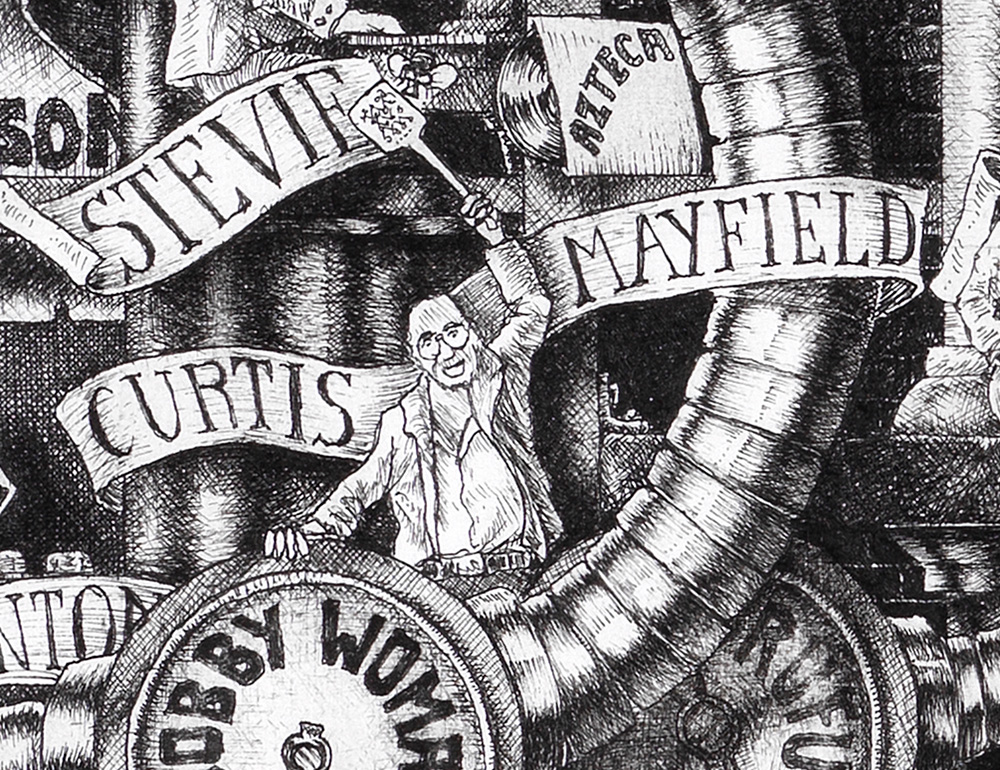
Super Fly: portraying the ghetto without glorifying it
Mayfield’s solo career brought more elaborate arrangements, deeper funk rhythms and increasingly explicit writing. In 1972 the soundtrack to Super Fly became his commercial and political masterpiece. The film belonged to the blaxploitation era, but Mayfield’s songs supplied a critical voice: Freddie’s Dead, Pusherman and Superfly examined drugs, exploitation and ambition without reducing them to glamour. Bass, percussion, strings, horns and guitar created funk that was both elegant and uneasy. It remains a striking case of a soundtrack morally commenting on the images it accompanies, while its success proved that social consciousness and pop sophistication could coexist.
The wounded body, the voice that remained
On August 13, 1990, during an outdoor concert in Brooklyn, stage lighting equipment fell and struck Mayfield, leaving him paralyzed from the neck down. For an artist whose work depended on both voice and physical command of an instrument, the injury appeared devastating. Yet he continued writing and eventually recorded again, positioned so that he could breathe sufficiently to sing phrases in stages.
New World Order, released in 1996, makes that persistence especially moving. His legacy runs through soul, funk, hip-hop and political songwriting: not only because of what he said, but because he showed that resolve, beauty and protest could inhabit the same song.
Curtis Mayfield turned the elegance of Chicago soul into an instrument of empowerment, anticipating politically conscious funk and many later forms of Black popular music.
Within The Great Rock and Roll History, Mayfield stands at the passage from gospel and rhythm and blues into soul and funk, an essential line for understanding how Black American music also nourished rock and, later, hip-hop and neo-soul.

Influenced by
- Sam Cooke
- The Staple Singers
- Chicago gospel
- Jerry Butler
- Ray Charles
Influent For
- Marvin Gaye
- Stevie Wonder
- Prince
- Bob Marley
- Kendrick Lamar
Related Artists
- The Impressions
- Jerry Butler
- Donny Hathaway
- Isaac Hayes
- Sly & the Family Stone
Get Your Rock Icon
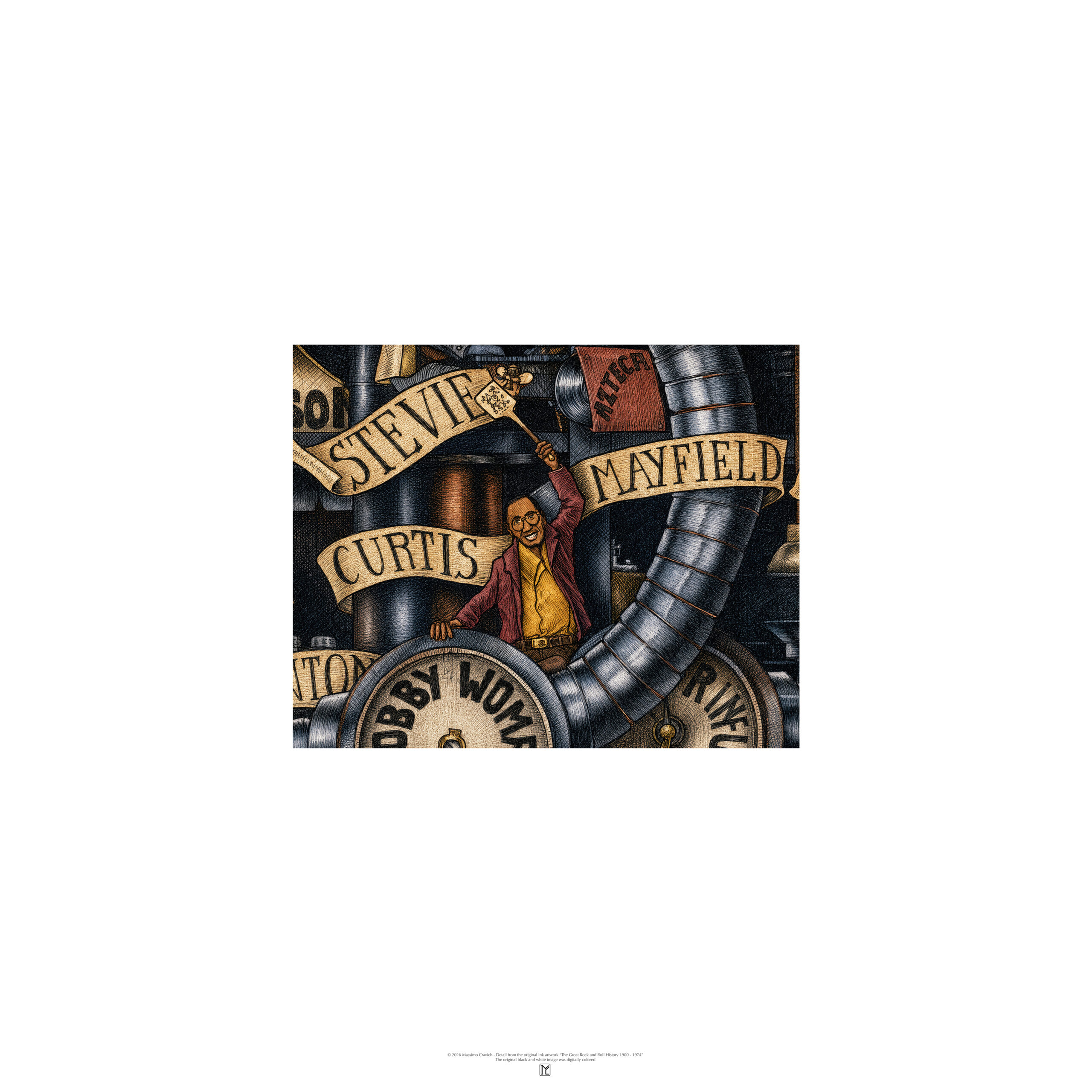
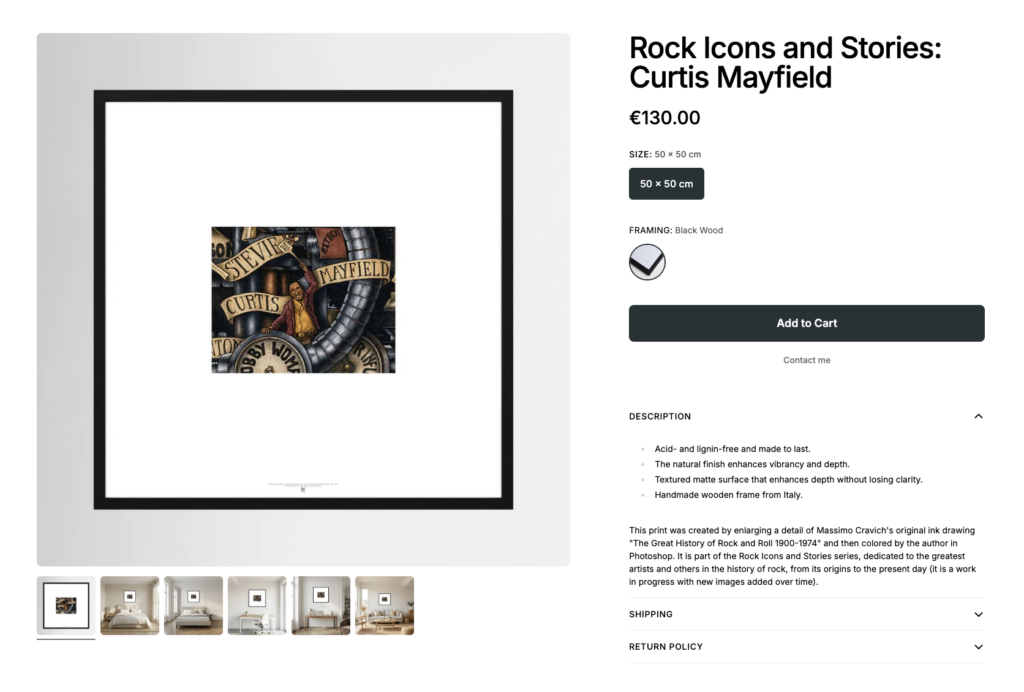
Selected artworks from Rock Icons and Stories are available as high-quality framed art prints. Printed on premium 230 gsm matte paper with excellent detail and colour reproduction, each print is professionally framed and delivered ready to hang.A carefully selected, high-quality alternative to the museum-grade Fine Art Giclée editions, offering an accessible way to own and display a reproduction of the original artwork. Printing, framing and worldwide fulfilment are handled by our specialist printing partner.
Sources
Rock & Roll Hall of Fame – Curtis Mayfield
Songwriters Hall of Fame – Curtis Mayfield
Recording Academy / GRAMMY – Curtis Mayfield
Curtis Mayfield remains central because he made music political without reducing its beauty, and spiritual without making it abstract. The tenderness of his falsetto, the precision of his guitar and the strength of his imagery addressed hope and violence, pride and vulnerability. From the Impressions to Super Fly, and finally to recordings made after his devastating accident, his work forms one of the deepest threads connecting gospel, soul, funk and contemporary African American music.