
Fairport Convention emerged in late-1960s London initially looking toward American folk rock, but within a few years shifted their center of gravity toward British traditions. This was not simply a change of repertoire: old ballads, acoustic instruments and narrative forms were placed inside an electric band shaped by Dylan, the Byrds and psychedelia. This profile places Fairport Convention within The Great Rock and Roll History, tracing the movement from transatlantic folk rock to an autonomous British folk-rock language and from there into the later English electric-folk scene.
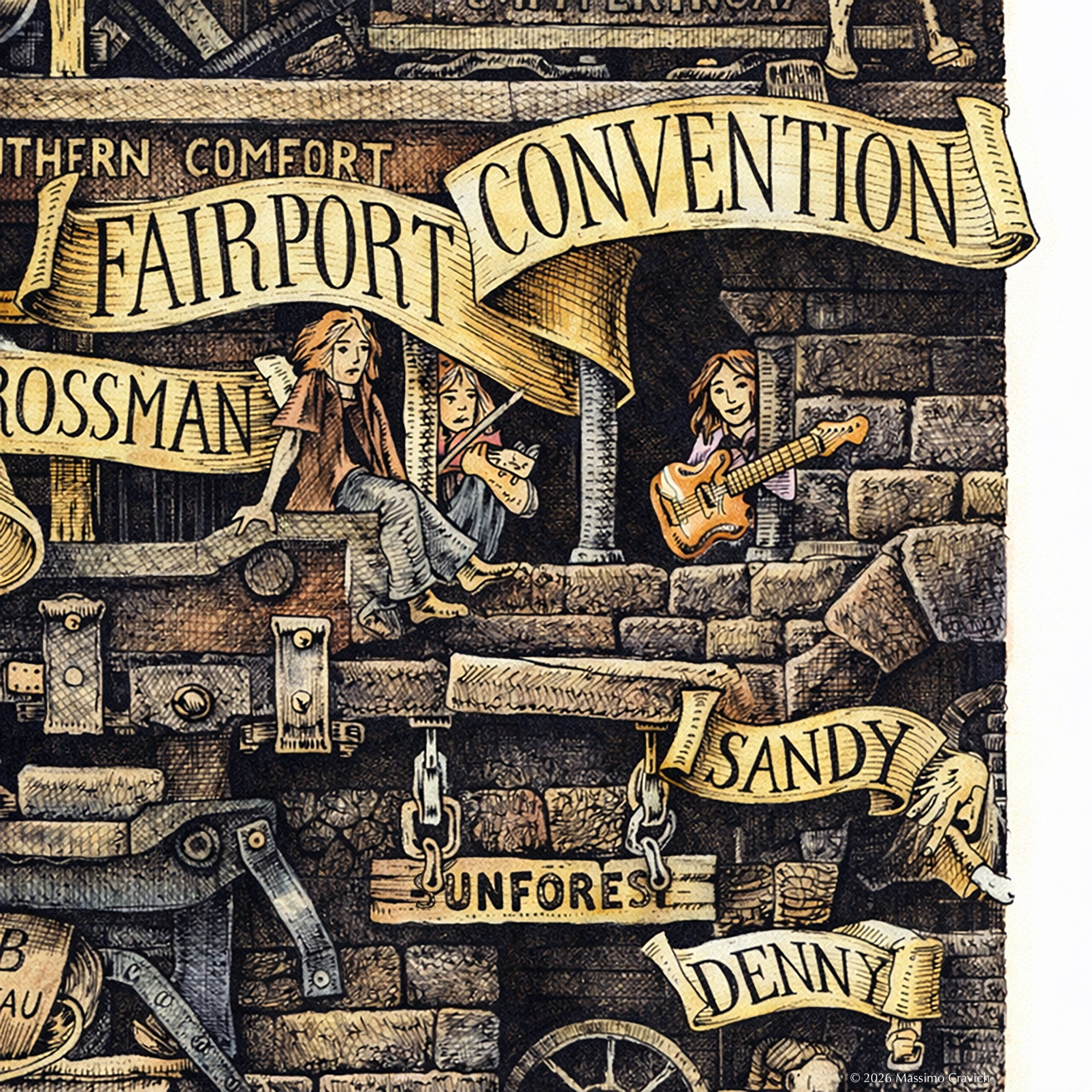
Rock Icons: Fairport Convention
From an imagined America to British tradition: when the old ballad enters the electric band.

Across What We Did on Our Holidays, Unhalfbricking and Liege & Lief, Fairport Convention moved from the influence of Dylan, the Byrds and American folk rock toward an electric reworking of British ballads and dance forms, with Sandy Denny, Richard Thompson, Ashley Hutchings and Dave Swarbrick central to the transition.
Formed: 1967, London(UK)
Status: Active
Genres: Folk rock, Progressive Folk Rock
ARTIST OFFICIAL SITE: www.www.fairportconvention.com
LISTEN
More to discover…
Tradition not as archive: British ballads inside the language of rock
At first Fairport Convention clearly belonged to the folk-rock climate created by the meeting of Dylan, the Byrds and the new rock culture. Their repertoire included American writers and their instrumentation was that of an electric band, while Sandy Denny’s arrival added a voice able to move between contemporary songwriting and traditional song. The shift came when the group began asking whether the American model could be applied to material closer to their own history.
The aim was not to imitate a vanished rural music, but to discover how British melodies, texts and structures could survive inside amplification, drums and electric guitar. Liege & Lief made that investigation explicit. Ballads such as Matty Groves and Tam Lin retain narrative and modal structures but are handled with the dynamics of a rock group; Dave Swarbrick’s fiddle is not merely folkloric color, while Richard Thompson’s guitar avoids turning the material into conventional blues rock. Even newly written songs can appear to belong to an older tradition.
The interesting point lies in that ambiguity: the band neither modernizes folk by erasing its characteristics nor reconstructs the past in purist form. It brings two musical systems into the same space.
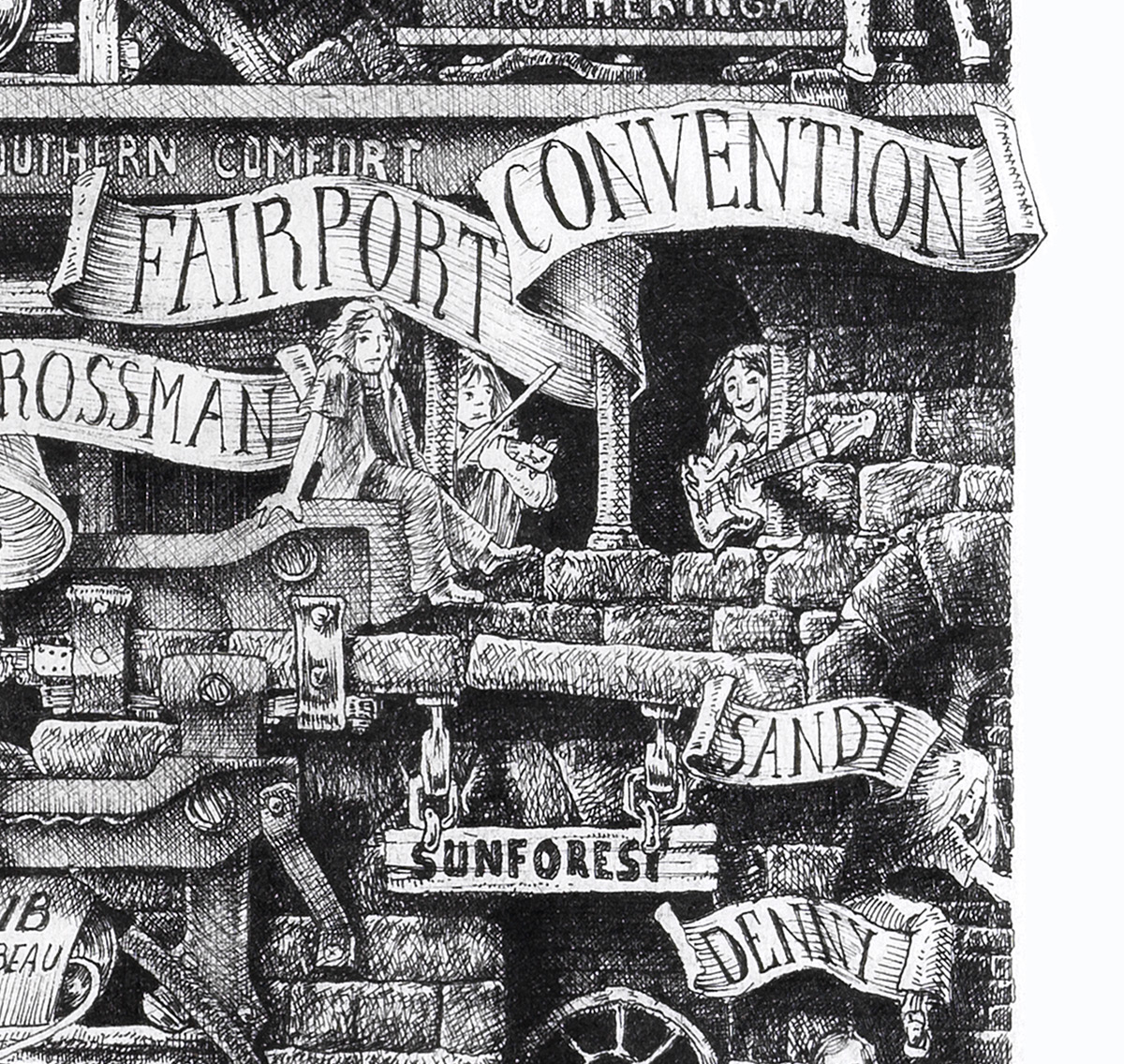
From this transition emerged a British line distinct from American folk rock. Ashley Hutchings continued the investigation with Steeleye Span and the Albion Band; Richard Thompson developed a personal language in which balladry, electric guitar and songwriting continued to interact; Pentangle, although following a different route more deeply intertwined with jazz and blues, belonged to the same broad expansion of the field.
The genealogy therefore runs: traditional British folk + folk revival -> Dylan/Byrds and folk rock -> Fairport Convention -> British electric folk -> Steeleye Span, Albion Band and later forms of British folk rock.
With Unhalfbricking and especially Liege & Lief, Fairport Convention brought folk rock, British traditional balladry and electric instrumentation into direct contact without reducing any of them to mere decoration.
Within The Great Rock and Roll History , Fairport Convention connect British traditional folk and the folk revival -> Dylan, the Byrds and folk rock -> Fairport Convention -> British electric folk -> Steeleye Span, the Albion Band and later developments in English folk rock.
Influenced by
Influent For
- Levellers
- Waterboys
- Kate Bush
- Steeleye Span
- Pentangle
Related Artists
Richard and Linda Thompson
Get Your Rock Icon
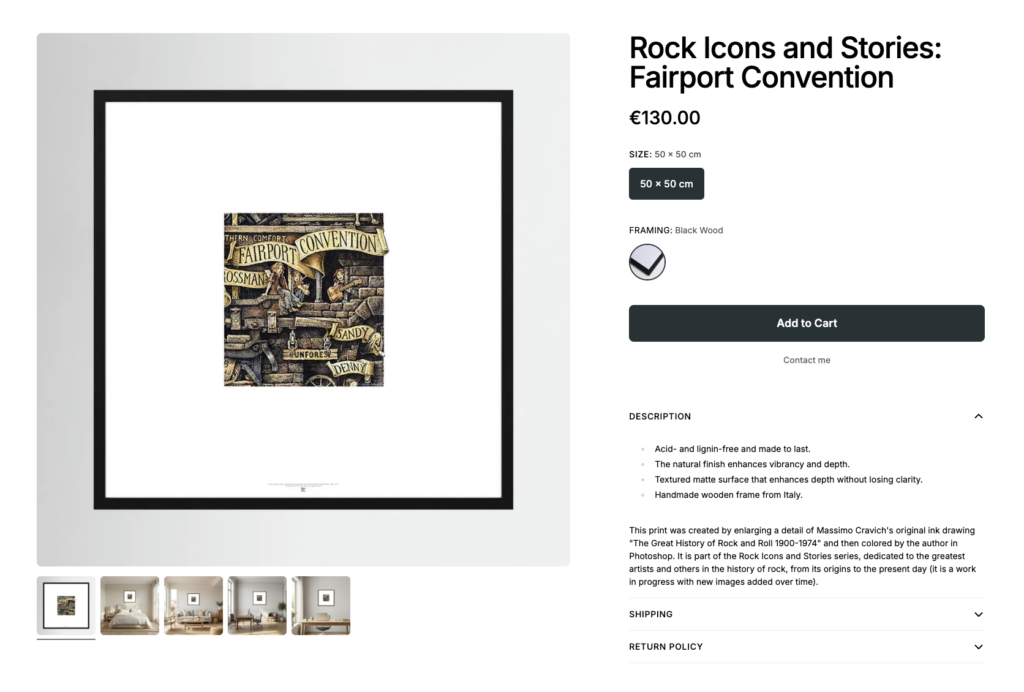
Selected artworks from Rock Icons and Stories are available as high-quality framed art prints. Printed on premium 230 gsm matte paper with excellent detail and colour reproduction, each print is professionally framed and delivered ready to hang.A carefully selected, high-quality alternative to the museum-grade Fine Art Giclée editions, offering an accessible way to own and display a reproduction of the original artwork. Printing, framing and worldwide fulfilment are handled by our specialist printing partner.

Linkable Sources
• Wikipedia — Fairport Convention — https://en.wikipedia.org/wiki/Fairport_Convention
• Fairport official history — https://www.fairportconvention.com/fairport-history/
• Wikipedia — https://en.wikipedia.org/wiki/Fairport%27s_Cropredy_Convention
• Wikipedia — Steeleye Span — https://en.wikipedia.org/wiki/Steeleye_Span
• Wikipedia — The Albion Band — https://en.wikipedia.org/wiki/The_Albion_Band
In rock genealogy, Fairport Convention occupy the point where British folk rock stops depending primarily on the American model and begins to engage directly with its own traditional repertoire. Ballads, modes and narrativeforms are not simply electrified: they alter the way the band itself constructs arrangements and dynamics. From that encounter emerges an autonomous line able to treat tradition not as material to be preserved unchanged, but as a language still available for transformation.