
Elvis Presley was one of the most influential figures in twentieth-century popular culture and the artist most responsible for transforming rock and roll into a global phenomenon. By blending gospel, blues, country and rhythm & blues traditions, he created a style that reshaped popular music and youth culture.
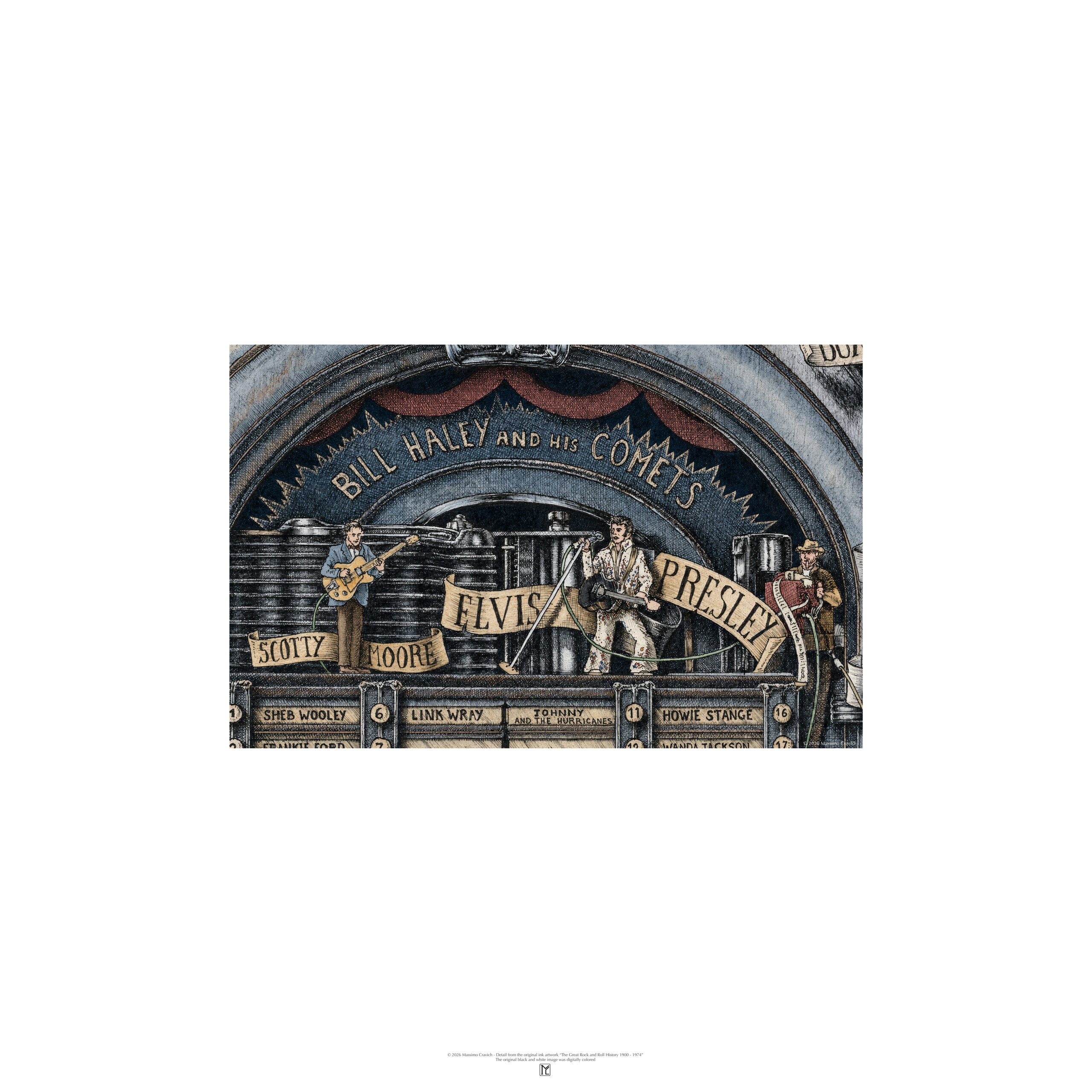
This illustrated profile explores Elvis Presley’s musical roots, voice, stage language and cultural impact within The Great Rock and Roll History, a large-scale illustrated timeline of music development.
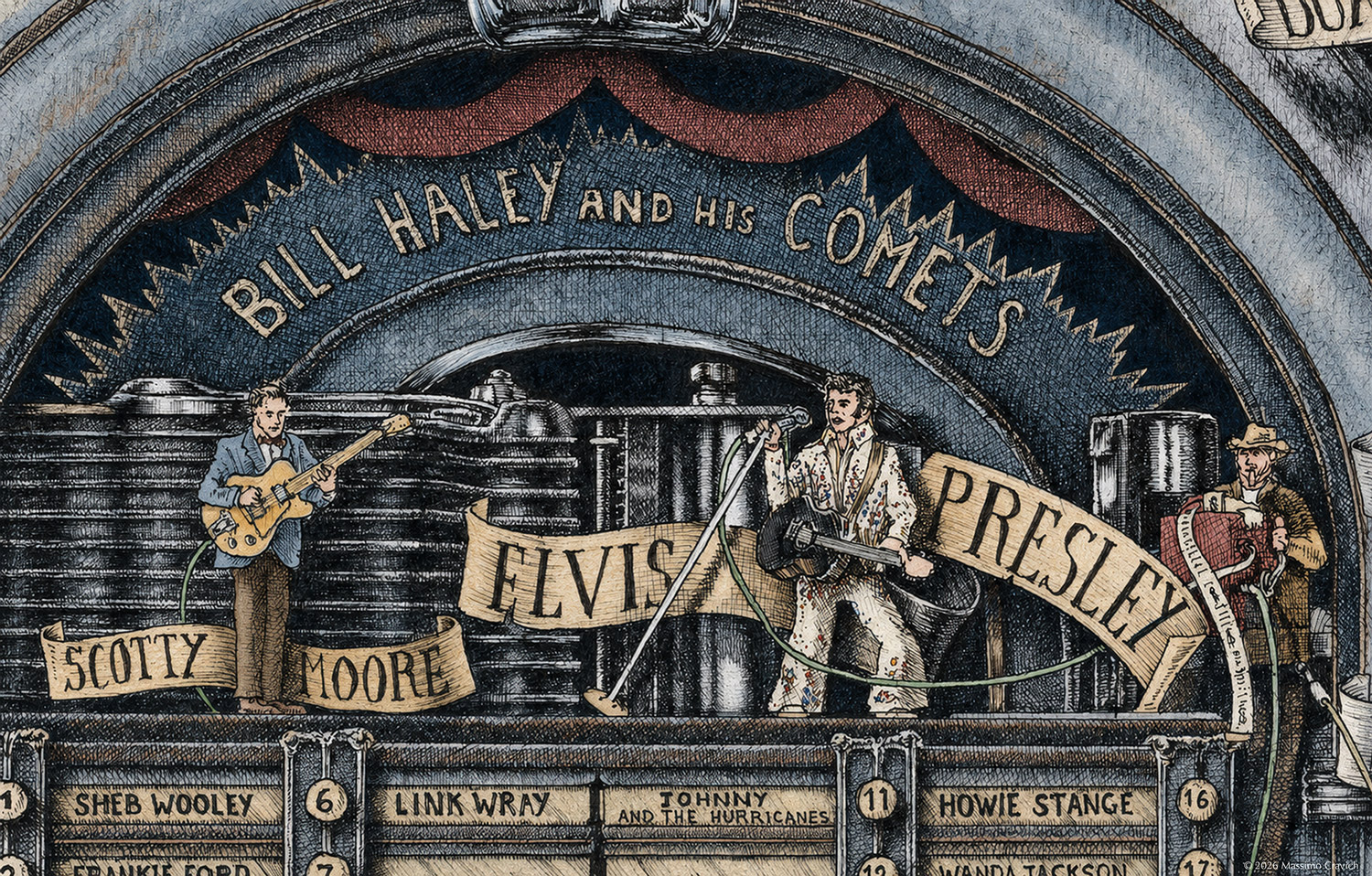
Rock Icons: Elvis Presley
The singer who stood at the crossroads of blues, country and gospel and turned rock and roll into a worldwide cultural phenomenon.
From the Sun Records sessions in Memphis to the revolutionary RCA hits of the 1950s, Elvis Presley helped carry Southern Black and white musical traditions into the new mass culture of rock and roll, changing popular singing, stage performance, youth fashion and the relationship between music and celebrity.

Real name Elvis Aaron Presley
Birth: January 8, 1935 — Tupelo, Mississippi (USA)
Death: August 16, 1977 — Memphis, Tennessee (USA)
Core genres: Rock and Roll, Rockabilly, Gospel, Country
ARTIST OFFICIAL SITE: www.elvisthemusic.com
LISTEN
More to discover…
The King Who Globalized Rock and Roll
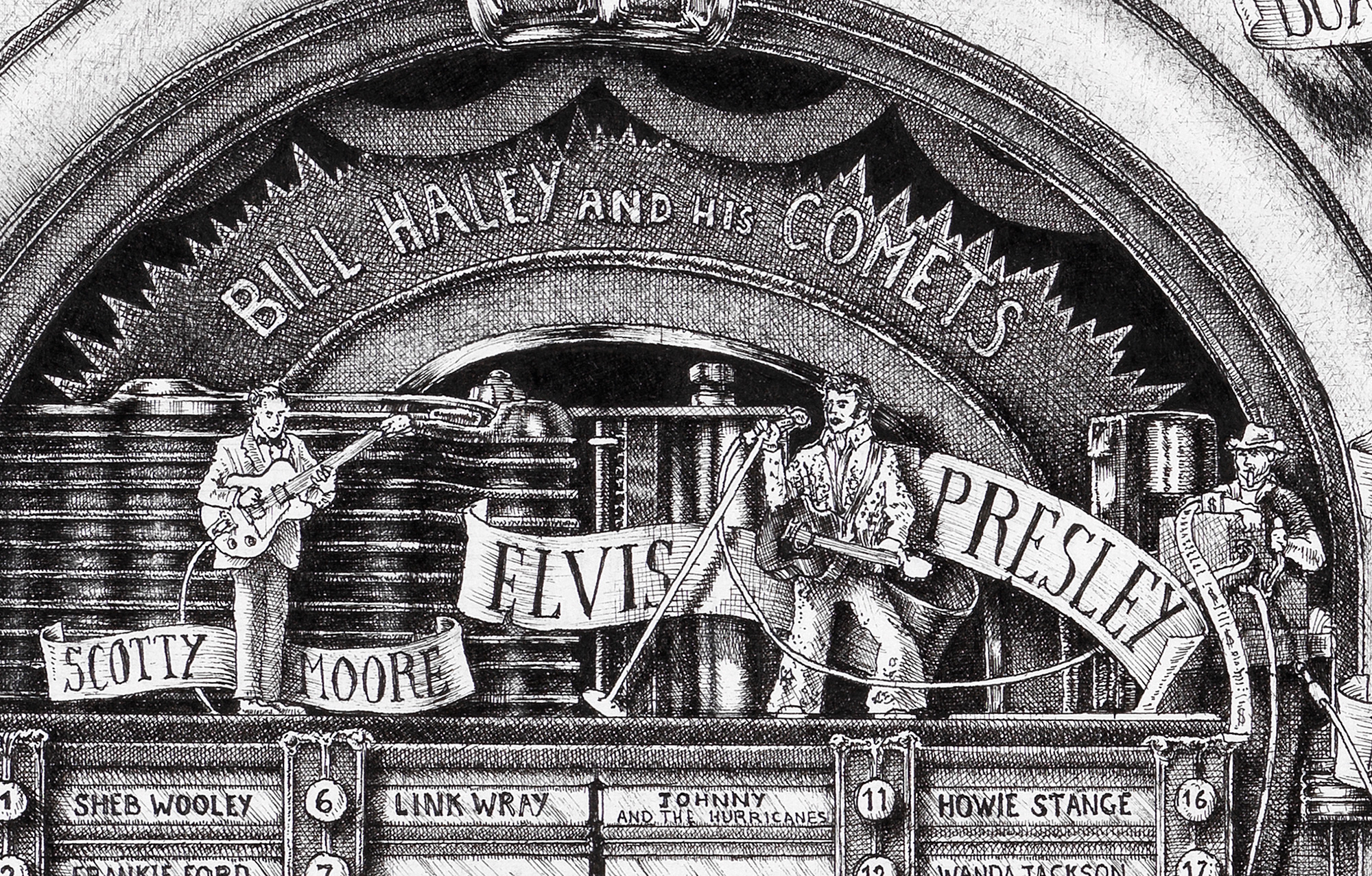
Elvis Presley did not invent rock and roll by himself, and the music did not begin with him. Its foundations had been built by generations of Black blues, gospel and rhythm & blues artists, alongside country, western swing and Southern popular traditions. What Elvis possessed was an extraordinary ability to inhabit those languages simultaneously.
Growing up in Mississippi and Memphis, he absorbed gospel singing, country radio and Black music with unusual openness. At Sun Records, producer Sam Phillips recognized that this young white singer could cross musical boundaries in a way that sounded instinctive rather than calculated.
The first recordings with guitarist Scotty Moore and bassist Bill Black are crucial because they reveal rockabilly as an act of recombination: Arthur Crudup’s blues could suddenly acquire country propulsion, slap bass and a nervousguitar vocabulary. When Elvis moved to RCA, that regional spark became mass culture. His voice, looks, movement and television appearances made him a symbol of generational rupture.
The history is inseparable from questions of race and the unequal American music industry: Elvis benefited from opportunities and exposure often denied to Black originators. Yet his importance also lies in the visibility he gave to musical forms he openly acknowledged as fundamental to his own art.
After the Army years and the increasingly formulaic Hollywood period, the 1968 television special and the Memphis recordings that followed restored a tougher, adult Elvis. Gospel, soul, country and dramatic pop returned to the foreground. His later story became entangled with Las Vegas spectacle, physical decline and the machinery of celebrity, but the musical core remains immense: Elvis changed not only what a singer could sound like, but what a popular performer could represent.
Recordings such as That’s All Right, Heartbreak Hotel, Hound Dog, Jailhouse Rock, In the Ghetto and Suspicious Minds trace Elvis Presley’s path from rockabilly pioneer to one of the defining voices of twentieth-century popular music.
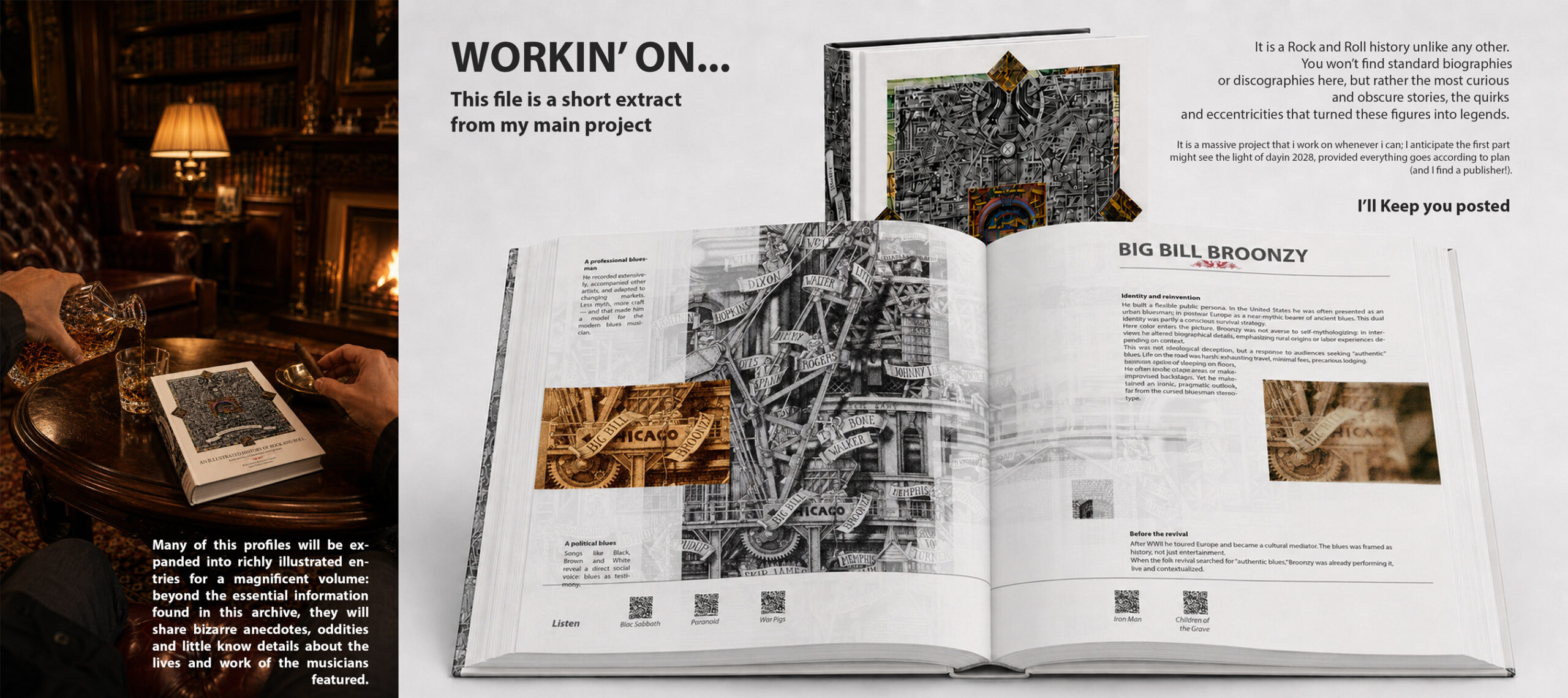
Within The Great Rock and Roll History, Elvis Presley stands at one of the most important junctions in the entire genealogy: blues, R&B;, gospel and country converge in the mid-1950s and are projected through records, radio, cinema and television toward a new international youth culture.

Influenced by
- Gospel (South)
- Afroamerican Blues
- Country
- rhythm & blues
- Arthur Crudup
- Big Mama Thornton
- Sister Rosetta Tharpe
Influent For
- Beatles
- Rolling Stones
- Bruce Springsteen
- U2
- Entire world pop and rock music
Related Artists
Scotty Moore
Bill Black
Rock Icons: Elvis Presley
Get Your Rock Icon
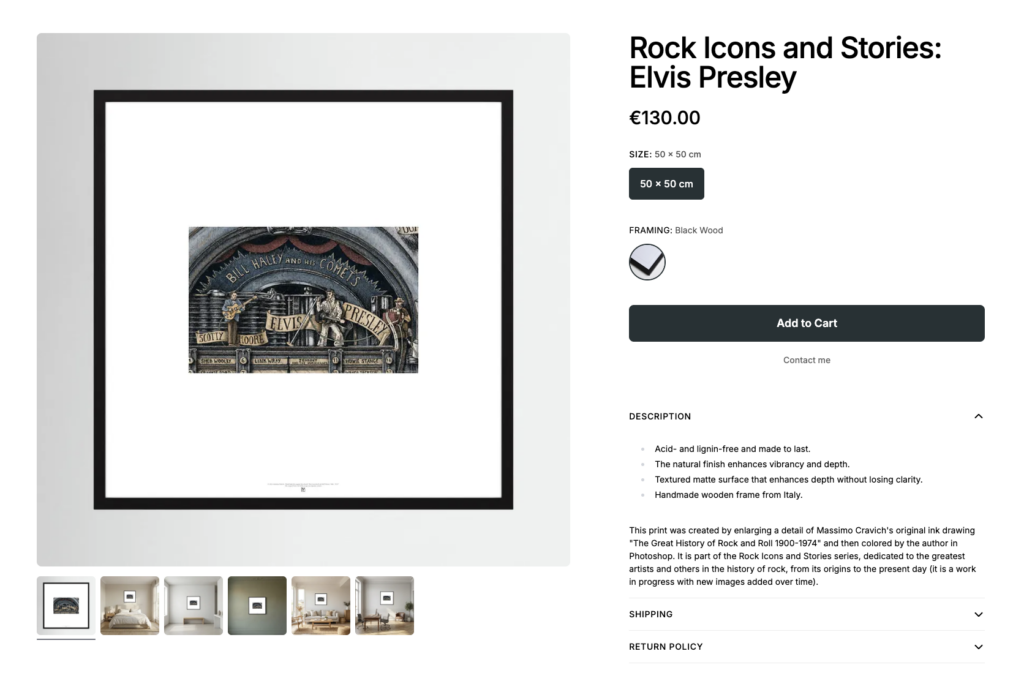
Selected artworks from Rock Icons and Stories are available as high-quality framed art prints. Printed on premium 230 gsm matte paper with excellent detail and colour reproduction, each print is professionally framed and delivered ready to hang.A carefully selected, high-quality alternative to the museum-grade Fine Art Giclée editions, offering an accessible way to own and display a reproduction of the original artwork. Printing, framing and worldwide fulfilment are handled by our specialist printing partner.
SOURCES
• Elvis Presley – official website: elvis.com
• Graceland – official Elvis Presley history and archive: graceland.com
• Rock & Roll Hall of Fame – Elvis Presley inductee profile: rockhall.com/inductees/elvis-presley/
• Peter Guralnick, Last Train to Memphis: The Rise of Elvis Presley, Little, Brown, 1994.
• Peter Guralnick, Careless Love: The Unmaking of Elvis Presley, Little, Brown, 1999.
• Ernst Jorgensen, Elvis Presley: A Life in Music, St. Martin’s Press, 1998.
Within the broader history of rock music, Elvis Presley represents a decisive point of convergence between blues, rhythm & blues, country and gospel. He did not create those traditions, but his recordings and performances helped bring their collision into the center of global popular culture, establishing a new model of the rock singer, the youth idol and the modern music superstar.