
Arthur ‘Big Boy’ Crudup is a fundamental figure in the passage from Delta blues to rock and roll: a Mississippi singer and guitarist whose direct, rhythmic and economical 1940s blues became a decisive source for Elvis Presley and the first rockabilly generation. This illustrated profile explores Arthur Crudup’s roots, musical language and legacy within The Great Rock and Roll History, where songs such as That’s All Right provide an unusually clear example of African-American blues entering the DNA of rock and roll.
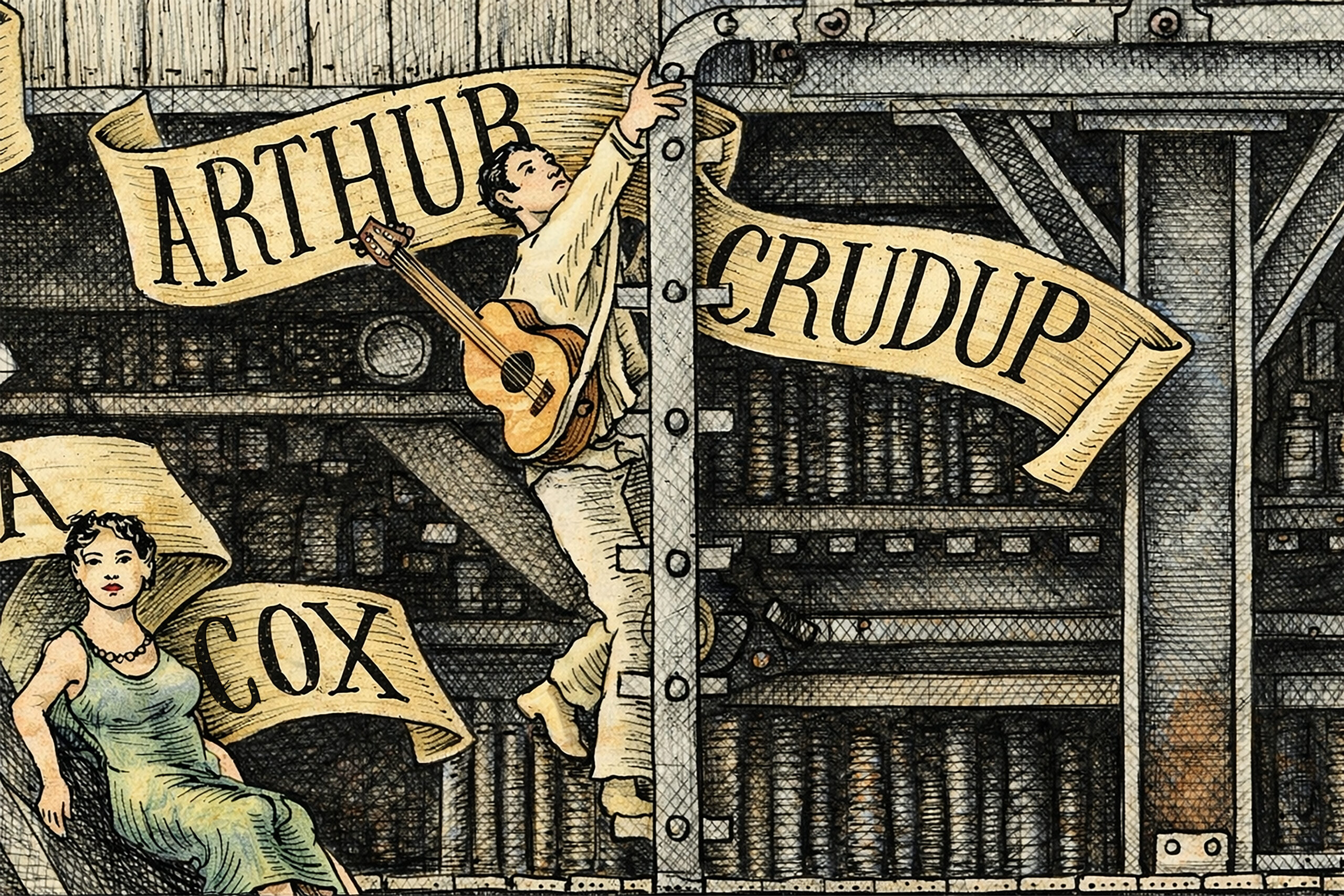
Rock Icons: Arthur Crudup
From Mississippi to Sun Records

His songs combined simple structures, strong rhythms and direct lyrical expression, creating a model that would later define early rock and roll driving and strikingly modern blues that Elvis transformed, but did not invent.
With songs including That’s All Right, My Baby Left Me and So Glad You’re Mine, Arthur Crudup built a 1940s bridge between country blues, urban blues and the future grammar of rock and roll, leaving a particularly visible imprint on Elvis Presley’s early recordings.
Full name Arthur William Crudup
Born August 24, 1905 – Forest, Mississippi, USA
Died March 28, 1974 – Nassawadox, Virginia, USA
Main instruments Vocals, guitar
Main genres Delta blues, country blues, electric / urban blues
Key recording period 1940s – early 1950s
Main labels Bluebird / RCA Victor; later recordings for other labels
LISTEN
More to discover…
The bluesman who handed Elvis one of rock and roll’s essential sparks
One of the key figures in the transition from blues to early rock and roll
Arthur Crudup belonged to the generation that carried Southern rural blues into an increasingly urban America. Born in Mississippi and entering professional music comparatively late, he retained a writing style that was elemental in the best sense: voice, guitar, a few chords, repeated phrases and a pulse that often mattered more than harmonic complexity. In his 1940s Chicago recordings, the Delta does not disappear; it becomes more compact and suited to records and a new urban audience. His music already contains the combination of riff, rhythm and immediacy that would become essential to rock and roll only a few years later.
The decisive genealogical point is That’s All Right, recorded by Crudup in 1946. When Elvis Presley recorded it at Sun in 1954 with Scotty Moore and Bill Black, the song changed character: the tempo became more nervous, guitar and bass interaction pushed it toward rockabilly, and Elvis’ voice carried the structure to a new audience. Yet the fundamental cell was already present in Crudup’s composition. Elvis also returned to his catalog for My Baby Left Meand So Glad You’re Mine. It is an almost perfect example of how rock and roll emerged: not through a sudden invention by one artist, but through transformations, crossings and transfers between African-American and country traditions.
Crudup’s story also illuminates the economic imbalance within that process. His songs reached enormous audiences through later performers, while for many years he received financial rewards far below the value generated by his repertoire and fought over unpaid royalties. Musically, however, his legacy is unmistakable. His rhythmic blues leads directly toward Elvis and rockabilly, and later toward blues rock as musicians searched backward for African-American sources.
Rock Icons: Arthur Crudup
Crudup is therefore an essential genealogical junction: not a single ‘father of rock and roll’, an overly simple label, but one of the writers whose recordings allow us to hear some of rock’s future foundations already taking shape.
The original recordings of That’s All Right, My Baby Left Me and So Glad You’re Mine make Arthur Crudup one of the clearest links between 1940s African-American blues, Elvis Presley, rockabilly and the birth of rock and roll.
Within The Great Rock and Roll History, Arthur Crudup occupies a central genealogical position: Delta and country blues enter the urban recording world of the 1940s; his songs reach Sun Records through Elvis Presley and are recombined with country elements, contributing to rockabilly and early rock and roll.
Influenced by
- Blind Lemon Jefferson
- Tampa Red
- Big Bill Broonzy
- Lonnie Johnson
- Mississippi Delta blues tradition
Influent For
- Elvis Presley
- Creedence Clearwater Revival
- Rod Stewart
- Buddy Holly
- Eric Clapton
- The Animals

Related Artists
- Elvis Presley
- Big Bill Broonzy
- Tampa Red
- Scotty Moore
- Big Joe Turner
SOURCES
• Encyclopaedia Britannica – Arthur Crudup, biographical and historical profile.
• Rock & Roll Hall of Fame – historical materials on Elvis Presley and rock and roll’s blues roots.• Elvis Presley / Graceland – discographical material on the early Sun recordings.
• Peter Guralnick, Last Train to Memphis: The Rise of Elvis Presley, Little, Brown, 1994.
• Historical Bluebird / RCA discographical sources covering Arthur Crudup’s recordings.
In rock history, Arthur Crudup matters not only because Elvis Presley recorded his songs, but because Crudup’s own language already contained elements that would become fundamental: economical riffs, insistent pulse, harmonic simplicity and vocal immediacy. The path from Crudup to Sun Records makes visible one of the crucial routes through which African-American blues contributed to the birth of rock and roll.