
Chuck Berry is one of the fundamental architects of rock and roll: the musician who, more than almost anyone else, helped define the language of rock guitar, the narrative form of its songs and its youthful world of cars, dancing, school and the desire for freedom. This profile explores Chuck Berry’s roots and legacy within The Great Rock and Roll History, tracing the path from African-American blues and rhythm & blues through country to the birth of a musical grammar that the Beatles, Rolling Stones, Beach Boys and later generations would turn into rock’s universal vocabulary.
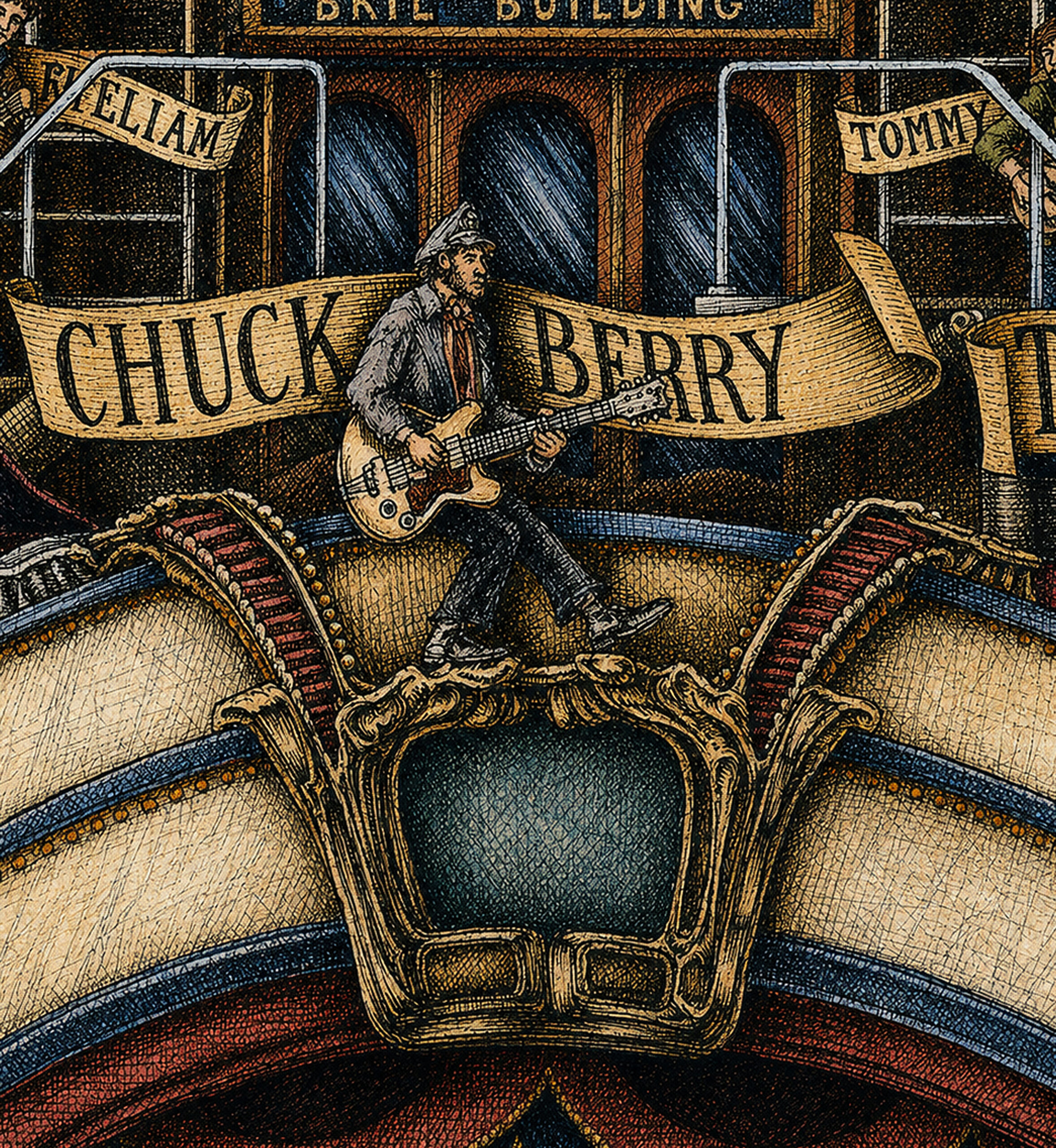
Rock Icons: Chuck Berry
Blues, country, guitar riffs and teenage life: the man who gave rock and roll a grammar built to last.
From his encounter with Muddy Waters and arrival at Chess Records to Maybellene, Roll Over Beethoven, School Day and Johnny B. Goode, Chuck Berry fused blues, rhythm & blues and country inflections into a model of songwriting and guitar playing that became one of rock’s fundamental templates.

Name: Charles Edward Anderson Berry
Birth: October 18, 1926 – St. Louis, Missouri, USA
Died: March 18, 2017 – Wentzville, Missouri, USA
Main instruments: Vocals, electric guitar
Genres: Rock and roll, rhythm & blues, blues
ARTIST OFFICIAL SITE: www.chuckberry.com
LISTEN
More to discover…
The grammar of rock: when the blues meets the teenage world
Chuck Berry emerged from African-American blues and rhythm & blues, but his decisive insight was cross-pollination. In St. Louis he absorbed blues, swing, gospel and country; when he reached Chess Records in Chicago in 1955, he brought a version of Ida Red, a country standard associated with Bob Wills. Leonard Chess recognized the potential of the mixture, and the song became Maybellene. Electric blues met country rhythm, speed and a story aimed at young listeners. Berry did not single-handedly invent rock and roll, which grew from many traditions and performers, but he made one of its essential formulas extraordinarily clear and repeatable.
The man who wrote the vocabulary of rock
The second revolution was the guitar. Berry reshaped figures from blues, boogie and players such as T-Bone Walker, turning double-stops, sharp introductions and compact riffs into instantly recognizable signals. The opening of Johnny B. Goode became almost an alphabet for future rock guitar.
Equally important was his writing: Berry described cars, jukeboxes, school, dates, music and generational conflict with cinematic precision and humor. In an America still deeply segregated, he created songs capable of crossing the R&B; market into the white teenage audience without erasing their African-American musical roots.
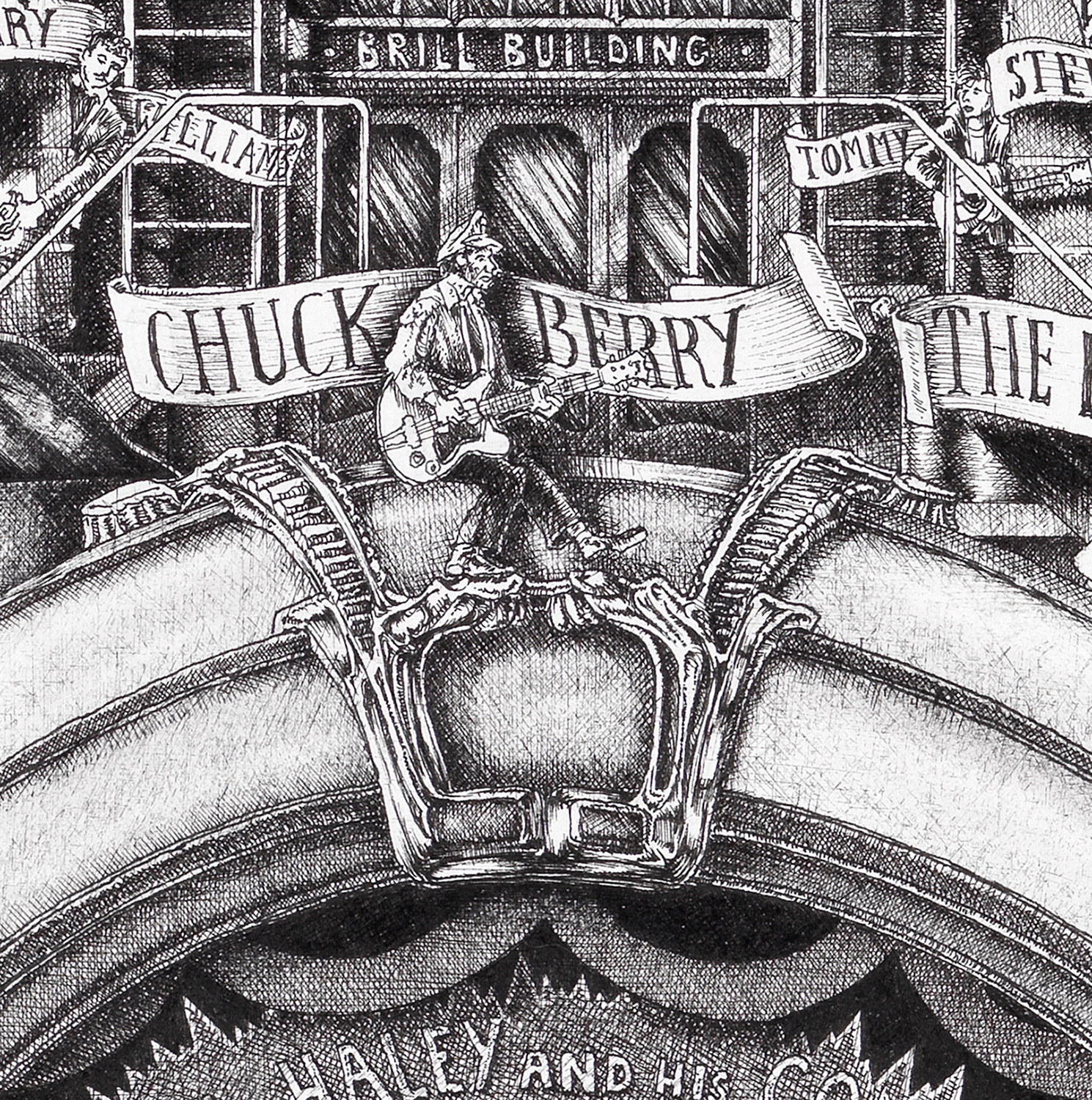
The genealogy that followed is immense. The Beatles and Rolling Stones literally learned rock repertoire through his songs; the Beach Boys translated the structure of Sweet Little Sixteen into the Californian world of Surfin’ U.S.A.; Keith Richards made Berry’s riff language one of the foundations of his own guitar style; garage rock, pub rock and punk inherited his economy, speed and immediacy.
The line is almost a backbone of rock history: blues + boogie + R&B; + country -> Chuck Berry -> rock and roll -> British beat and surf -> garage and hard rock -> punk and later rock. Few musicians supplied so many basic words in rock’s vocabulary. With songs such as Maybellene, Roll Over Beethoven, Johnny B. Goode and Sweet Little Sixteen, Chuck Berry defined riffs, narrative structure and teenage imagery that became central elements of rock and roll and later rock.
Within The Great Rock and Roll History, Chuck Berry forms one of the major genealogical junctions: blues, boogie, rhythm & blues and country -> Chuck Berry -> rock and roll -> Beatles, Rolling Stones, surf and British beat -> garage, hard rock, pub rock and punk.
Influenced by
- T-Bone Walker
- Muddy Waters
- Country music
- Jump blues
- Gospel
Influent For
- The Beatles
- The Rolling Stones
- The Beach Boys
- The Kinks
- AC/DC
Related Artists
Get Your Rock Icon
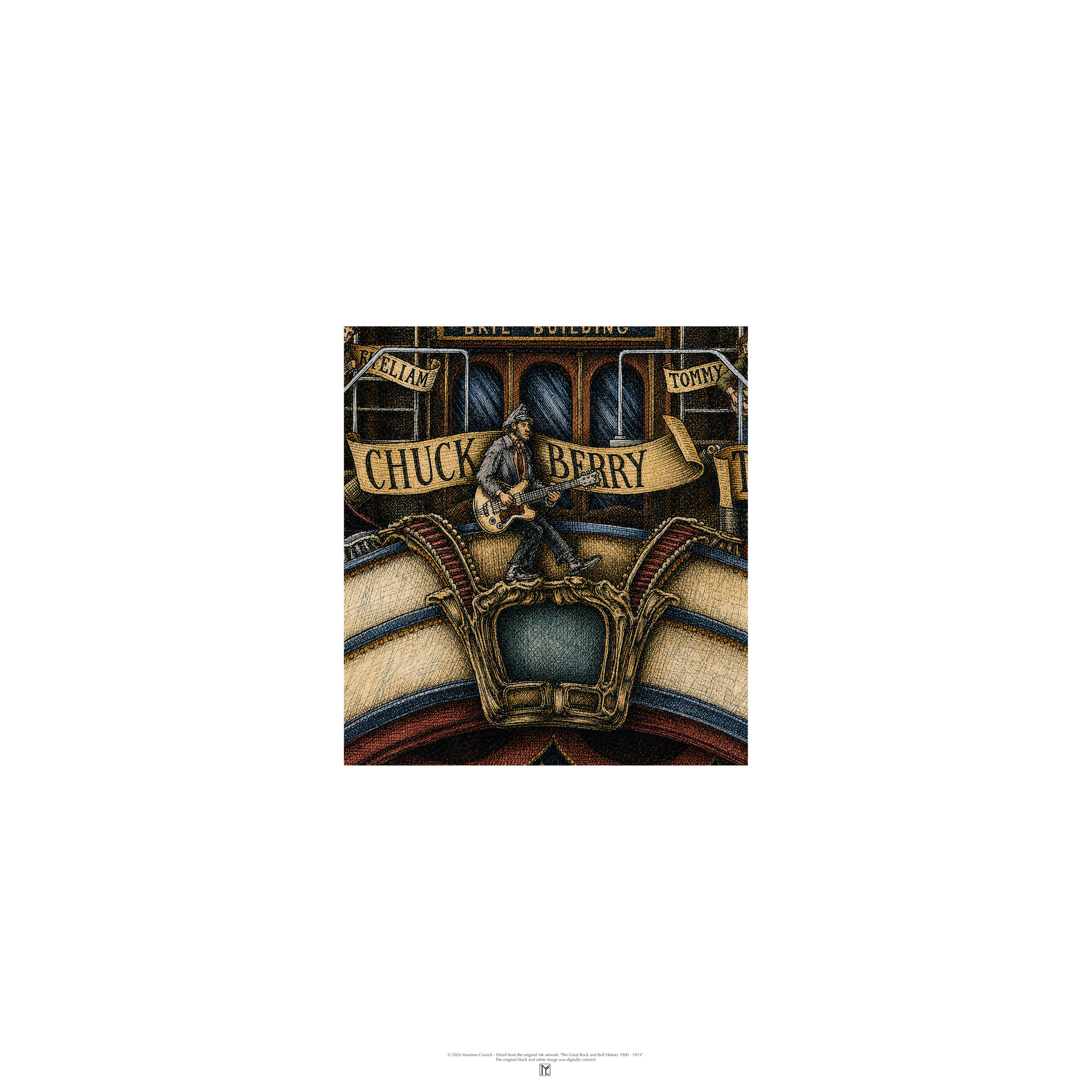
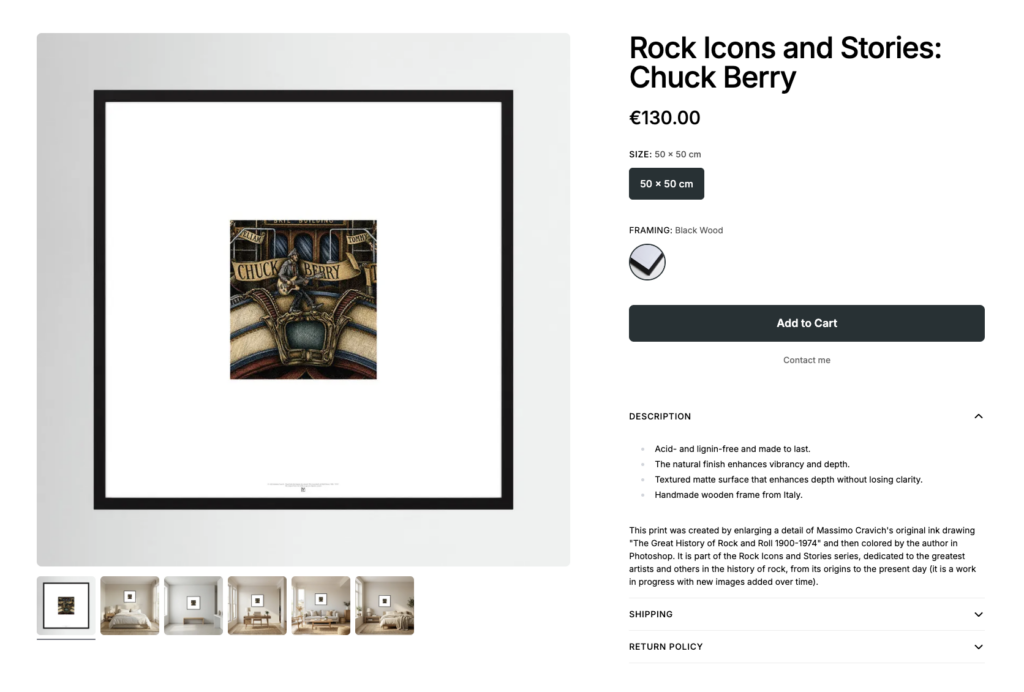
Selected artworks from Rock Icons and Stories are available as high-quality framed art prints. Printed on premium 230 gsm matte paper with excellent detail and colour reproduction, each print is professionally framed and delivered ready to hang.A carefully selected, high-quality alternative to the museum-grade Fine Art Giclée editions, offering an accessible way to own and display a reproduction of the original artwork. Printing, framing and worldwide fulfilment are handled by our specialist printing partner.
SOURCES
Official website • Rock & Roll Hall of Fame • AllMusic • Chuck Berry autobiography
Within the broader narrative of rock and roll history, Chuck Berry represents one of the most revolutionary fusions of blues guitar, teenage storytelling and modern musical mythology. His influence extends across rock guitar culture, songwriting, punk, hard rock, British Invasion music and the entire evolution of modern popular music.
In the genealogy of rock, Chuck Berry represents one of the points where earlier traditions became a new grammar. Blues, boogie, rhythm & blues and country converged in short, fast, narrative songs led by a guitar language that supplied models for generations of musicians. His legacy runs through the Beatles, Rolling Stones, Beach Boys, garage, hard rock and punk. If rock and roll grew from many roots rather than a single inventor, Berry was unquestionably one of the musicians who gave it its most recognizable and durable vocabulary.