
Elton John is one of the great architects of British pop-rock: a pianist shaped by classical discipline, rhythm and blues and rock and roll who, with Bernie Taupin, created a catalogue where immediate melodies coexist with ambition, eccentricity and vulnerability. Within Great Rock and Roll History, his trajectory captures the 1970s like few others: enormous success, spectacle, excess and a stubborn search for identity.
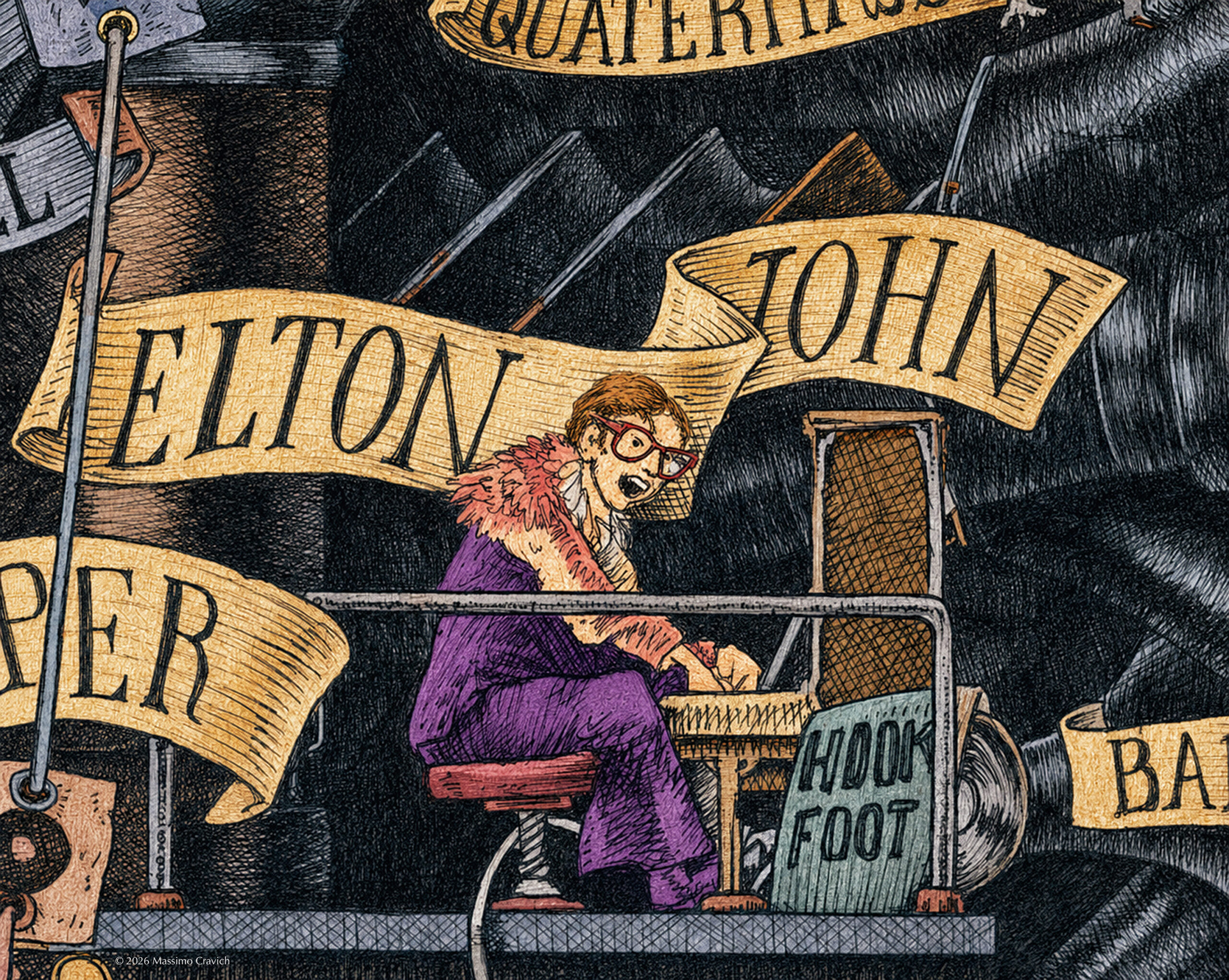
Rock Icons: Elton john
From a shy boy at the piano to a superstar: songs, excess and the need to be loved.

From Your Song to Goodbye Yellow Brick Road, Elton John turned piano, gospel, soul and rock into a personal pop language, sustained by his extraordinary partnership with lyricist Bernie Taupin.
Birth name Reginald Kenneth Dwight
Born March 25, 1947, Pinner, Middlesex, England
Roles Singer, pianist, composer, performer
Creative partner Bernie Taupin
Genres Pop rock, rock, glam rock, soft rock
Classic band Davey Johnstone, Dee Murray, Nigel Olsson; later Ray Cooper
ARTIST OFFICIAL SITE: www.eltonjohn.com
LISTEN
More to discover…
Reginald Dwight: the talent before the character
Before the giant glasses and costumes there was an introverted child with exceptional ability at the piano. Reginald Dwight grew up in an emotionally difficult family environment and studied at the Royal Academy of Music, while rock and roll, gospel, soul and rhythm and blues offered a route beyond classical discipline.
He played with Bluesology and backed visiting American performers, learning the trade from the ground up. In 1967 he answered a Liberty Records advertisement and was given lyrics by Bernie Taupin. One of popular music’s longest creative partnerships began there. Taupin wrote words away from the piano; Elton turned them into songs. The physical separation between them, rather than weakening the process, became part of its secret.
America 1970: a superstar born in days
The Troubadour concert in Los Angeles in August 1970 was the moment a British prospect became an American sensation. Elton did not simply sit at the piano: he leapt, attacked the keys and brought the physicality of rock and roll into singer-songwriter music. Your Song revealed the other pole of his musical personality, intimate and melodic.
Albums followed at extraordinary speed, supported by a band crucial to his sound, including Dee Murray, Nigel Olsson and later Davey Johnstone. Country, gospel, soul, hard rock and orchestration coexisted without contradiction. Yet behind the ascent was a man far less secure than his public character. Increasing theatricality became both celebration and armor: the more Elton John occupied the stage, the more Reginald Dwight could disappear.
Yellow Brick Road: glory, loneliness and excess
Across Honky Château, Don’t Shoot Me I’m Only the Piano Player and Goodbye Yellow Brick Road, Elton reached almost unimaginable popularity. His costumes grew increasingly spectacular, turning the pianist into a glam icon without ever confining him to one movement. Success also accelerated addiction, insecurity and turbulent personal relationships.
In 1975, Someone Saved My Life Tonight revisited an earlier moment when a near-marriage might have suffocated his identity. Around the same period he spoke publicly about his bisexuality in an industry still deeply hostile to homosexuality. His story exposes celebrity’s central contradiction: being recognized everywhere does not necessarily mean being able to recognize yourself.
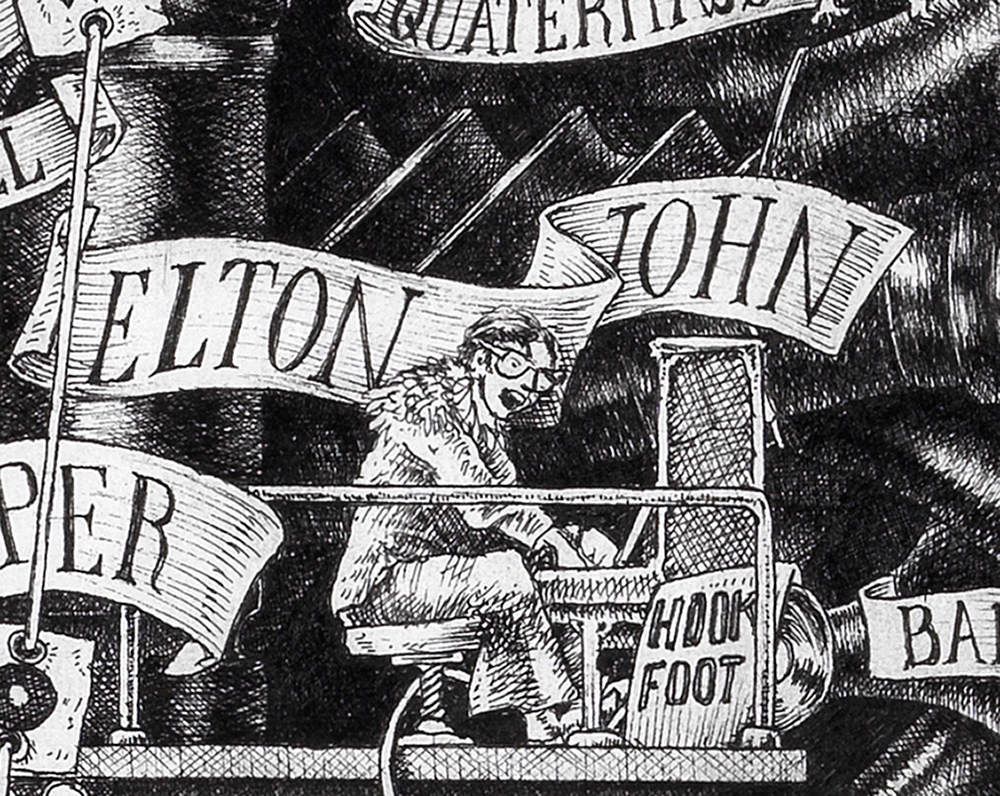
Surviving the character he created
Elton’s career did not move in a straight line. Fashions, collaborators and his relationship with Taupin changed; creative crises, addiction and instability followed. The decisive turning point was personal before it was artistic: by the end of the 1980s he confronted his addictions seriously and entered recovery in 1990.
He gradually rebuilt his relationship with himself and turned fame into activism, particularly in the fight against HIV/AIDS. His later life with David Furnish and fatherhood belong to a stability the young Reginald could scarcely have imagined.
Musically, his legacy lies in making the piano central to rock again while joining extravagant spectacle to melodic vulnerability. The mask never vanished; at last, however, it was no longer a prison.
Elton John returned the piano to the center of 1970s rock, joining the tradition of great American songwriters to glam theatricality and an instantly recognizable melodic sensibility.
Within Great Rock and Roll History, Elton John stands at the crossroads of piano rock and roll, gospel, soul, singer-songwriter craft and glam: a British synthesis that conquered America and anticipated later generations of stadium pop.
Influenced by
- Ray Charles
- Little Richard
- Jerry Lee Lewis
- Leon Russell
- The Beatles
Influent For
- Billy Joel
- Freddie Mercury
- George Michael
- Kate Bush
- Lady Gaga

Related Artists
- Bernie Taupin
- Leon Russell
- David Bowie
- Rod Stewart
- Billy Joel
Get Your Rock Icon
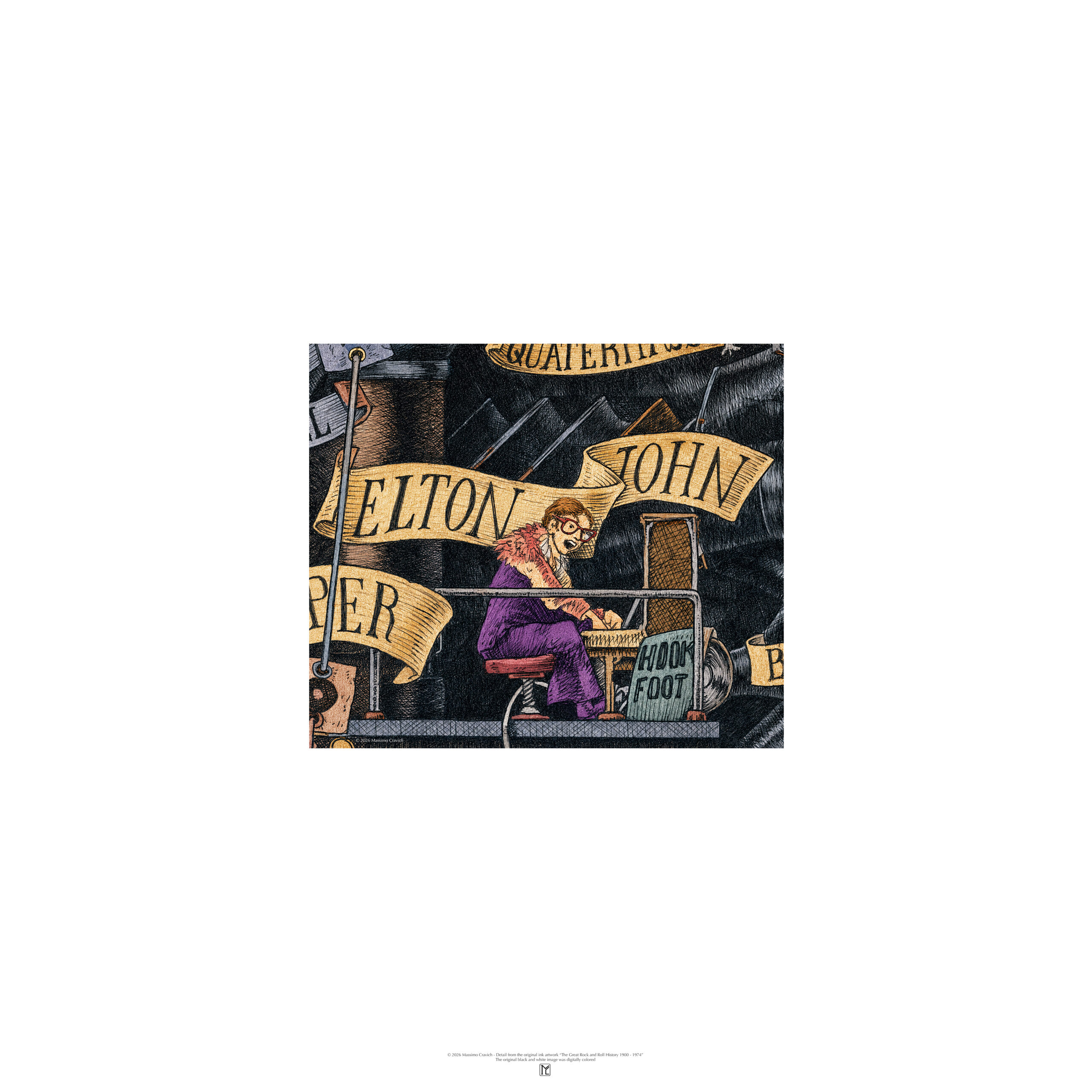
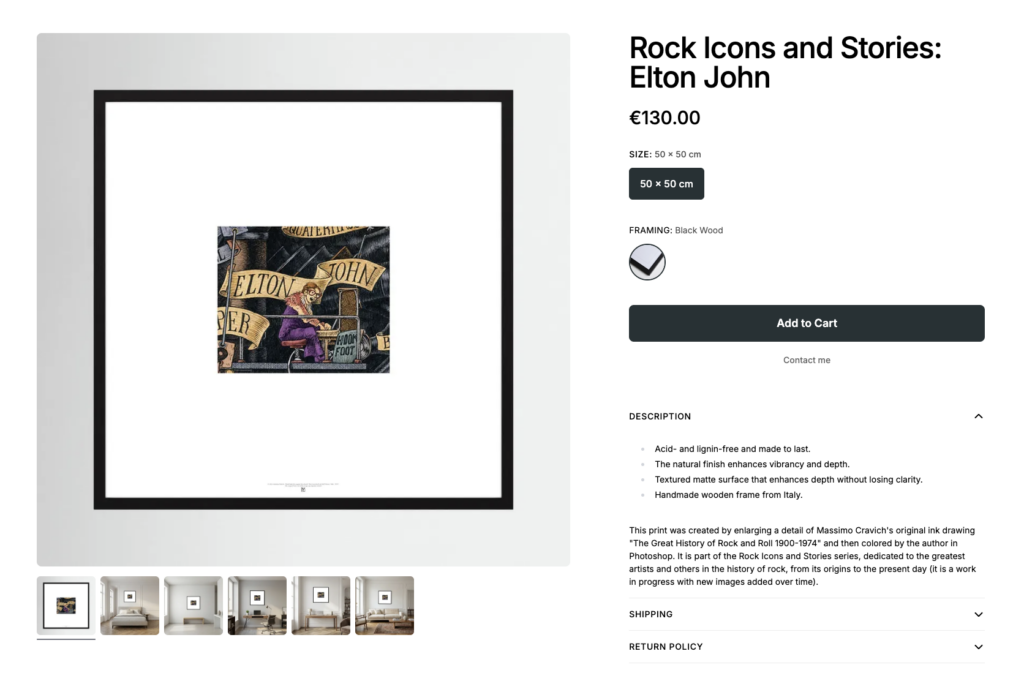
Selected artworks from Rock Icons and Stories are available as high-quality framed art prints. Printed on premium 230 gsm matte paper with excellent detail and colour reproduction, each print is professionally framed and delivered ready to hang.A carefully selected, high-quality alternative to the museum-grade Fine Art Giclée editions, offering an accessible way to own and display a reproduction of the original artwork. Printing, framing and worldwide fulfilment are handled by our specialist printing partner.
Sources
Rock & Roll Hall of Fame – Elton John
Songwriters Hall of Fame – Elton John & Bernie Taupin
Elton John official biography / archive
Elton John constructed one of pop history’s most flamboyant images, yet his songs often work for the opposite reason: beneath the spectacle remain loneliness, desire, friendship and the need to belong. His partnership with Bernie Taupin, the piano recast as a rock instrument and his ability to survive his own excesses make his story more than a sequence of hits: it is the story of a man who invented a superstar in order, slowly, to become himself.