
Crosby, Stills, Nash & Young brought together four already distinct musical paths and turned the meeting of folk rock, vocal harmony, country, electric rock and individual songwriting into an unusually fluid form. Rather than a conventional band, they were an unstable balance of separate identities, and that instability reflected many of the musical tensions of the late 1960s.
This profile follows Crosby, Stills, Nash & Young within The Great Rock and Roll History, connecting the The Byrds, Buffalo Springfield and the Hollies to a language spanning folk rock, country rock and singer-songwriters, moving between acoustic intimacy and sudden electric expansion.
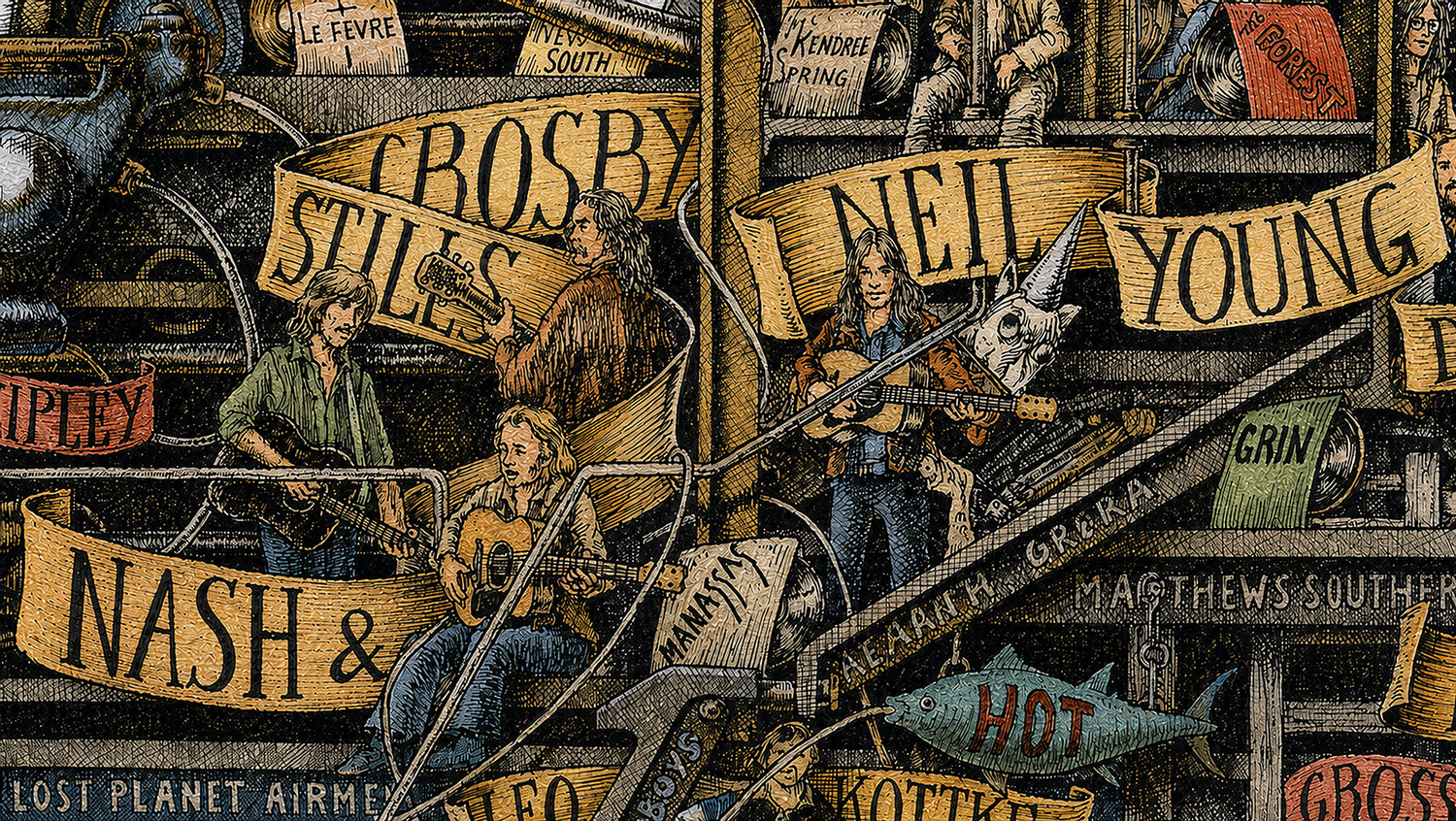
Rock Icons: Crosby, Stills, Nash and Young (CSN&Y)
Four writers, shared harmonies and identities never fully merged: folk rock becomes a crossroads.

From the 1968 meeting of David Crosby, Stephen Stills and Graham Nash to Neil Young’s arrival and Déjà Vu, CSN&Y; connected the experiences of The Byrds, Buffalo Springfield and the Hollies with folk, country and electric rock, helping shape the transition toward the 1970s singer-songwriter culture.
Founded: Los Angeles, California – 1969
Status: Disbanded
Classic Core:David Crosby, Stephen Stills, Graham Nash, Neil Young
Genres: Folk rock, country rock, singer-songwriter, soft rock
ARTIST OFFICIAL SITE: www.csny.com
LISTEN
• Ohio
• Helpless
• Carry On
More to discover…
A band without a single center: from folk rock to the autonomy of the songwriter
Before the group even existed, Crosby, Stills, Nash & Young already formed a genealogy. Crosby brought The Byrds and therefore the meeting of Dylan, electric folk, psychedelia and harmony; Stills and Young came from Buffalo Springfield, where folk, country and electric guitars had already begun to coexist; Nash came from the Hollies and a British pop tradition built on vocal precision. When Crosby, Stills and Nash combined their voices, the new element was not simply three-part harmony but the way previously separate languages could coexist without surrendering their individual identities.
Neil Young’s arrival intensified that instability. Déjà Vu does not sound like the product of one uniform collective personality: it moves among different writers, timbres and perspectives, from acoustic music to electric rock, country and personal confession. The group’s structure remained porous as well: solo records, cross-collaborations and temporary reunions were part of the same system. In that sense CSN&Y; anticipated a characteristic 1970s model in which a band could become a meeting place for already recognizable songwriters rather than absorbing them into a single identity.
The genealogical consequence concerns above all the movement from folk rock toward the centrality of the songwriter. Vocal harmonies connect folk and pop-group traditions to the new author-centered song; acoustic guitars and country elements prepare part of the ground for country rock and the West Coast sound; the electric force of Stills and Young prevents the project from collapsing into a purely soft formula.
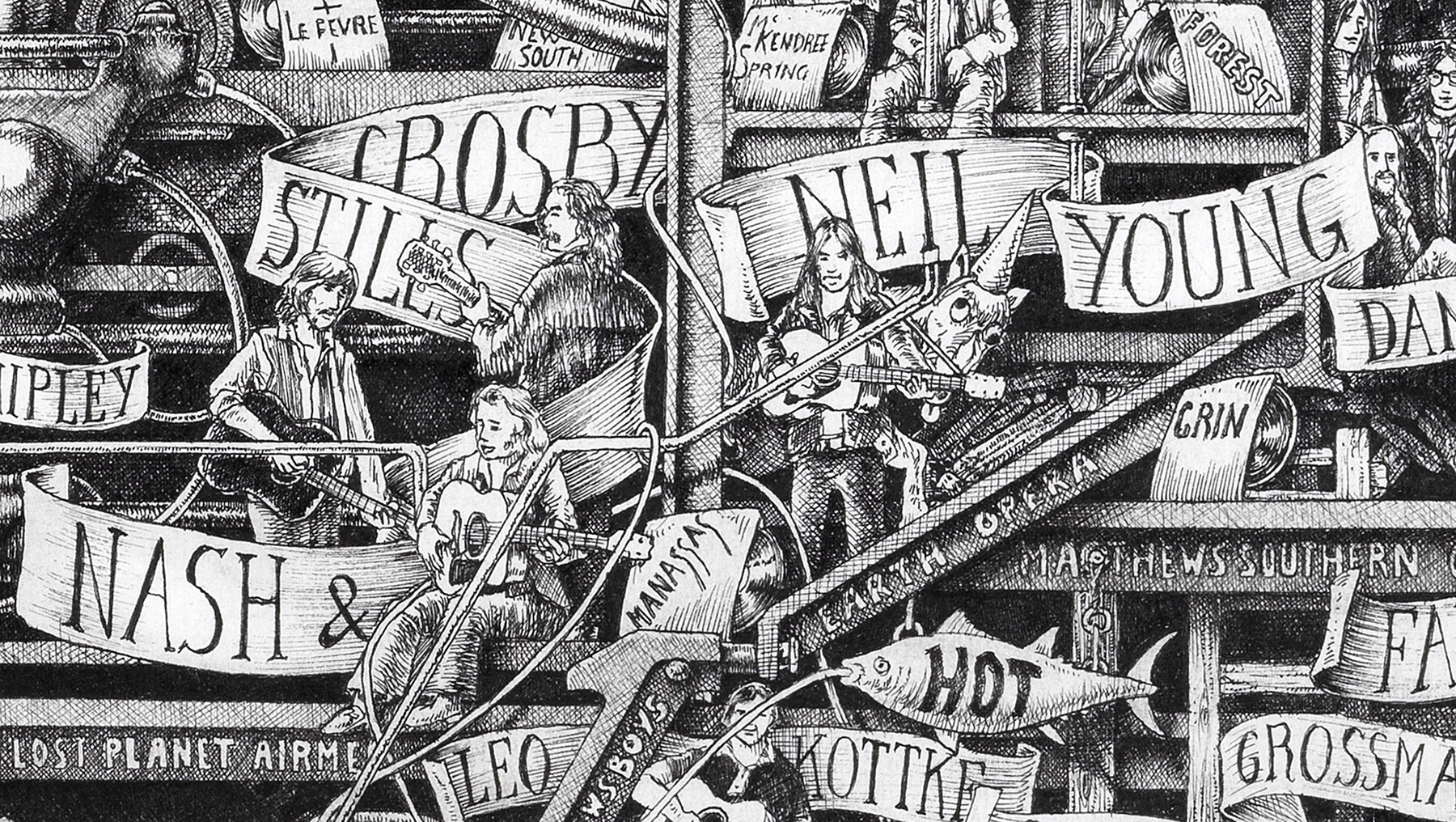
The line can be read as folk revival + Byrds/Hollies/Buffalo Springfield -> Crosby, Stills, Nash & Young -> mature folk rock and country rock -> singer-songwriters and 1970s West Coast rock.
Crosby, Stills & Nash and Déjà Vu show how vocal harmony, folk rock, country and individual songwriting could coexist with electric rock, contributing to the transition toward singer-songwriters, country rock and the West Coast sound. Songs such as Ohio, Suite: Judy Blue Eyes and Teach Your Children became defining landmarks of American folk rock and countercultural music history.
Within The Great Rock and Roll History, CSN&Y; connect folk revival and vocal harmony -> Byrds, Hollies and
Buffalo Springfield -> folk rock and country rock -> the rise of the singer-songwriter -> 1970s West Coast rock.
Influenced by
- Bob Dylan
- The Beatles
- American folk
- The Byrds
- Buffalo Springfield and the British folk revival
Influent For
Related Artists
- The Byrds
- Buffalo Springfield
- Joni Mitchell
- Neil Young
- Eagles
SOURCES
Rock and Roll Hall of Fame
CSNY official archives
AllMusic
American folk-rock historical archives
In rock genealogy, Crosby, Stills, Nash & Young function above all as a point of convergence. The four musicians’ previous experiences are not erased but remain audible inside a repertoire that continually moves among folk,country, vocal pop and electric rock. That unstable structure becomes part of the group’s musical meaning: it captures the moment when folk rock stops being only a genre and becomes a space in which autonomous writers, collective harmonies and different musical languages can coexist. An important route toward the singer-songwriter and 1970s California rock passes through that space.