
Carl Perkins was one of rockabilly’s architects: his songs brought Tennessee country together with African American blues, giving rock and roll a cutting rhythm and unmistakable guitar sound. In The Great Rock and Roll History, his story also illuminates the uneasy relationship between musical invention, commercial fortune and performers who become more famous than the songwriter.
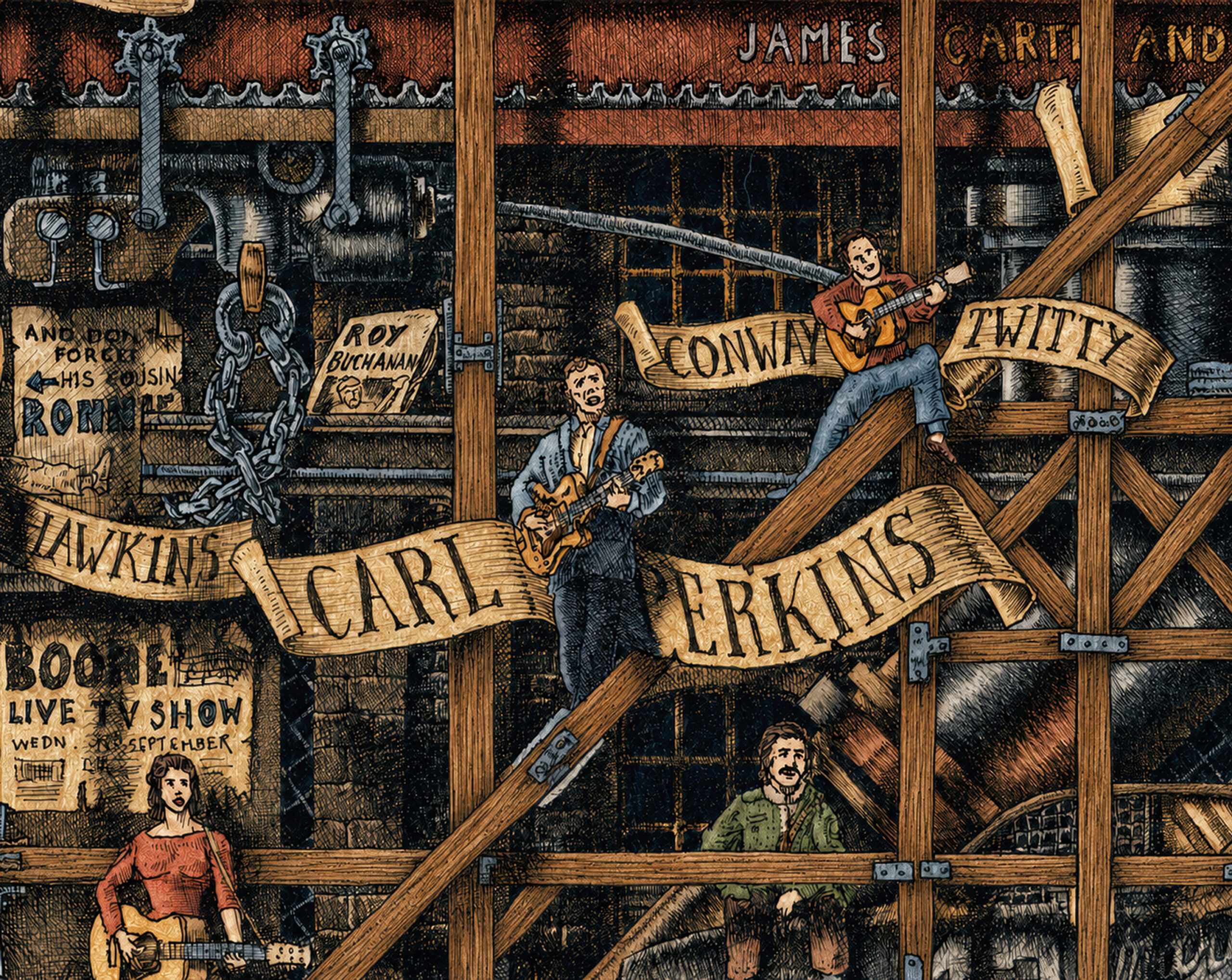
Rock Icons: Carl Perkins
Blue shoes, the road to Memphis and the man behind the myth.

The writer of Blue Suede Shoes and a key Sun Records artist, Carl Perkins turned the meeting of country and rhythm and blues into one of rock and roll’s foundational languages.
Name Carl Lee Perkins
Born April 9, 1932, Tiptonville, Tennessee
Died January 19, 1998, Jackson, Tennessee
Instruments Vocals, guitar
Genres: Rockabilly, rock and roll, country, gospel
Key Label Sun Records; later Columbia and others
LISTEN
Everybody’s Trying to Be My Baby
More to discover…
Cotton fields, radio and a homemade guitar
Carl Perkins grew up in a Tennessee sharecropping family, in a South where poverty crossed racial lines but segregation was rigidly enforced. He worked in cotton fields as a boy, listened to gospel and country radio, and absorbed blues from musicians around him.
An African American farmworker, John Westbrook, helped shape his guitar playing: an important reminder that rock emerged from cultural exchanges society tried to keep apart.
With his brothers Jay and Clayton, Perkins played bars and clubs, developing a repertoire that combined honky-tonk drive with blues phrasing. His style grew from practical demands: make people dance, cut through the noise of a room and give the guitar a voice people could recognize.
Blue Suede Shoes: the record, the crash, the paradox
In 1954 Perkins arrived at Sam Phillips’s Sun Records in Memphis, where Elvis Presley’s breakthrough was opening new possibilities. Released in 1956, Blue Suede Shoes became a major hit across pop, country and rhythm-and-blues charts. But as Perkins travelled to New York for a crucial television appearance, a serious car accident injured him; his brother Jay suffered lasting consequences.
Meanwhile Elvis recorded the song and made it one of his signature numbers. It would be wrong to suggest Presley’s recording erased the original’s success: Perkins’s version was already a landmark. Yet the accident and the stars’ unequal media reach produced one of rock’s great ironies: a song can immortalize its author without giving him an equal place in popular memory.
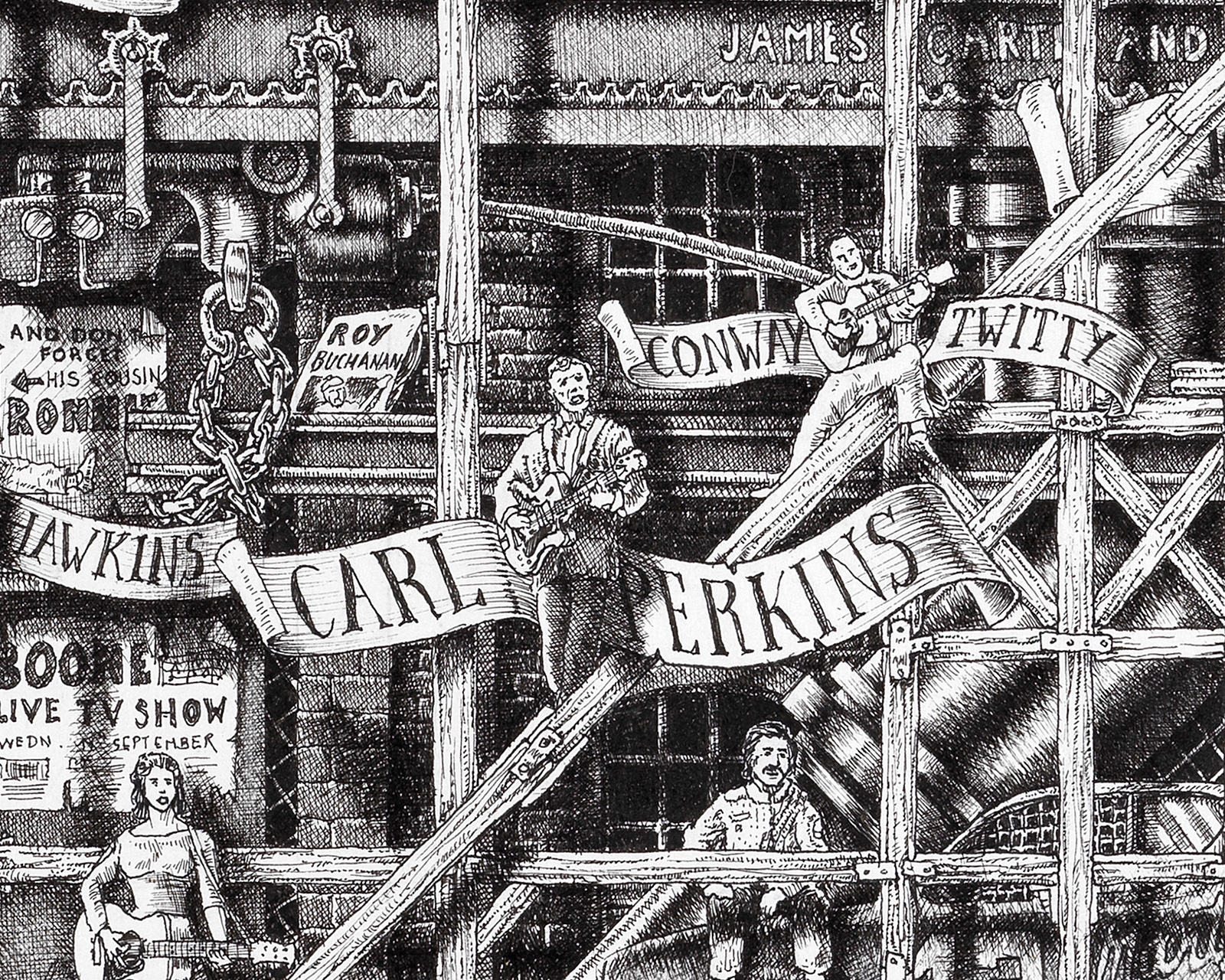
Family, alcohol and the solidarity of musicians
Success did not end personal insecurity. Perkins lived with the aftermath of the crash, changes in the music business and struggles with alcohol while trying to safeguard his family and musical identity. In December 1956 he happened to be at Sun Studios alongside Elvis Presley, Jerry Lee Lewis and Johnny Cash: the famous Million Dollar Quartet session captures a small scene that was competitive but still shaped by friendship and mutual curiosity.
Later, Cash became a crucial ally: Perkins joined his touring show and wrote Daddy Sang Bass for him. Behind the rockabilly-pioneer image stands a working musician who kept adapting and found support in lasting professional and personal relationships.
From the Beatles to reclaiming his own name
As rockabilly’s first commercial wave faded, Perkins’s songs kept travelling. The Beatles recorded Matchbox, Honey Don’t and Everybody’s Trying to Be My Baby; George Harrison in particular openly acknowledged his debt to Perkins’s guitar style. In the 1980s the televised concert Blue Suede Shoes: A Rockabilly Session, with guests including Harrison, Eric Clapton and Ringo Starr, made visible a musical lineage audiences had long heard without always knowing its source.
Perkins was more than a precursor rediscovered in retrospect: his fusion of blues, country and electric guitar remains part of rock’s everyday vocabulary. His career shows that artistic influence and celebrity do not necessarily travel together.
Carl Perkins’s rockabilly directly influenced British Invasion guitar playing and preserved the essential connection between country, blues and rock and roll.
In The Great Rock and Roll History, Perkins marks the crossroads between Memphis’s Sun Records, the rockabilly explosion and its later British reinterpretation: a path that helps identify the writers behind songs made famous by other performers.
Influenced by
Bill Monroe
John Westbrook
Ernest Tubb
Influent For
George Harrison
Brian Setzer
Dave Edmunds
John Fogerty

Related Artists
Johnny Cash
Sam Phillips
Wanda Jackson
Get Your Rock Icon
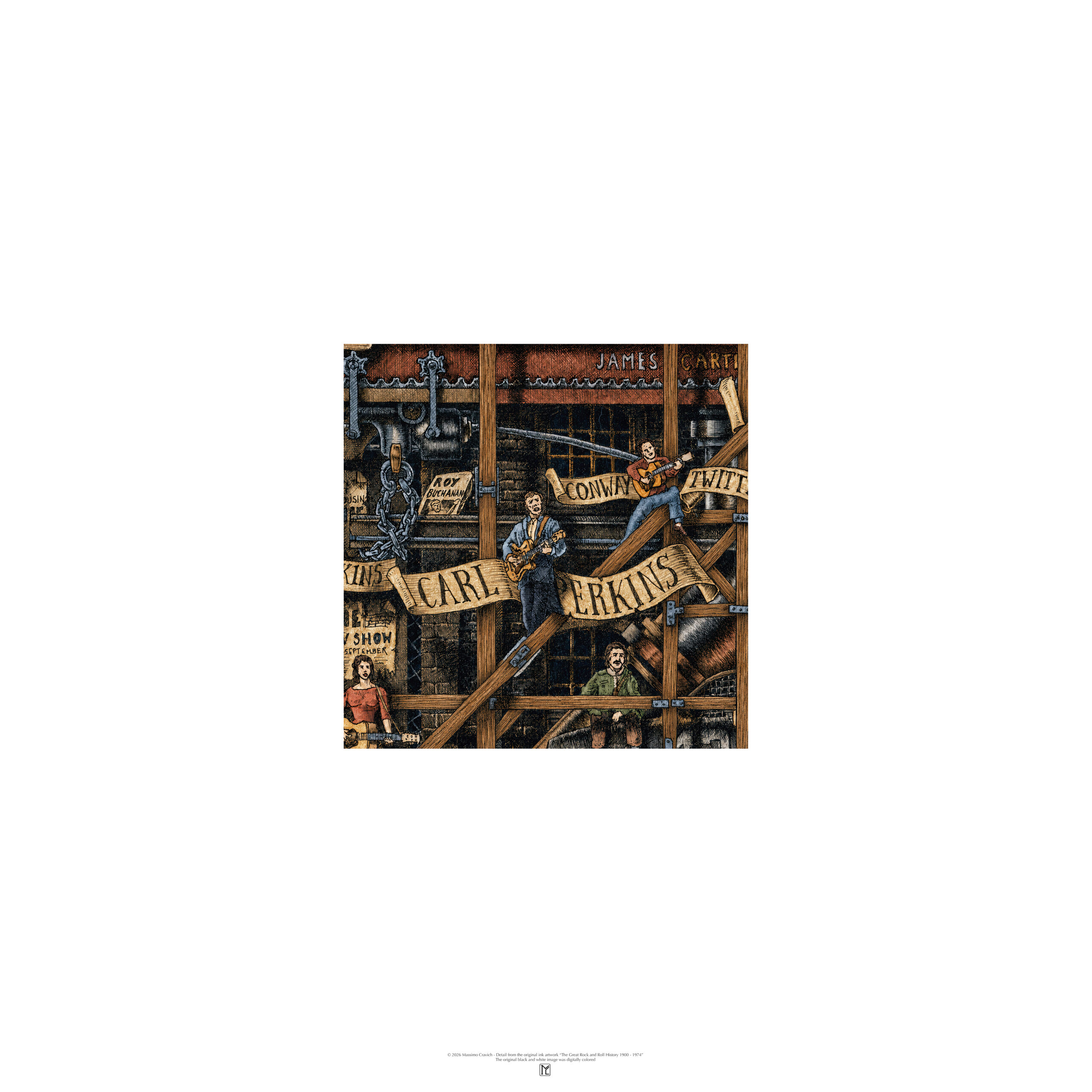
Selected artworks from Rock Icons and Stories are available as high-quality framed art prints. Printed on premium 230 gsm matte paper with excellent detail and colour reproduction, each print is professionally framed and delivered ready to hang.A carefully selected, high-quality alternative to the museum-grade Fine Art Giclée editions, offering an accessible way to own and display a reproduction of the original artwork. Printing, framing and worldwide fulfilment are handled by our specialist printing partner.

SOURCES
Rock & Roll Hall of Fame: https://rockhall.com/inductees/carl-perkins/
Country Music Hall of Fame: https://countrymusichalloffame.org/artist/carl-perkins/
Sun Records: https://sunrecords.com/
Carl Perkins was no footnote to Elvis’s story: he was a decisive songwriter and guitarist who shaped rockabilly with an instantly recognizable musical language. Blue Suede Shoes, the Sun recordings and his influence on the Beatles tell a story of innovation, setbacks and rediscovery that runs through rock’s entire family tree.