
Carlos Santana transformed the meeting of electric blues, psychedelic rock and Afro-Latin rhythms into a distinctive guitar language. Born in Mexico and established in 1960s San Francisco, he brought Latin percussion and rhythmic structures into international rock with his band. This profile places Carlos Santana within The Great Rock and Roll History, tracing his roots, the Woodstock breakthrough and the move toward jazz rock and fusion.
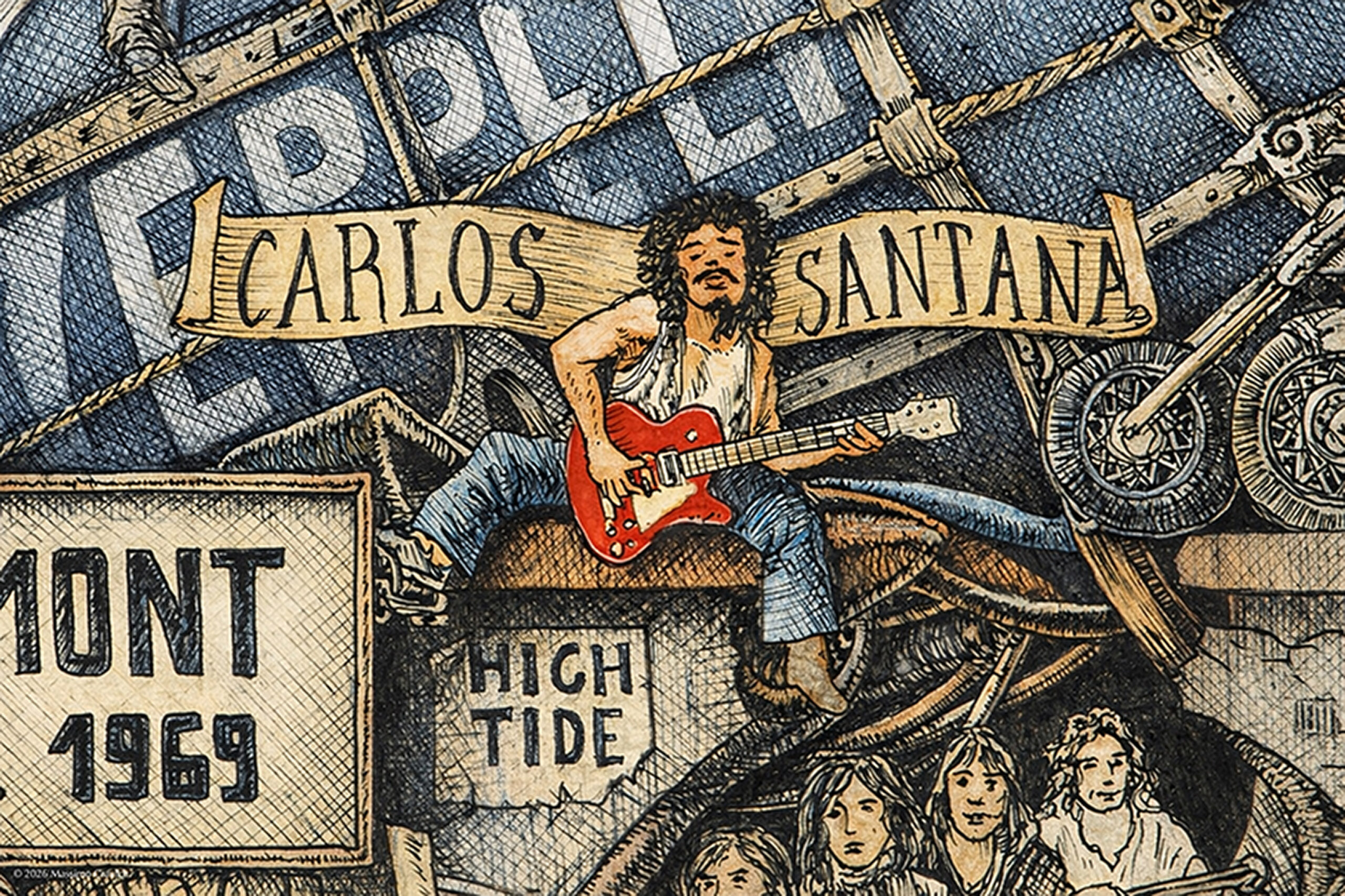
Rock Icons: Carlos Santana
Electric blues meets Afro-Latin percussion

Carlos Santana’s music is defined by a highly recognizable guitar tone and a fluid melodic approach. His playing emphasizes sustain, phrasing and expressive clarity rather than technical excess.
At the same time, his work integrates diverse musical traditions, blending Latin percussion, blues guitar and elements of jazz into a cohesive and evolving sound. This fusion created a new musical language that became a defining feature of Latin rock.
His breakthrough performance at Woodstock introduced a global audience to a new form of rock music rooted in Latin rhythms.From Santana and Abraxas to Santana III and Caravanserai, Carlos Santana combined blues, psychedelic rock, congas, timbales and jazz improvisation, expanding the language of Latin rock.
Name Carlos Humberto Santana Barragán
Born July 20, 1947, Autlán de Navarro, Jalisco, Mexico
Role Guitarist, composer, bandleader
Scenes Tijuana; San Francisco Bay Band Santana Blues Band, later Santana
Genres: Blues rock, Latin rock, psychedelic rock, jazz rock, fusion
Instrument Electric guitar
Key Period 1966-1974: formation, Woodstock, early albums and fusion turn
ARTIST OFFICIAL SITE: santana.com
LISTEN
Soul Sacrifice (Woodstock 1969)
Black Magic Woman / Gypsy Queen
More to discover…
From borderland blues to psychedelic San Francisco
Santana grew up between Mexico and Tijuana. His violinist father introduced him to music, while Carlos discovered the electric blues of B.B. King and T-Bone Walker. After moving to San Francisco, he entered a scene shaped by rock, jazz, counterculture and musicians from different backgrounds. His group began in 1966 as the Santana Blues Band, but it was never simply a blues outfit with Latin decoration. Gregg Rolie’s organ, José Areas’s and Michael Carabello’s percussion, Michael Shrieve’s drums and the bass created a rhythmic system in which the guitar could sustain notes, answer the percussion and move between tension and release.
Woodstock and the language of Latin rock
Santana’s 1969 Woodstock performance, before the debut album had reached a wide audience, made that combination visible. Soul Sacrifice foregrounded the interplay of drums, congas, timbales, organ and guitar. Across Santana, Abraxas and Santana III, blues, pop melodies, Afro-Cuban rhythms and extended instrumental passages coexist. Black Magic Woman, originally by Peter Green, leads into Gábor Szabó’s Gypsy Queen; Oye Como Va reworks Tito Puente. These choices reveal a method: transforming existing material through a new relationship between blues phrasing, sustained tone and polyrhythm while keeping its sources audible.
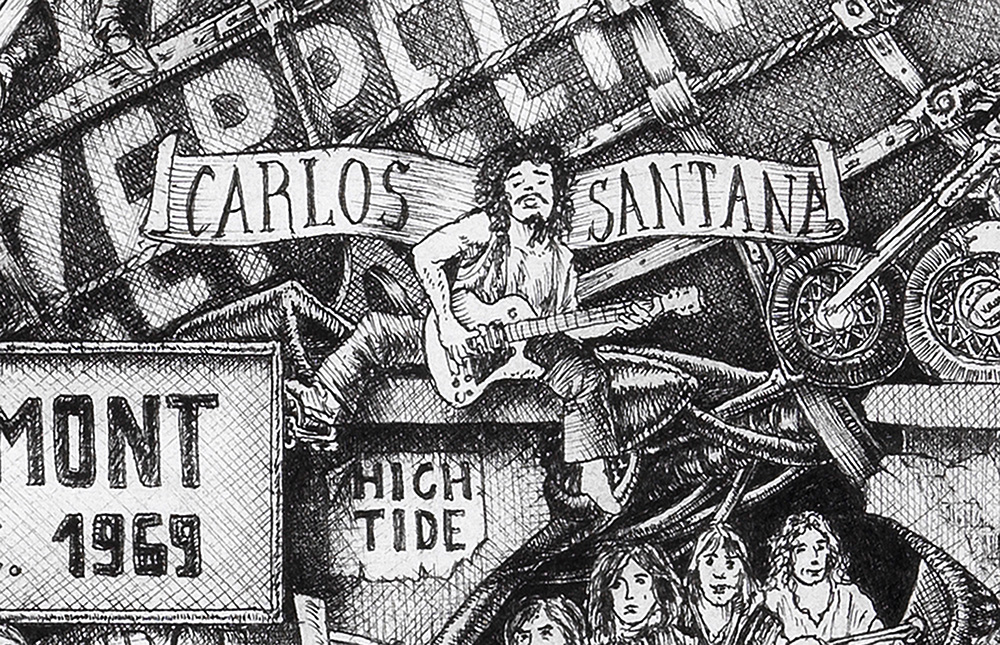
From the band to spiritual and jazz exploration
International success brought pressure and musical disagreements. As lineups changed, Santana listened increasingly to John Coltrane and Miles Davis and explored structures less tied to the conventional song. Caravanserai (1972) opened a more atmospheric, improvisational phase; his collaboration with John McLaughlin and later projects moved toward fusion and spiritual exploration, which also shaped his public imagery.
In rock genealogy, Santana connects blues and psychedelia to Afro-Latin traditions before opening toward jazz rock: his contribution is not merely a guitar tone, but a different way of organizing a band around rhythm.
Tracks including Soul Sacrifice, Oye Como Va and Samba Pa Ti reveal the meeting of blues phrasing, guitar sustain, Afro-Latin percussion and melodic development that characterizes Santana’s Latin rock.
Within The Great Rock and Roll History, Santana illustrates the multicultural character of late-1960s San Francisco: psychedelic rock met Latin repertoires and musicians as festivals and albums became crucial ways of reaching an international audience.
Influenced by
T-Bone Walker
Tito Puente
Gábor Szabó
John Coltrane
Influent For
Neal Schon
Carlos Alomar
Prince
Juanes
Maná
Related Artists
Peter Green
Tito Puente
John McLaughlin
Miles Davis
SOURCES
Rock & Roll Hall of Fame – Santana: https://rockhall.com/inductees/santana/
Santana – official site: https://santana.com/
Woodstock – official archive: https://www.woodstock.com/
Encyclopaedia Britannica – Carlos Santana: https://www.britannica.com/biography/Carlos-Santana
In rock genealogy, Carlos Santana occupies a meeting point between electric blues, California psychedelia and Afro-Latin rhythms. His contribution goes beyond guitar tone: percussion, organ and bass reshape the soloist’s musical space. From the Woodstock breakthrough to the exploration of Caravanserai, Santana showed how rock could absorb different rhythmic traditions and open toward jazz without losing its melodic force.