
Janis Joplin entered rock through a vocal tradition that predated rock itself: classic female blues, gospel, rhythm & blues, and singers who treated inflection, grain and dynamics as expressive material. In the psychedelic San Francisco of the 1960s, that musical memory came into contact with an electric band and with an entirely different audience from the ones in which its sources had developed.
This profile places Janis Joplin withinThe Great Rock and Roll History, tracing the route from Bessie Smith, Big Mama Thornton and African American blues to the psychedelia of Big Brother and the Holding Company, and onward to a form of rock singing in which the blues remains recognizable while changing scale, volume and context.
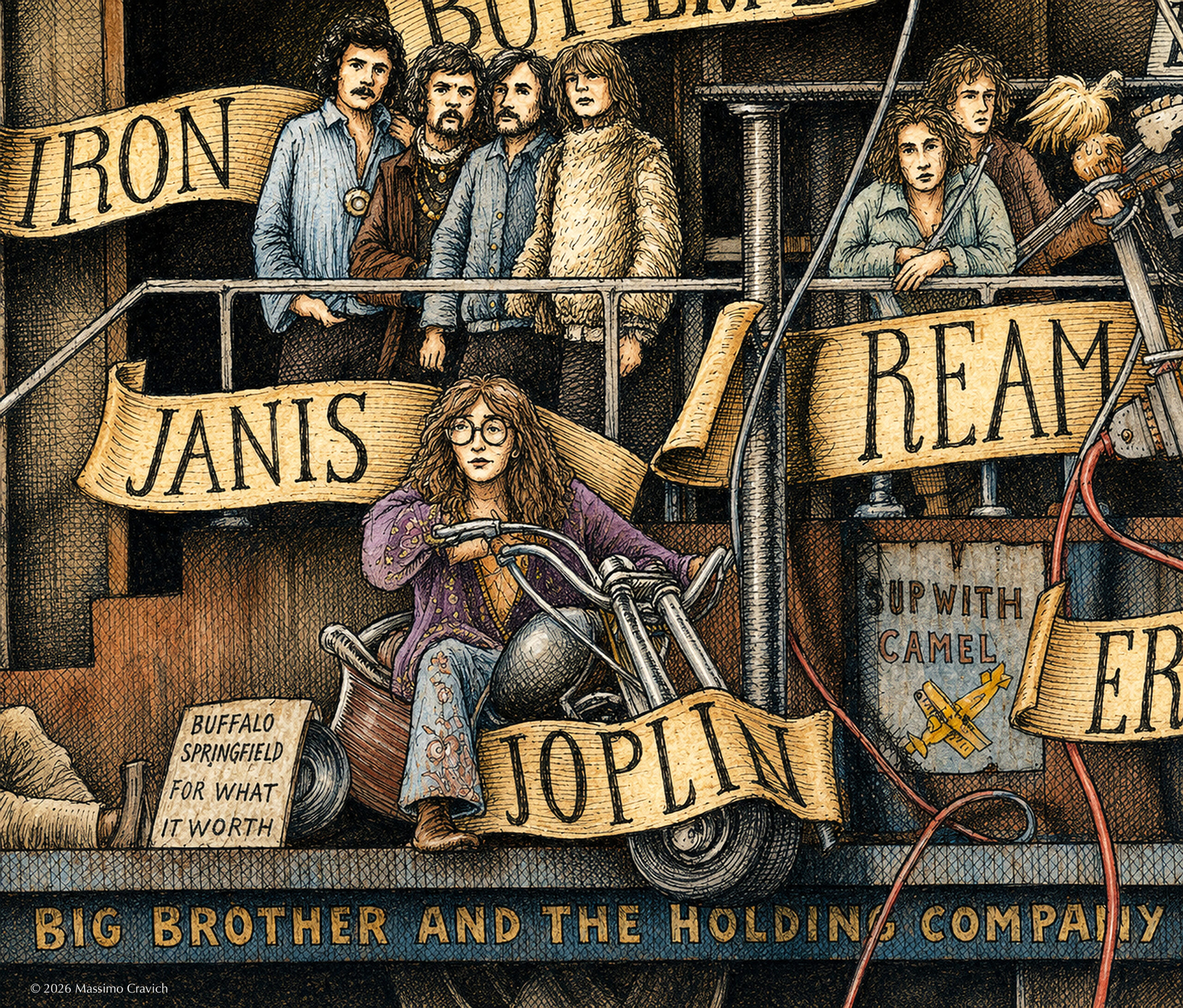
Rock Icons: Janis Joplin
A voice shaped by the blues inside the volume of California psychedelia.

Wounded queen of the counterculture suspended between blues, alcohol, desperate love and emotional self-destruction. From her listening to Bessie Smith and Big Mama Thornton through Big Brother and the Holding Company and on to Cheap Thrills, I Got Dem Ol’ Kozmic Blues Again Mama! and Pearl, Janis Joplin carried blues phrasing, intensity and repertoire into late-1960s rock.
Name: Janis Lyn Joplin
Birth: January 19, 1943 — Port Arthur, Texas, USA
Died: October 4, 1970 — Los Angeles, California, USA
Main instruments: vocals
Genres: blues rock, psychedelic rock, soul rock
Main Groups: Big Brother And The Holding Company, Kozmic Blues Band, Full Tilt Boogie Band
ARTIST OFFICIAL SITE: janisjoplin.com
LISTEN
More to discover…
The woman who transformed pain into sonic explosion
Janis Joplin occupies absolutely gigantic place within American music history. More than rock singer, she resembled exposed nerve transformed into human being. Watching her perform felt almost dangerous. Janis did not simply interpret songs: she devoured them. Her voice constantly sounded on the verge of collapse, explosionor breakdown.
Yet behind that devastating intensity existed deeply fragile woman haunted by exclusion, desperate need for love and constant fear of inadequacy. That contradiction — between animal force and absolute vulnerability — made Janis completely unique. But her story is also the story of American counterculture consumed too quickly: alcohol, heroin, chaotic relationships, loneliness and inability to survive her own myth. That is why Janis Joplin remains one of the most authentic, tragic and revolutionary souls in rock history.
Joplin’s starting point was more specific than a general enthusiasm for blues. Her singing grew from close listening to voices such as Bessie Smith, Odetta and especially Big Mama Thornton, singers for whom timbre, attack and variation of a phrase mattered as much as the written melody. When she joined Big Brother and the Holding Company, that vocabulary encountered a rough psychedelic band very different from the orchestras, small R&B; groups or acoustic settings associated with many of her sources. The tension between those worlds is central to the result: the voice is not simply placed on top of rock but has to cut through its volume and density.
Ball and Chain makes the transition especially clear. The song came from Big Mama Thornton, but Joplin and Big Brother stretched it, pushed it toward rock-concert dynamics and placed it inside San Francisco psychedelic culture. With the Kozmic Blues Band and later the Full Tilt Boogie Band, the relationship changed again: horns, soul and R&B; became more prominent, while Pearl placed the voice within more controlled arrangements. The path is therefore not a linear progression toward one style but a continuing negotiation among blues, soul, psychedelia and rock.

The genealogical consequence concerns the role of the voice above all. Joplin made a line descending from African American female blues highly audible within mass rock culture, but did so inside a different cultural and commercial system, one also shaped by inequalities that had restricted the visibility of many of her sources.
Her later influence is not simply a matter of copying a rasp or stage intensity: she helped widen the space available for rock singing that was unpolished, physical and openly blues-derived. The line can be read as classic blues + gospel/R&B; -> Big Mama Thornton and other blues voices -> Janis Joplin -> blues rock and rock vocal language -> later rock and roots singers.
Performances such as Ball and Chain, Piece of My Heart and Try (Just a Little Bit Harder) show how Janis Joplin carried techniques and intensity from blues and soul into the volume, instrumentation and audience of rock.
Within The Great Rock and Roll History, Janis Joplin connects classic blues, gospel and R&B; -> Bessie Smith, Big Mama Thornton and African American vocal traditions -> San Francisco psychedelia and blues rock -> later forms of rock and roots singing.
Influenced by
- Bessie Smith
- Big Mama Thornton
- Lead Belly
- Odetta
- Texas blues and Delta blues
Influent For
- Stevie Nicks
- Patti Smith
- Chrissie Hynde
- Courtney Love
- Modern female rock vocals

Related Artists
- Jimi Hendrix
- Jim Morrison
- Big Mama Thornton
- Grace Slick
- Country Joe McDonald
SOURCES
Official Janis Joplin archives
Monterey Pop Festival archives
San Francisco psychedelic archives
Blues rock historical collections
Within the broader history of American rock music, Janis Joplin represents one of the most intense, vulnerable and culturally decisive figures of the twentieth century. Her work permanently reshaped the relationship between blues, rock music, femininity and emotional authenticity.
In rock genealogy, Janis Joplin is above all a point of transfer between different traditions and contexts. A vocal language shaped through blues enters California psychedelia and later encounters soul and R&B; without losing its source. That passage made those vocal techniques audible to a much wider rock audience, but it did not erase the debt to the African American women who had developed them under very different conditions. Her later trace also lies here: in the way rock learned to use the voice as an irregular, dynamic and physical surface rather than necessarily a sound to be polished.