
Bessie Smith was the most celebrated classic blues singer of the 1920s and one of the foundational voices of African-American music. Known as the “Empress of the Blues”, she transformed theatrical and vaudeville blues into an expressive form of extraordinary power, connecting Southern traditions with the new recording industry and urban culture.
This profile explores Bessie Smith’s roots, vocal language and legacy within The Great Rock and Roll History, a large-scale illustrated timeline of modern music.
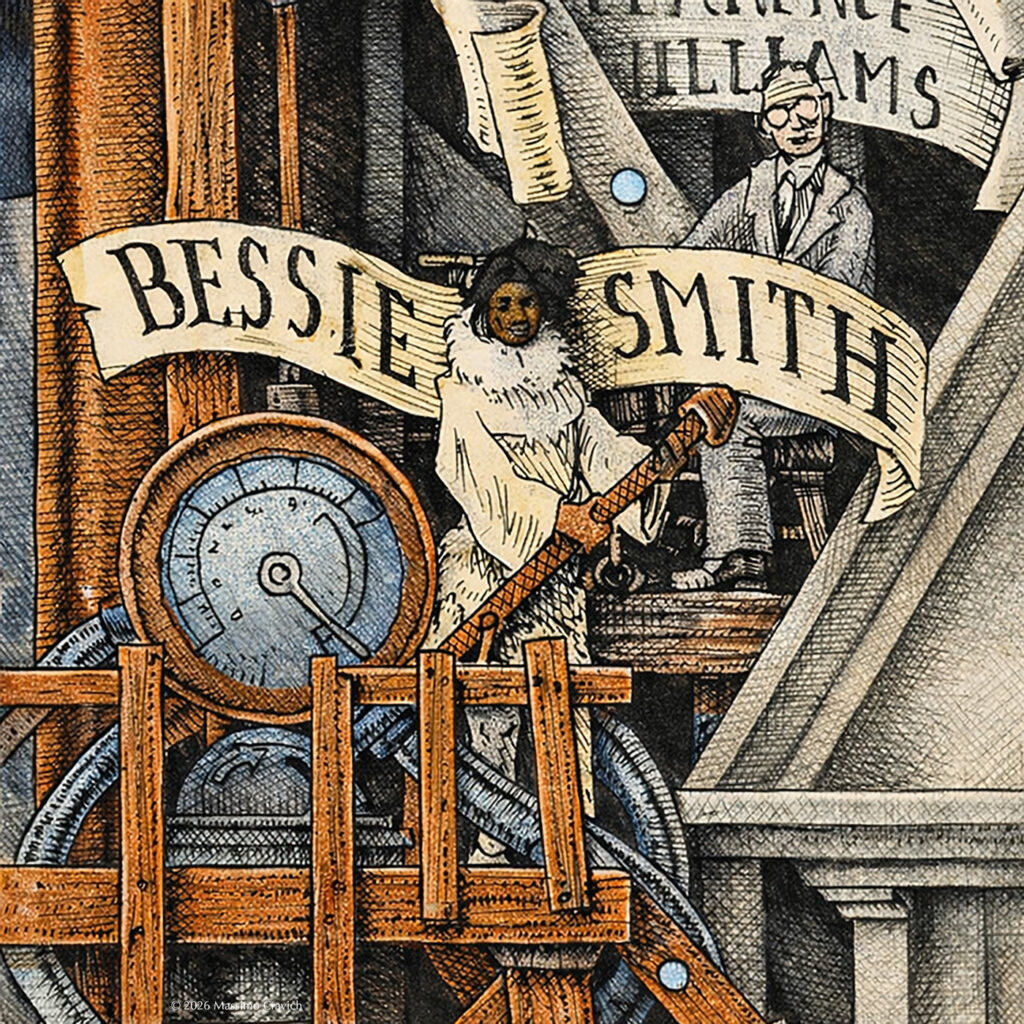
Rock Icons: Bessie Smith
Before the modern microphone and the electric guitar, a voice powerful enough to fill a theater turned desire, pain and independence into the grammar of the blues.

From Southern touring companies to her 1920s Columbia recordings, Bessie Smith joined blues, vaudeville and jazz through a powerful voice, rhythmically free phrasing and an interpretive presence that directly influenced blues, jazz, rhythm & blues and rock singers.
Born April 15, 1894 – Chattanooga, Tennessee, USA
Died September 26, 1937 – Clarksdale, Mississippi, USA
Role Singer
Genres Classic blues, vaudeville blues, jazz blues
Recording period 1923-1933
Key label Columbia Records
Nickname Empress of the Blues
ARTIST RELATED SITE: www.bessiesmithcc.org
LISTEN
Nobody Knows You When You’re Down and Out
More to discover…
The voice that turned the blues into a theater of life
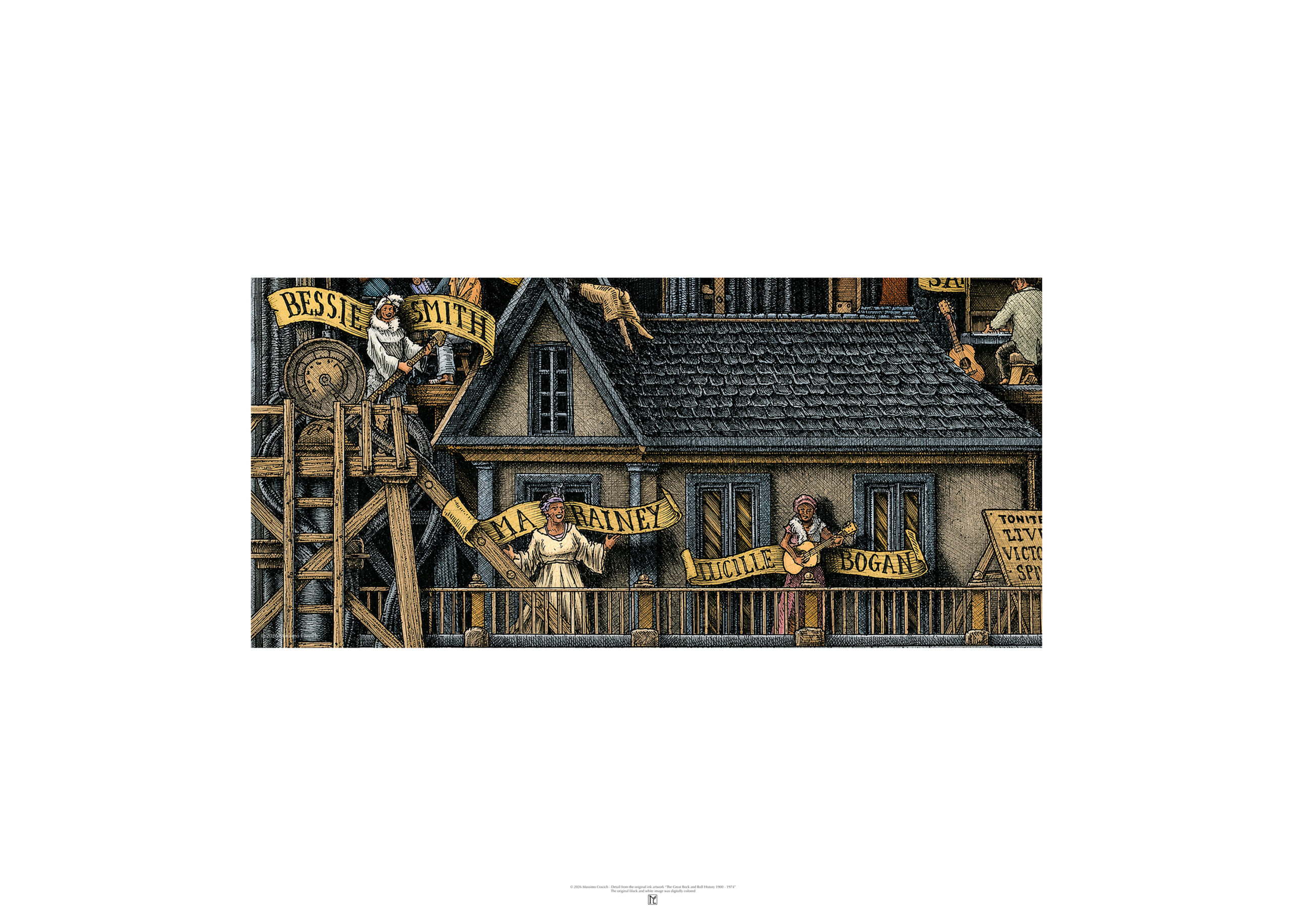
Bessie Smith emerged from a world that predates the modern idea of the pop singer. Touring companies, tent shows and African-American vaudeville were places where music, theater and stage presence were inseparable. Ma Rainey became one of the young Smith’s most important reference points.
Bessie quickly developed an authority of her own: a broad, penetrating voice capable of projecting over small ensembles, combined with extraordinary rhythmic precision. She could delay a word, compress a phrase or bend a note until the simple blues form became narrative.
The success of Downhearted Blues in 1923 coincided with the expansion of the African-American record market. Her recordings also document a meeting point between blues and jazz: musicians including Louis Armstrong, Fletcher Henderson and Coleman Hawkins appeared beside her. On St. Louis Blues, the exchange with Armstrong reveals two approaches to musical phrasing that challenge and complement each other. Her songs address relationships, abandonment, poverty, sex, travel, alcohol, violence and survival with a directness that gives female protagonists desire, anger and the ability to answer back.
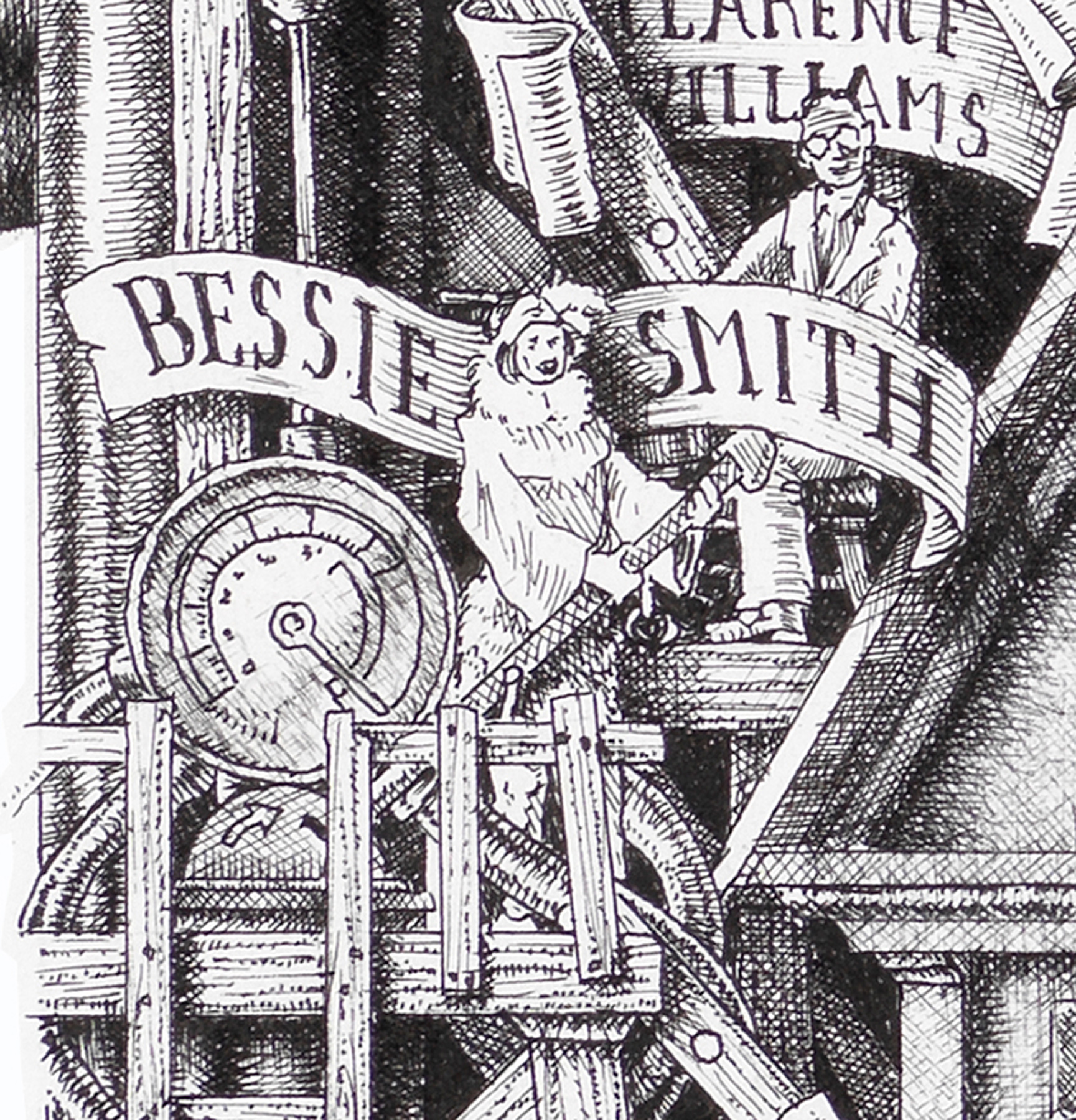
Rock Icons: Bessie Smith
Her genealogical importance extends far beyond classic blues. Bessie Smith established a model of the singer dominating a song through timbre, phrasing and personality; Billie Holiday inherited its interpretive freedom, Dinah Washington and major R&B; voices carried the lesson into the postwar era, while Janis Joplin made the connection to rock explicit. Soul also inherited the idea that a voice could turn simple material into autobiographical experience. The line runs deep: blues and vaudeville -> Bessie Smith -> vocal jazz and rhythm & blues -> soul -> rock singers.
Recordings including Downhearted Blues, St. Louis Blues and Back-Water Blues established Bessie Smith as a central figure in classic blues and a decisive model for the later evolution of jazz, rhythm & blues, soul and rock singing.
Within The Great Rock and Roll History, Bessie Smith occupies a primary genealogical junction: Southern blues, vaudeville and tent shows -> recorded classic blues -> encounter with jazz -> R&B; and soul singing -> the vocal expressiveness of rock.
Influenced by
- Ma Rainey
- African-American blues and spirituals
- African-American vaudeville
- Southern tent-show tradition
- Blues oral tradition
Influent For
- Billie Holiday
- Big Mama Thornton
- Dinah Washington
- Janis Joplin
- Aretha Franklin
Related Artists
- Ma Rainey
- Louis Armstrong
- Fletcher Henderson
- Ethel Waters
- Mamie Smith
Get Your Rock Icon
Selected artworks from Rock Icons and Stories are available as high-quality framed art prints. Printed on premium 230 gsm matte paper with excellent detail and colour reproduction, each print is professionally framed and delivered ready to hang.A carefully selected, high-quality alternative to the museum-grade Fine Art Giclée editions, offering an accessible way to own and display a reproduction of the original artwork. Printing, framing and worldwide fulfilment are handled by our specialist printing partner.

Sources
Wikipedia — Bessie Smith — https://en.wikipedia.org/wiki/Bessie_Smith
Britannica — Bessie Smith biography — https://www.britannica.com/biography/Bessie-Smith
WAMS — Jazz Age profile — https://wams.nyhistory.org/confidence-and-crises/jazz-age/bessie-smith/
Rock & Roll Hall of Fame – Bessie Smith, inductee profile.
National Women’s History Museum – Bessie Smith biographical materials.
Library of Congress – historical recordings and materials on early blues.
Chris Albertson, Bessie, revised edition, Yale University Press, 2003.
Columbia / Legacy – historical discography and reissue materials for Bessie Smith.
In the genealogy of rock, Bessie Smith represents one of the great sources of the modern singing voice. Her meeting of blues, theater and jazz established a model in which power, phrasing, personal experience and interpretive authority became inseparable. Through Billie Holiday, Dinah Washington, Big Mama Thornton, Aretha Franklin and Janis Joplin, that conception traveled through rhythm & blues, soul and rock.