
The Doors emerged from mid-1960s Los Angeles, yet their language remained somewhat removed from the brightness often associated with the California scene. Blues, jazz, psychedelia, poetry and theatrical forms coexisted in music built on the contrast between Ray Manzarek’s organ, Robby Krieger’s guitar, John Densmore’s drums and Jim Morrison’s voice.
This profile places the Doors within The Great Rock and Roll History, tracing the movement from blues and psychedelia toward a darker, more dramatic form of rock in which improvisation, repetition, language and stage tension become structural elements.
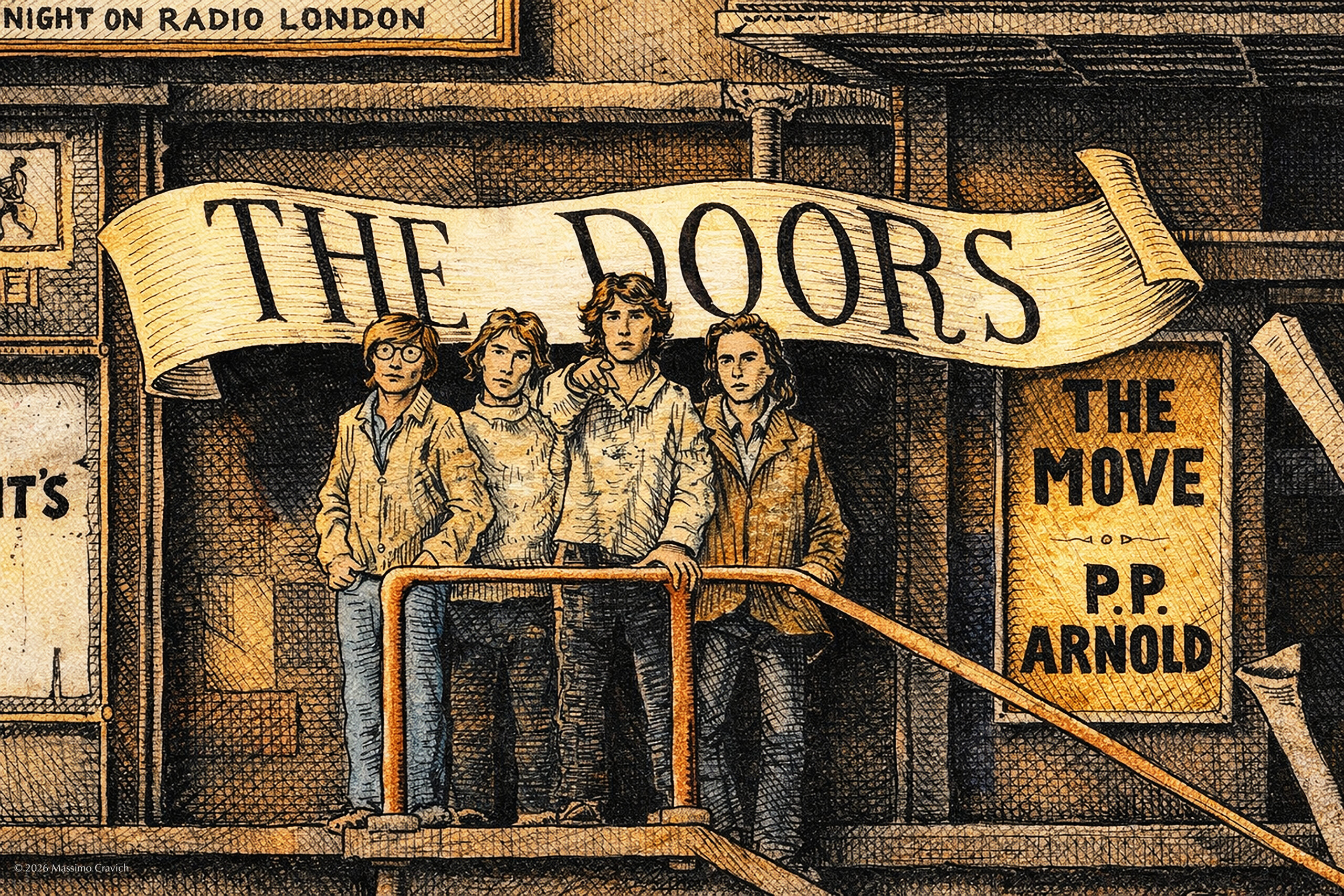
Rock Icons: The Doors
Blues, jazz, poetry and psychedelia

American psychedelic rock band blending blues, poetic lyricism and dark experimental atmospheres. From The Doors and Strange Days through Morrison Hotel and L.A. Woman, the group reshaped blues, jazz, psychedelia and spoken word into a recognizable language, moving between compact songs and open structures such as The End and When the Music’s Over.
By combining blues traditions, psychedelic experimentation and poetic lyricism, The Doors helped redefine the emotional and artistic possibilities of rock music.
Formed: 1965, Los Angeles
Disbanded: 1973 (effectively 1971 after Morrison’s death)
Line-up: Jim Morrison, Ray Manzarek, Robby Krieger, John Densmore
Genres: Country rock, Rockabilly, Roots rock, Instrumental rock
Historical role: Fusion of rock, theater, beat poetry and urban psychodrama
ARTIST OFFICIAL SITE: thedoors.com
LISTEN
More to discover…
Psychedelia without escape: blues, improvisation and the theater of tension
The Doors formed within the Los Angeles scene, but their sources produced an unusual combination. Ray Manzarek brought an approach grounded in blues, jazz and keyboards; John Densmore a rhythmic sensibility open to jazz; Robby Krieger incorporated blues, flamenco and a guitar style largely removed from conventional hard-rock riffing. Morrison added poetry, blues singing, spoken word and a concept of performance close to theater.
The initial absence of a permanent bass player also helped shape the band’s identity: Manzarek’s keyboard bass left a different kind of sonic space from that of the standard rock lineup. On the early records this structure allowed the band to move without rupture from relatively concise pop songs to much more open forms. Light My Fire contains an extended instrumental section shaped by the interaction of organ, guitar and drums; The End uses repetition and improvisation to build a dramatic progression closer to ritual than to a conventional pop song.
The Doors’ psychedelia does not depend only on studio effects: it comes from duration, waiting, crescendo and the relationship between language and accompaniment. On the later albums blues moves back toward the foreground, revealing how strongly that root had been present from the beginning.
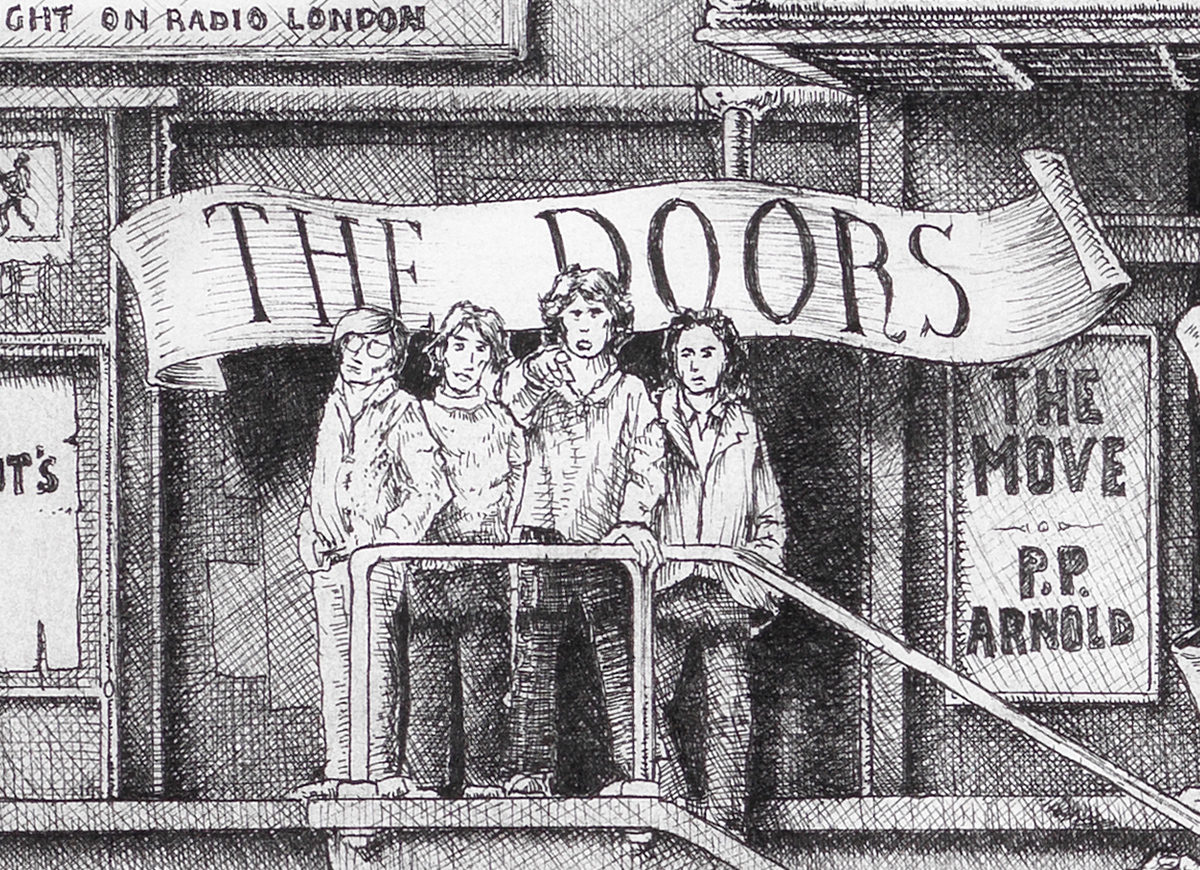
Their genealogical position lies in connecting territories that later rock would often separate. Blues remains the physical base; jazz and improvisation expand form; psychedelia opens possibilities of atmosphere and duration; stage presence and lyrics introduce a darker dimension later taken up, in very different ways, by post-punk, gothic rock and other strands of dark rock. There is no simple linear descent but a network: blues + jazz + poetry/spoken word + psychedelia -> the Doors -> theatrical and atmospheric rock -> elements later heard in post-punk, gothic and alternative rock.
Songs such as Light My Fire, The End, When the Music’s Over and Riders on the Storm show how the Doors brought blues, jazz, psychedelia and spoken language together, expanding both song form and rock’s atmospheric dimension.
Within The Great Rock and Roll History, the Doors connect blues and jazz -> poetry and spoken word -> Los Angeles psychedelia -> theatrical and atmospheric rock -> later dark, post-punk, gothic and alternative elements.
Influenced by
- Blues traditions
- Beat poetry
- Jazz improvisation
- Psychedelic culture
Influent For
- Gothic rock
- Alternative rock
- Dark psychedelic music
- Poetic rock songwriting
Get Your Rock Icon
Selected artworks from Rock Icons and Stories are available as high-quality framed art prints. Printed on premium 230 gsm matte paper with excellent detail and colour reproduction, each print is professionally framed and delivered ready to hang.A carefully selected, high-quality alternative to the museum-grade Fine Art Giclée editions, offering an accessible way to own and display a reproduction of the original artwork. Printing, framing and worldwide fulfilment are handled by our specialist printing partner.
In rock genealogy, the Doors are less useful as the origin of a single genre than as a point of intersection. Blues provides a base onto which the group layers jazz improvisation, psychedelic forms, poetry and a strong theatrical dimension. The result can remain concise or expand into long, unstable structures while retaining a distinctive tension. That combination leaves rock with a particular po