
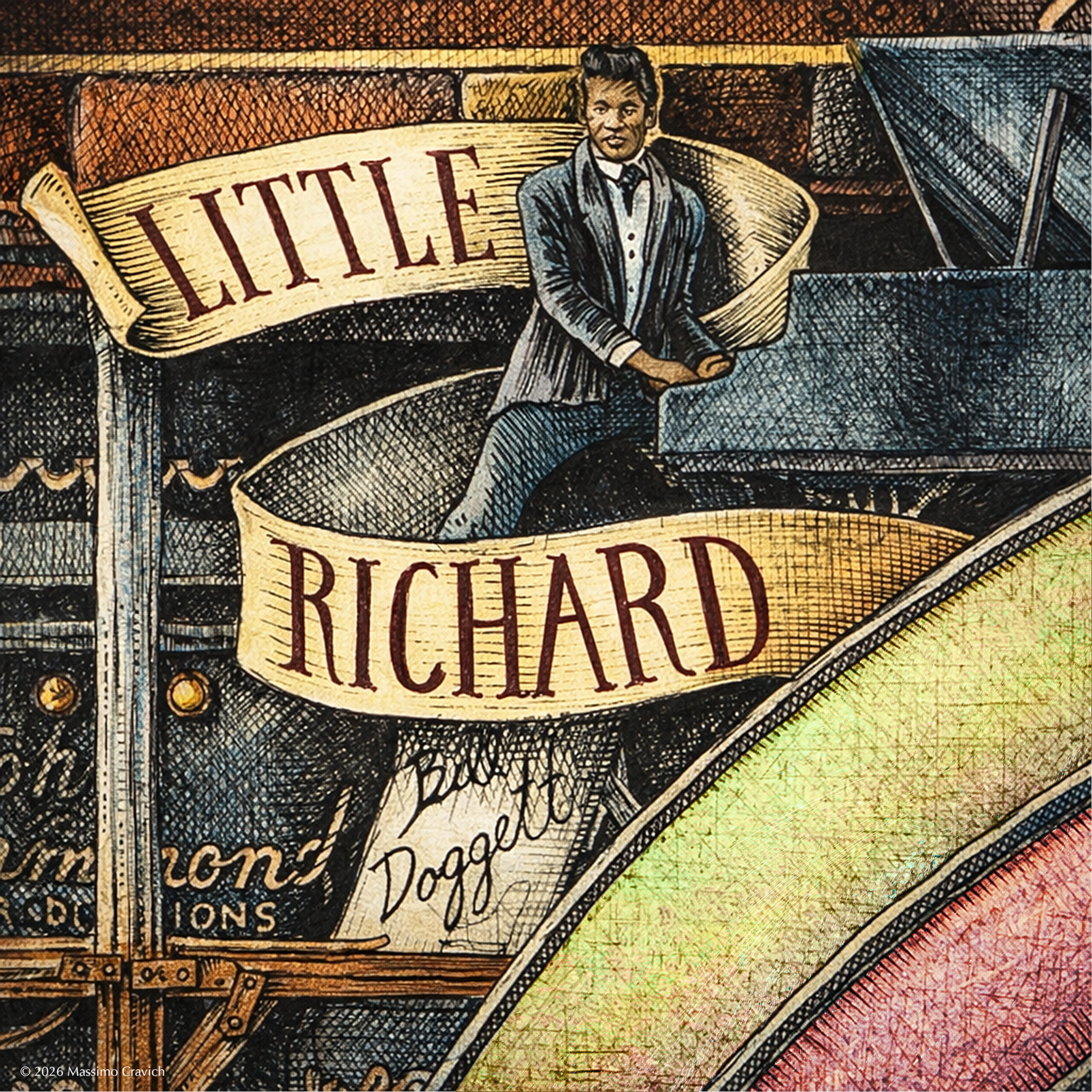
Little Richard transformed gospel, rhythm and blues and boogie-woogie into one of early rock and roll’s most explosive forms. His voice, pounding piano and deliberately extravagant stage image changed how singers sounded and performed. Within The Great Rock and Roll History, his story also illuminates segregated America, the conflict between faith and show business, and the central role of Black musicians in rock’s emergence.
Rock Icons: Little Richard
Between pulpit and stage: a voice that demanded to be seen as well as heard.

By combining gospel intensity, rhythm and blues and a highly energetic performance style, Little Richard helped define the sound and attitude of early rock and roll. From Tutti Frutti to Long Tall Sally and Good Golly, Miss Molly, Little Richard established a vocal and theatrical model that shaped rock and roll, soul, the British beat boom and glam rock.
Name Richard Wayne Penniman
Born December 5, 1932, Macon, Georgia
Died May 9, 2020, Tullahoma, Tennessee
Role Singer, pianist, songwriter, performer
Genres Gospel, rhythm and blues, rock and roll
Breakthrough 1955: Tutti Frutti, Specialty Records
Key figures Bumps Blackwell; Art Rupe; Dorothy LaBostrie
Core genres: Rock’n’roll, Rhythm & Blues, Gospel
LISTEN
More to discover…
Defining the raw explosive energy of Rock and Roll
Macon: gospel, family and the need to be different
Richard Penniman grew up in a large Georgia family, surrounded by church music, gospel singing and the strict racial boundaries of the segregated South. The energy of preachers and the theatricality of worship left a lasting mark on his voice; outside church, rhythm and blues offered another outlet for the same intensity. His exuberance and unconventional presentation also brought family and social tensions.
Working in traveling shows and on Black entertainment circuits, he learned that the stage could provide employment, refuge and the chance to invent himself. He did not arrive fully formed as an icon: he experimented, watched other performers and searched for a setting in which his personality would not have to be restrained.
Tutti Frutti: when the voice crossed boundaries
The breakthrough came in 1955 with Specialty Records and producer Bumps Blackwell. Tutti Frutti, with lyrics revised by Dorothy LaBostrie, unleashed a combination of cries, driving piano, rhythm and almost percussive syllables. Long Tall Sally, Rip It Up and Lucille followed: rooted in blues and R&B; forms, but propelled by speed, urgency and sheer physical presence.
Success came in a market where white artists’ cover versions could receive greater exposure. Richard would repeatedly insist on Black musicians’ contribution to rock, while his makeup and clothing challenged conventional public masculinity. His influence was never limited to individual songs: he showed a generation that performance could be deliberately overwhelming.orms, making him a revolutionary figure not only in sound but also in cultural expression.
Rock Icons: Little Richard
Faith and show business: an unresolved divide
In 1957, during an Australian tour, Richard interpreted several events as religious signs and decided to leave rock to preach and record gospel. This was more than an eccentric footnote: the conflict between religious upbringing, private life and entertainment followed him for decades. He repeatedly returned to secular music and then preaching, sometimes making contradictory public statements about himself and his image.
Behind the legend of an unstoppable performer stood a person struggling to reconcile desires, convictions and the expectations of audiences who wanted the same character every night. That tension makes his story less straightforward, and more human, than the familiar myth of a rock founder.
The legacy: from the Beatles to soul and glam
Early-1960s British tours brought him into contact with musicians absorbing American rock: the Beatles and Rolling Stones acknowledged his importance, while James Brown and numerous soul singers drew on the idea of the voice as a rhythmic, physical event. His stage presence anticipated aspects of glam and theatrical rock, though he cannot be confined to any single genre. Jimi Hendrix briefly played in his band, an encounter also marked by friction between strong personalities.
His genealogy runs from gospel, boogie-woogie and R&B; through rock and roll toward soul, beat, hard rock and theatrical pop: an influence made of sound and the courage to command the stage. His figure occupies a central position within the broader visual narrative of The Great Rock and Roll History.
Tutti Frutti, Long Tall Sally and Lucille show how Little Richard transformed gospel phrasing and rhythm-and-blues energy into a foundational rock-and-roll model.
Within The Great Rock and Roll History Little Richard reveals the gap between the musicians creating new sounds and those receiving exposure in the 1950s American record business: his success crossed racial barriers without erasing them.
Influenced by
- Sister Rosetta Tharpe
- Esquerita
- Billy Wright
- Louis Jordan
- Mahalia Jackson
Influent For
- Paul McCartney
- James Brown
- Mick Jagger
- Prince
- David Bowie
Related Artists
- Chuck Berry
- Bo Diddley
- Jimi Hendrix
- David Bowie
- Sam Cooke
- Fats Domino
SOURCES
Rock & Roll Hall of Fame – https://rockhall.com/inductees/little-richard/
Encyclopaedia Britannica – https://www.britannica.com/biography/Little-Richard
Charles White, The Life and Times of Little Richard
Little Richard holds a crucial place in rock genealogy because he made voice, rhythm and stage presence inseparable. His Specialty recordings connected gospel and rhythm and blues to rock and roll, while his image opened expressive possibilities that resurfaced in soul and glam. His story also reveals an unresolved personal struggle between faith and performance, and reminds us how much rock’s origins owe to Black American musicians.