
Traffic were an English rock band formed in Birmingham in 1967, and one of the most original bridges between British psychedelia, folk rock, jazz-rock improvisation and the early progressive imagination. Built around Steve Winwood, Jim Capaldi, Chris Wood and Dave Mason, the group transformed late-1960s rock into a fluid musical territory where songs, jams and rural atmosphere could coexist.
This illustrated profile explores Traffic’s improvisational language, studio identity and cultural influence within The Great Rock and Roll History, a large-scale illustrated timeline of modern music.
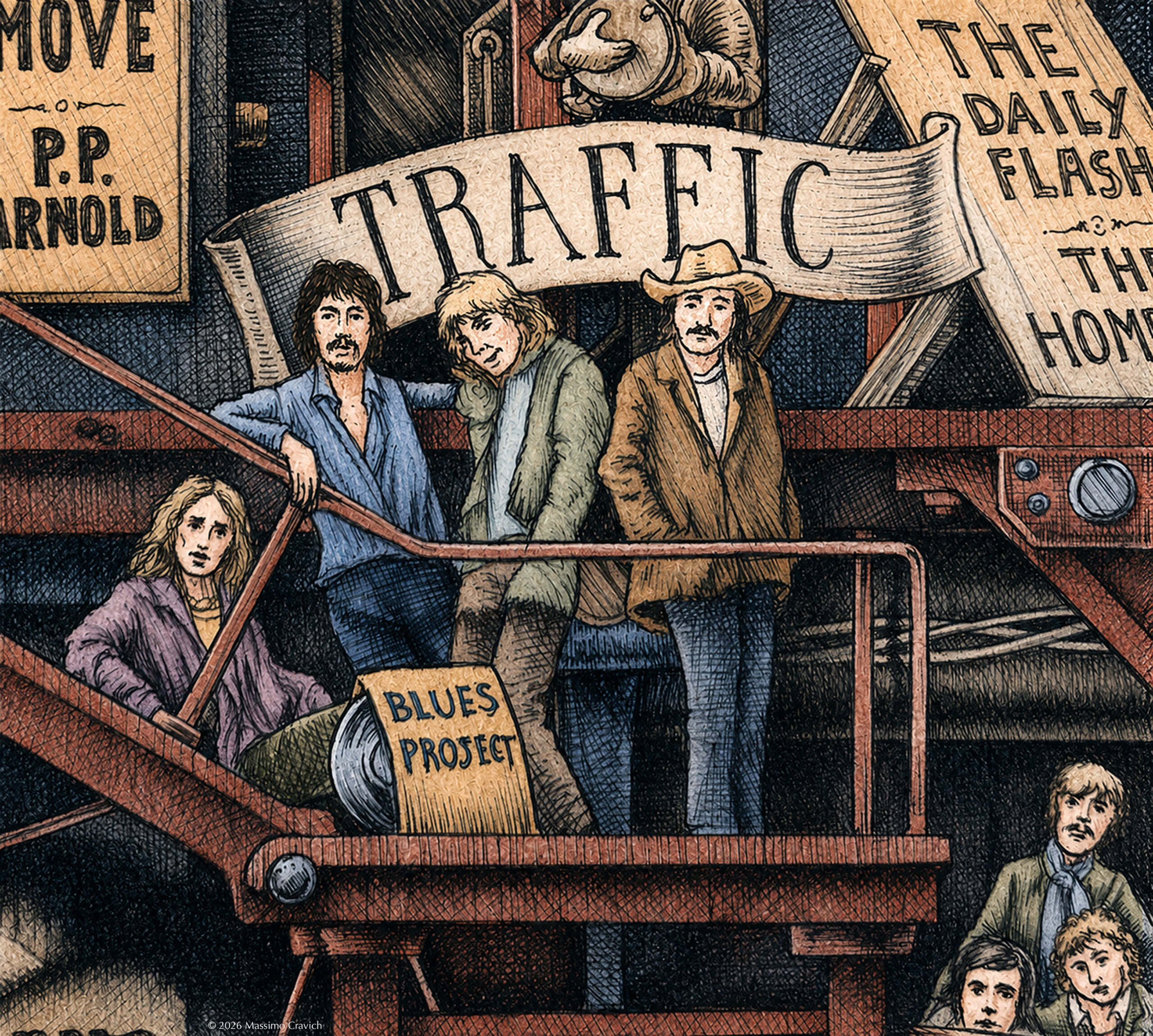
Rock Icons: Traffic

British psychedelic and progressive rock band blending jazz improvisation, folk atmosphere, soul phrasing and experimental songwriting.
By combining psychedelic rock, English folk, rhythm and blues, jazz improvisation and Steve Winwood’s unmistakable soul voice, Traffic helped define a crucial passage from 1960s underground experimentation to the wider language of progressive rock and jam-oriented rock culture.
Formed: April 1967 – Birmingham, England
Status: Disbanded. Main activity: 1967-1969, 1970-1974; reunions in 1994 and 2004.
Classic Line up: Steve Winwood – vocals, keyboards, guitar; Jim Capaldi – drums, percussion, vocals, lyrics; Chris Wood – flute, saxophone, keyboards; Dave Mason – guitar, vocals, sitar, songwriting.
Genres: Psychedelic rock, progressive rock, folk rock, jazz rock, rhythm and blues, soul-influenced rock.
ARTIST OFFICIAL SITE: www.stevewinwood.com
LISTEN
Dear Mr. Fantasy – the early psychedelic manifesto, suspended between blues, soul and underground melancholy.
Paper Sun – the colorful 1967 single where sitar, pop melody and psychedelia meet.
John Barleycorn – the folk ritual that reveals the darker, archaic side of the band.
The Low Spark of High Heeled Boys – the long, hypnotic jazz-rock drift that became one of their defining statements.
Feelin’ Alright? – Dave Mason’s concise song that escaped Traffic and became a standard through countless covers.
More to discover…
The rural psychedelic band that turned rock into open landscape
Traffic were never a simple psychedelic group, a progressive band in the strict symphonic sense, or a jazz-rock experiment in academic clothing. Their identity was more elusive. They sounded like musicians trying to escape the city, the single market, the fixed role of the pop group and even the idea that a song must remain the same every time it is played.
Steve Winwood brought to Traffic an extraordinary mixture of soul authority and musical precocity. Jim Capaldi gave the band a rhythmic intelligence and a lyrical sensibility often darker than the surface suggested. Chris Wood supplied the woodwind colors that made Traffic immediately recognizable, while Dave Mason introduced concise, melodic and sometimes eccentric songs that created productive friction inside the group.
From this perspective, Traffic occupy a decisive point in rock genealogy: they connect the Birmingham rhythm and blues scene to British psychedelia, rural folk to jazz improvisation, and the free live mentality of the late 1960s to later progressive and jam-band cultures. Their importance lies not only in famous records, but in theway they made rock sound less like a closed format and more like a road, a cottage, a conversation and a drift.

Albums such as Mr. Fantasy, John Barleycorn Must Die and The Low Spark of High Heeled Boys became essential landmarks for British psychedelic rock, progressive rock, folk-jazz experimentation and extended rock improvisation.
Traffic’s music occupies a central position within the broader visual narrative of The Great Rock and Roll History, where rock is read as a network of scenes, migrations, temporary alliances, stylistic crossings and unexpected returns.
Influenced by
- American rhythm and blues and soul – for Winwood’s vocal language and the Birmingham club roots behind the band.
- The Beatles and British psychedelia – for the idea that pop music could expand into studio color, album form and surreal imagery.
- English folk tradition – especially visible in John Barleycorn and in the group’s rural, archaic atmosphere.
- Jazz improvisation – for the long forms, instrumental dialogue and rhythmic freedom that shaped the live band.
- Indian and exotic instrumentation in 1960s pop – for the sitar colors and open textures of the early singles.
Influent For
- Blind Faith and Steve Winwood’s later work – because Traffic flows directly into Winwood’s wider career and post-Cream supergroup history.
- Jethro Tull and folk-progressive rock – for the use of flute, folk memory and extended rock structures in a British context.
- Progressive and jazz-rock bands of the 1970s – for the elastic bridge between song form and improvisation.
- Jam-band culture – especially bands that treated songs as flexible live frameworks rather than fixed objects.
- Alternative folk-prog and chamber rock artists – for the mixture of pastoral tone, sophisticated arrangement and emotional looseness.
Related Artists
Spencer Davis Group – Winwood’s pre-Traffic launching point and the Birmingham rhythm and blues root.
Blind Faith – Winwood’s supergroup with Eric Clapton, Ginger Baker and Ric Grech after Traffic first dissolved.
Jimi Hendrix – a crucial neighboring universe: Mason, Winwood and Wood all connect in different ways to Hendrix-era sessions and networks.
Joe Cocker – whose version of Feelin’ Alright? turned Dave Mason’s Traffic song into a worldwide rock-soulstandard.
Grateful Dead – linked through the 1994 tour and through a shared culture of extended live performance.
Get Your Rock Icon
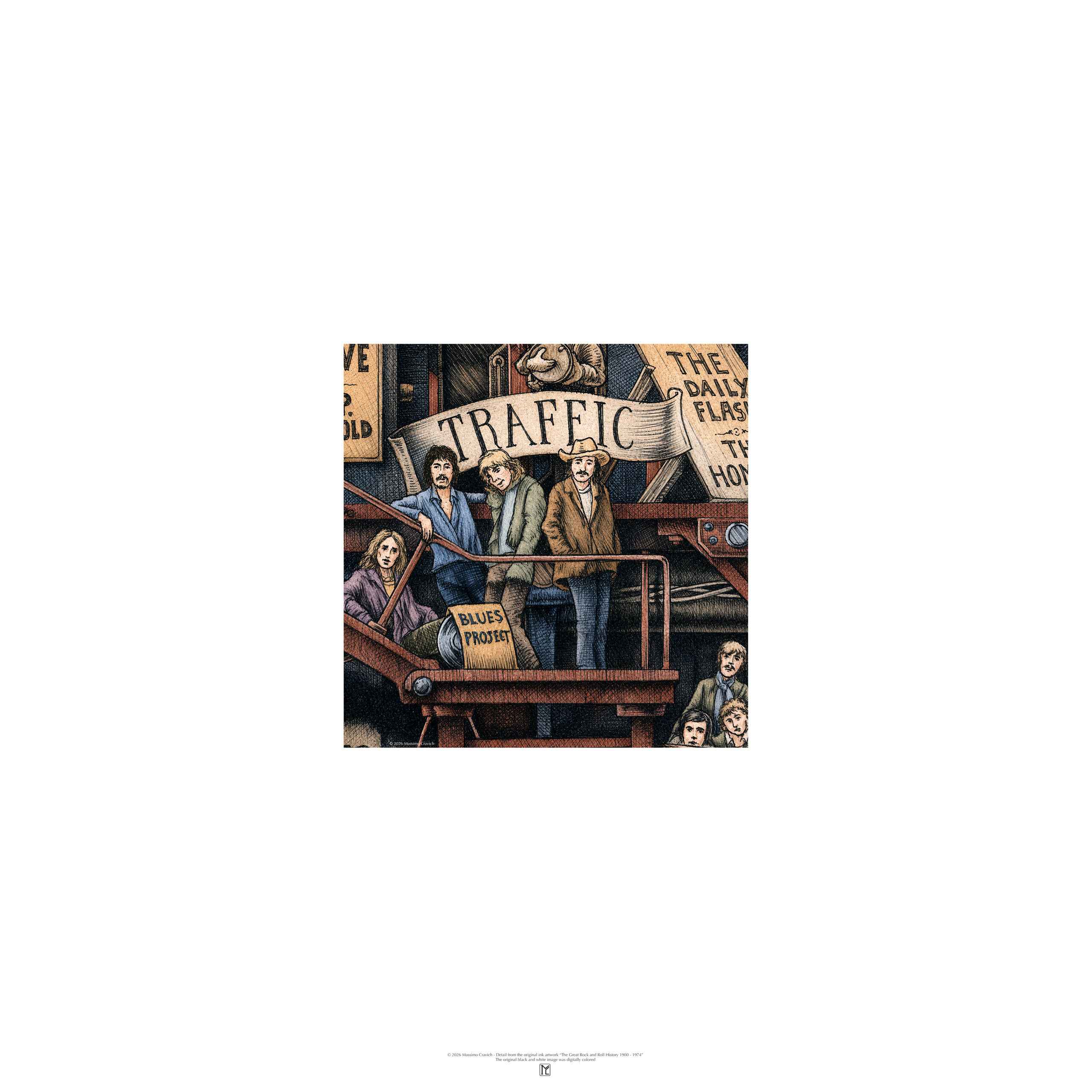
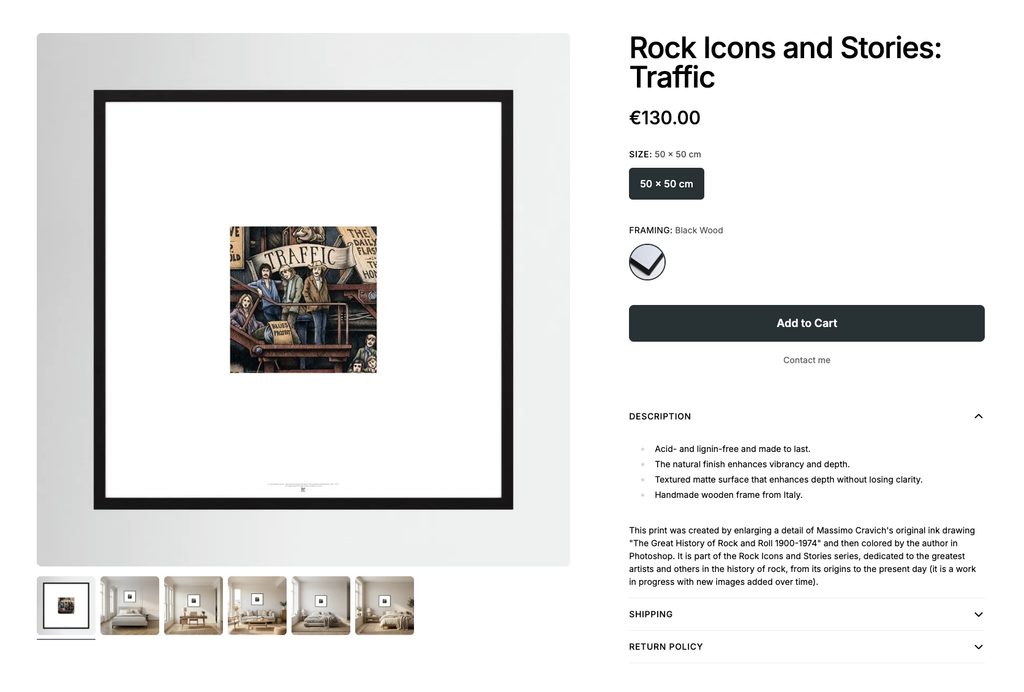
Selected artworks from Rock Icons and Stories are available as high-quality framed art prints. Printed on premium 230 gsm matte paper with excellent detail and colour reproduction, each print is professionally framed and delivered ready to hang.A carefully selected, high-quality alternative to the museum-grade Fine Art Giclée editions, offering an accessible way to own and display a reproduction of the original artwork. Printing, framing and worldwide fulfilment are handled by our specialist printing partner.
SOURCES
• Rock & Roll Hall of Fame – Traffic inductee profile: https://www.rockhall.com/inductees/traffic
• AllMusic – Traffic biography and discography: https://www.allmusic.com/artist/traffic-mn0000012472/biography
• University of Reading Special Collections – Mr. Fantasy / Aston Tirrold cottage note: https://www.reading.ac.uk/adlib/Details/collect/17183
• Dave Mason, Only You Know and I Know: A Memoir, 2024
• Chris Welch, Steve Winwood: Roll With It, 1990
Within the broader narrative of rock history, Traffic represent one of the most important links between British psychedelia, folk rock, jazz-rock improvisation and the early progressive imagination.
Their influence crosses different generations: from 1970s progressive and jazz-rock musicians to jam bands, folk-progressive artists and every rock project that treats the song not as a closed object, but as an open route through sound, atmosphere and collective movement.