
John Lee Hooker was one of the most recognizable and influential voices in electric blues: a musician who reduced the language of the Delta to a hypnotic, flexible and immensely powerful pulse, creating a direct bridge between rural blues, Detroit, rhythm & blues and future blues rock.
This illustrated profile explores John Lee Hooker’s style, roots and enormous legacy within The Great Rock and Roll History, where his elemental boogie becomes one of the rhythmic cells that would repeatedly reappear in rock.

Rock Icons: John Lee Hooker
A voice, a guitar and a foot beating time:
John Lee Hooker turned blues into trance and handed rock one of its most primitive and irresistible rhythms.

Full name John Lee Hooker
Born August 22, 1917 – near Clarksdale, Mississippi, USA
Died June 21, 2001 – Los Altos, California, USA
Main instruments Vocals, electric and acoustic guitar
Main genres Delta blues, electric blues, boogie, rhythm & blues
Early key recordings Detroit, late 1940s
Breakthrough song Boogie Chillen’
ARTIST OFFICIAL SITE: johnleehooker.com
LISTEN
One Bourbon, One Scotch, One Beer
More to discover…
The hypnotic pulse that carried the Delta into the city
John Lee Hooker carried into Detroit a blues that seemed to come from a time far older than the industrial city that received him. His roots lay in Mississippi and the Delta tradition, but his playing did not depend on the regular structures urban blues was consolidating. Hooker could lengthen or shorten a measure according to his voice, stop, restart, remain on a single chord and turn an elementary figure into pure tension. His foot striking the floor became almost a rhythm section. On Boogie Chillen’, recorded in 1948, voice, amplified guitar and pulse create a sound that is bare yet strikingly modern: rather than merely accompanying a song, the riff creates a hypnotic state.
That freedom could make Hooker difficult to accompany for musicians accustomed to counting regular measures, but it was precisely the source of his power. His boogie was not the orderly piano boogie of larger ensembles: it was a cyclical, physical figure continually reshaped by phrasing. Recordings such as I’m in the Mood, Dimples and Boom Boom showed how the formula could take different forms without losing its identity. When the folk revival and then theBritish blues boom redirected attention toward African-American blues masters, young rock groups heard something immediately usable in Hooker: riff, repetition and groove could sustain an entire performance.
His influence was especially powerful because it did not require literal imitation. Canned Heat recorded Hooker ‘n Heat with him; the Animals carried his repertoire into British rock; Van Morrison, the Yardbirds, the Rolling Stones and countless blues-rock groups absorbed his conception of rhythmic tension. Later, Hooker could collaborate with generations he had helped create without becoming a static monument to the past. The genealogy is unusually clear:

Rock Icons: John Lee Hooker
Delta blues and boogie pass through urban amplification in Detroit, become riff and rhythmic trance, and re-emerge in blues rock, garage and even minimalist strains of rock. Few musicians demonstrated so forcefully how little material is required when rhythm possesses an absolute personality.
From Boogie Chillen’ and I’m in the Mood to Boom Boom, John Lee Hooker transformed boogie blues into a personal language of riff, repetition and pulse, becoming a fundamental source for British and American blues rock.
Within The Great Rock and Roll History, John Lee Hooker occupies an essential genealogical passage: Delta blues migrates to the industrial city, meets amplification and rhythm & blues, then crosses the Atlantic and directly feeds the British blues boom, garage rock and riff-based rock.
Influenced by
- Will Moore (his stepfather)
- Delta Blues
- Blind Lemon Jefferson
- Bukka White
- Tommy Johnson
- Son House
Influent For
- Rolling Stones
- The Doors
- Canned Heat
- Van Morrison
- Eric Clapton
- ZZ Top
- Garage Rock
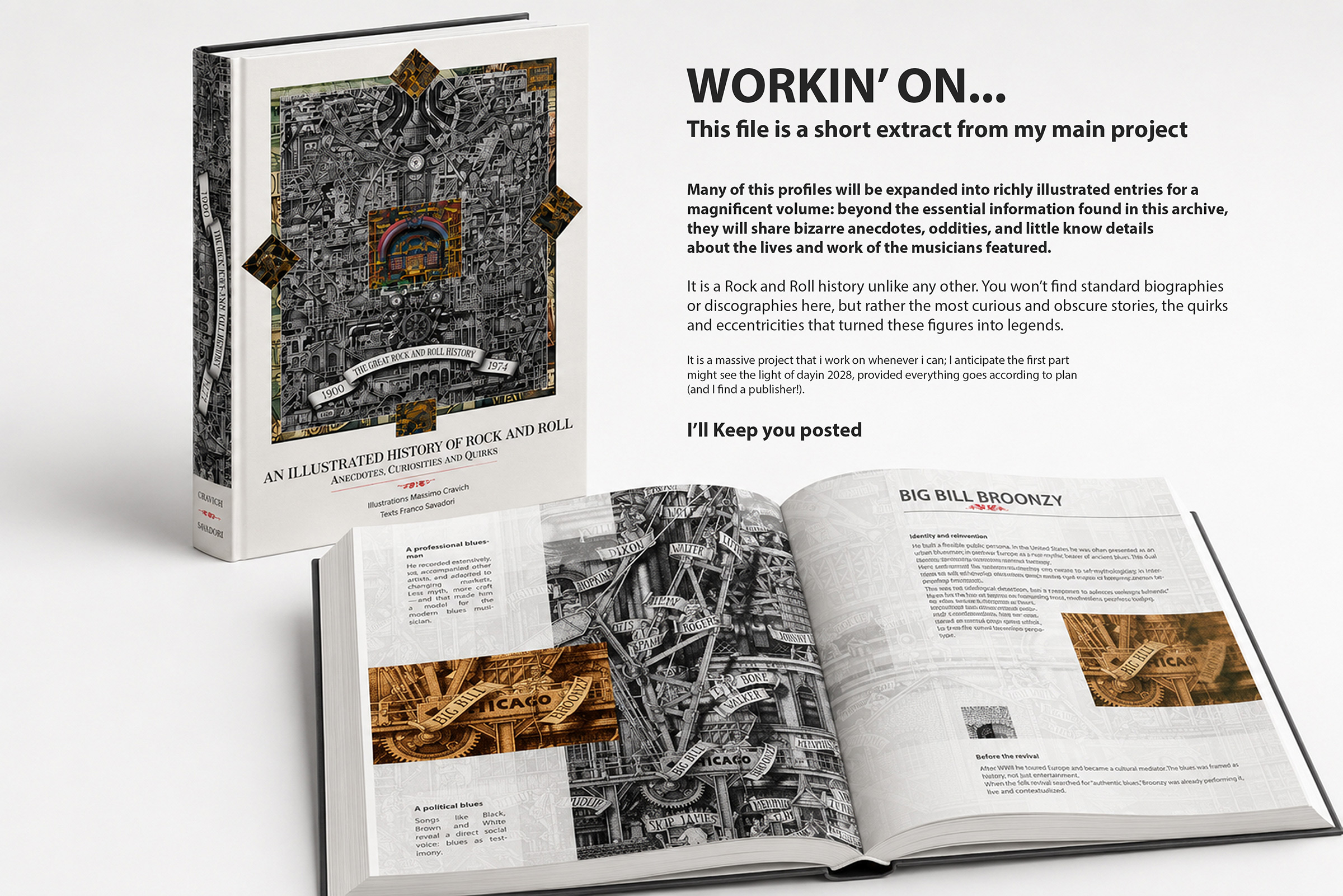
Related Artists
Lightnin’ Hopkins
Howlin’ Wolf
Canned Heat
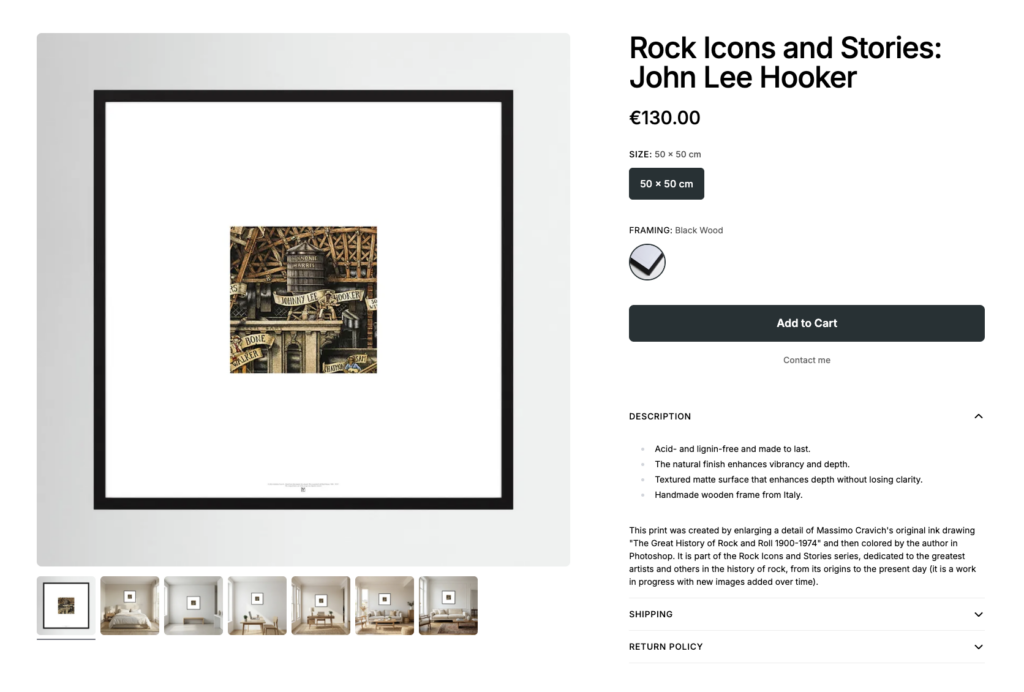
Get Your Rock Icon
Selected artworks from Rock Icons and Stories are available as high-quality framed art prints. Printed on premium 230 gsm matte paper with excellent detail and colour reproduction, each print is professionally framed and delivered ready to hang.A carefully selected, high-quality alternative to the museum-grade Fine Art Giclée editions, offering an accessible way to own and display a reproduction of the original artwork. Printing, framing and worldwide fulfilment are handled by our specialist printing partner.

SOURCES
• John Lee Hooker – official estate / biographical materials.
• Rock & Roll Hall of Fame – John Lee Hooker, inducted 1991.• Blues Foundation – John Lee Hooker, Blues Hall of Fame.
• Charles Shaar Murray, Boogie Man: The Adventures of John Lee Hooker in the American Twentieth Century.
• Historical Vee-Jay, Modern and Chess discographies covering Hooker’s major recordings.
In rock history, John Lee Hooker is one of the clearest examples of an old form generating future music. His irregular, hypnotic boogie, dark voice and radically economical riff connect Delta blues to electric blues and from there to rock. More than a repertoire to copy, Hooker left a principle: repetition, groove and intensity can transform very few elements into an entire musical universe.