
Hawkwind are an English rock band widely regarded as pioneers of space rock and one of the most experimental groups to emerge from the British psychedelic and progressive rock scenes. Hawkwind turned British space rock into a collective experience of hypnotic rhythms, science fiction, electronics and multimedia performance. Formed in London in 1969 around Dave Brock, they brought together the free-festival counterculture and a physical, repetitive approach to rock. This illustrated profile explores their cosmic sound, improvisational approach and cultural influence within The Great Rock and Roll History, a large-scale illustrated timeline of modern music.
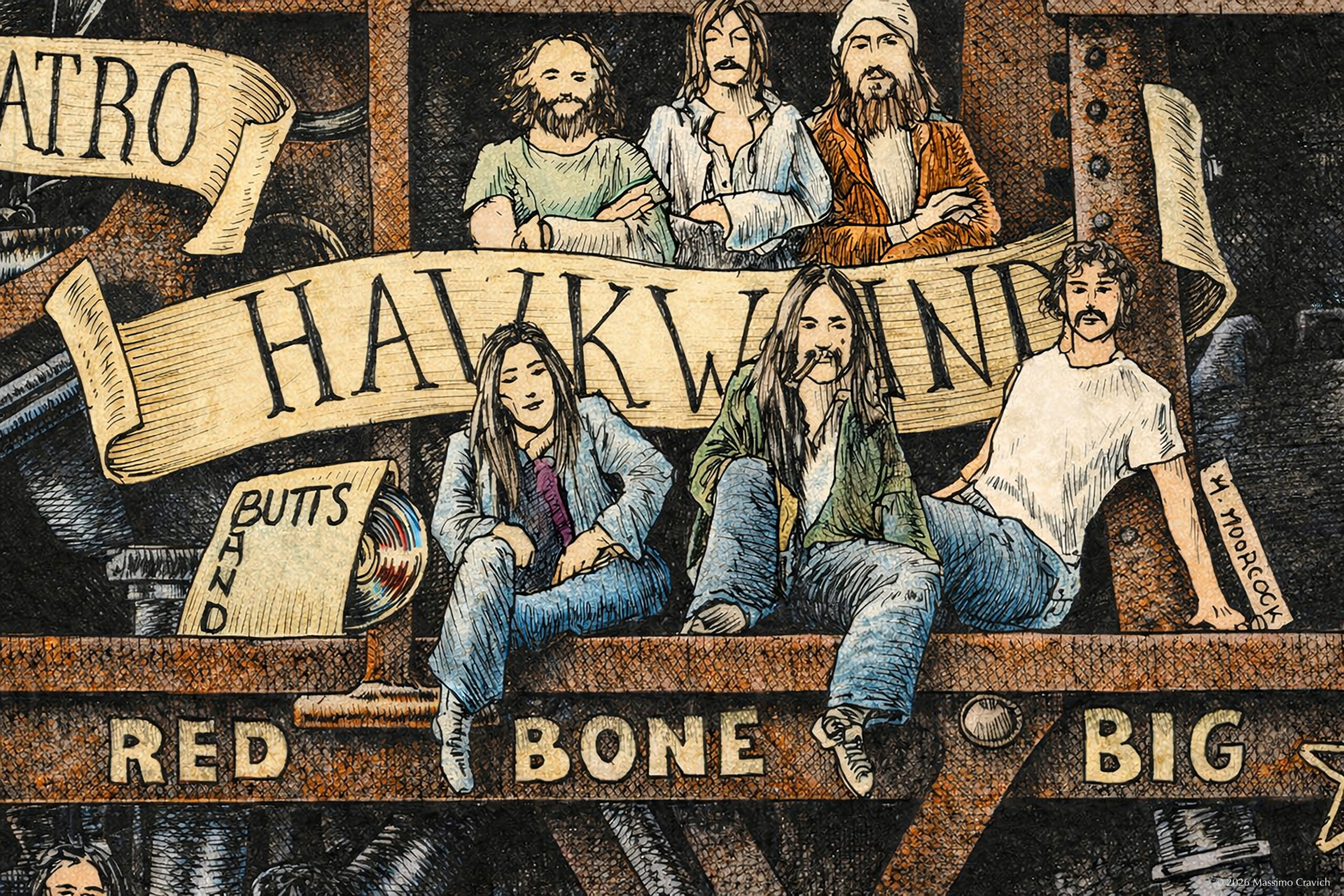
Rock Icons: Hawkwind
English space rock pioneers blending psychedelic improvisation, electronic experimentation and science fiction imagery. By combining psychedelic improvisation, electronic textures and science fiction imagery, Hawkwind helped expand the sonic possibilities of rock music. From In Search of Space to Space Ritual, Hawkwind combined distorted guitars, synthesizers, science fiction and relentless rhythms to create a form of space rock far removed from symphonic progressive virtuosity.

Formed: 1969, London (UK)
Status: active (through multiple incarnations and lineups)
Genres: Space rock, Psychedelic rock, Proto-metal, Kraut-influenced rock
Historic core: Dave Brock, Nik Turner, Lemmy Kilmister (1971–1975), Simon King, Del Dettmar
ARTIST OFFICIAL SITE: www.www.hawkwind.com
LISTEN
More to discover…
Space rock: traveling without moving
Dave Brock and the road: more than a fixed lineup
Dave Brock came from London’s folk and blues circuit but imagined a group in which rhythmic repetition mattered more than solo display. Around him Hawkwind became a shifting, often unstable collective that found its natural environment at free festivals and within British alternative culture. This was more than hippie imagery: taking music beyond conventional venues gave the group a distinct social identity.
Yet collective freedom coexisted with strong personalities, precarious living conditions and continual personnel changes. Brock remained the central thread while other musicians contributed, each in their own way, to a constantly changing sound machine.
Silver Machine: unexpected success and internal tensions
With In Search of Space (1971), cosmic imagery became integral to both the music and the artwork. Nik Turner added saxophone and an unpredictable stage presence; electronics and effects stretched the sound. In 1972 Silver Machine, sung by Lemmy, became a chart hit: a paradox for a band so closely identified with the underground.
Lemmy brought distorted bass, rhythmic urgency and a more aggressive attitude, but his personality did not always fit the group’s internal balance. After his dismissal in 1975 he founded Motörhead, taking the name from a Hawkwind song. The episode reveals an unusual lineage: communal space rock could also give rise to one of heavy rock’s most direct forms.

Space Ritual: science fiction, bodies and spectacle
Space Ritual (1973) captured the ambition to create not merely a concert but an immersive environment. Robert Calvert’s words and ideas, along with those of science-fiction writer Michael Moorcock, met lighting, projections, costumes and Stacia’s dancing. Science fiction offered an indirect way to address power, alienation and escape, but onstage the message was transmitted above all through volume and repetition.
The effect was physical before it was narrative. Beneath the apparent unity were very different contributions: Calvert’s wit and imagination, Turner’s theatricality, Brock’s musical persistence and Barney Bubbles’s visual work. Their collaboration shows how much Hawkwind’s identity depended on people and art beyond the conventional rock lineup.
After the voyage: change and descendants
With Hall of the Mountain Grill and Warrior on the Edge of Time, the band expanded its arrangements, helped by violinist and keyboardist Simon House. Internal disagreements and departures nevertheless prevented any lineup from becoming permanent. Robert Calvert later returned to lead important phases, while Brock continued renewing Hawkwind through punk, electronics and later revivals of interest in space rock.
Their influence extends beyond the genre they helped establish: repetitive drive, directness and a refusal of technical perfection resonated with punk, metal, stoner rock and later psychedelia. In rock genealogy, Hawkwind connect British psychedelia and experimental electronics to a rhythmic force that opened unexpected paths.
This approach positioned Hawkwind as one of the foundational forces behind space rock and later experimental forms of heavy and psychedelic music. Tracks such as Silver Machine, Master of the Universe and Brainstorm illustrate Hawkwind’s contribution to space rock through distorted bass, synthesizers and repetitive structures. Albums such as Space Ritual became defining examples of space rock experimentation during the 1970s.
Within The Great Rock and Roll History, Hawkwind also tell an alternative music-industry story: free festivals, underground audiences, visionary sleeve design and multimedia concerts built a cultural circuit alongside large-scale progressive productions.
Influenced by
- Psychedelic culture
- Electronic experimentation
- Science fiction and fantasy literature (Moorcock)
- Late-1960s British psychedelia.
- Pink Floyd
- The Velvet Underground
- The Jimi Hendrix Experience
- Amon Düül II
- British blues
Influent For
- Motörhead and fast metal.
- Spiritualized and modern space rock.
- Monster Magnet and stoner rock.
- Ozric Tentacles
- The Sisters of Mercy
- Orange Goblin
- European psychedelic / neo-psych scenes.
- Trance electronics and ambient rock hybrids.
Related Artists
- Motörhead and fast metal.
- Robert Calvert
- Michael Moorcock
- Gong
- Pink Fairies
Selected Sources
• Hawkwind — general profile (Wikipedia).
• Lemmy Kilmister biographies and interviews.
• Michael Moorcock collaborations with Hawkwind.
• Live performance archives and documentaries.
Encyclopaedia Britannica – Hawkwind: https://www.britannica.com/topic/Hawkwind
Discogs – Hawkwind discography: https://www.discogs.com/artist/74333-Hawkwind
In rock history, Hawkwind represent a path through space rock where experimentation never loses contact with the body or the audience. Dave Brock and his collaborators turned an unstable lineup into a lasting project that could absorb electronics, science fiction and new rock energies. Their legacy lies as much in the music as in the idea of a concert as a shared experience built from sound, images and community.