
Carly Simon turned private confession, wit and vulnerability into a pop language that crossed folk, rock and American songwriting. In The Great Rock and Roll History, , her story also traces the independence of a writer who refused to be defined solely as somebody’s muse or partner.

Rock Icons: Carly Simon
An elegant voice, a restless spirit and the courage to reveal herself.

From her solo debut to You’re So Vain, Anticipation and Nobody Does It Better, Carly Simon developed a distinctive voice within 1970s American songwriting.
Full name Carly Elisabeth Simon
Born June 25, 1943, New York City
Early career Folk duo the Simon Sisters with her sister Lucy
Solo debut 1971, album Carly Simon
Styles Singer-songwriter, folk rock, pop rock, adult contemporary
Collaborations and connections James Taylor, Mick Jagger, Richard Perry; later film composers
Awards Best New Artist Grammy; Academy Award and Grammy for Let the River Run
Artist Official Site: Carlysimon.com
LISTEN
That’s the Way I’ve Always Heard It Should Be
More to discover…
A house full of books, a voice of her own
The daughter of Richard Simon, co-founder of Simon & Schuster, Carly grew up in a culturally privileged household that was nevertheless far from free of shadows. Childhood stuttering made singing a kind of liberation: melody allowed her to express what ordinary speech sometimes could not. With her sister Lucy, she formed the folk duo the Simon Sisters, learning vocal interplay and the demands of performing.
By the time she launched her solo career in the early 1970s, her writing already had a distinctive quality: she examined feelings without idealizing them, shifting between tenderness, desire and sometimes ruthless clarity. That’s the Way I’ve Always Heard It Should Be questioned marriage as an inevitable destination, making a personal dilemma resonate with women seeking greater independence.
A song’s mystery and the burden of being watched
With Anticipation and especially You’re So Vain, Simon became an international star. The latter song also set a trap for listeners: speculation over the vain man’s identity lasted for decades, while the song’s real achievement was its sharp portrait of an unequal relationship. Mick Jagger’s uncredited backing vocals added to the record’s mystique.
Fame, however, made privacy harder to protect. Simon struggled with stage fright, and the gap between her success on record and the difficulty of performing became part of her story. Her sophisticated public image could obscure the work of a songwriter who turned deeply intimate contradictions into shared experience.
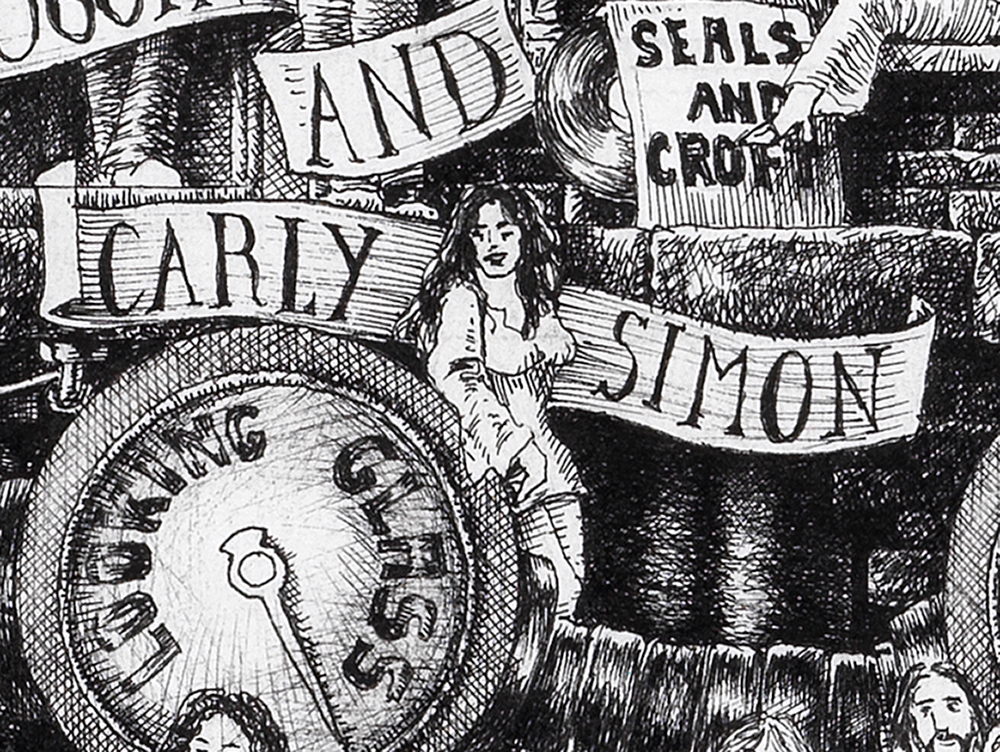
Carly and James: two writers, one family in the spotlight
In 1972 she married James Taylor. Their marriage, two children and occasional collaborations made them, in the public imagination, an ideal couple of American songwriting. Behind the photographs and duets, however, were demanding careers, vulnerabilities and problems no public image could resolve.
Simon continued to forge her own path: Hotcakes, Playing Possum and Boys in the Trees belong to the work of an artist unwilling to be reduced to a famous colleague’s wife. The couple divorced in 1983. Reading every song as a literal diary of that marriage would miss the point: her skill lay in transforming experience, observation and invention into emotions others could recognize.
Beyond the seventies: film, memory and independence
Carly’s voice found new settings beyond the traditional album circuit. Nobody Does It Better, the theme from the James Bond film The Spy Who Loved Me, showed how completely she could inhabit a song written by others. Later, she wrote and performed Let the River Run for Working Girl, winning an Academy Award and reaffirming her standing as a composer. Her subsequent career embraced further recordings, books and public reflections on her life.
Her place in rock history does not depend on electric volume: she brought a complex, sometimes uncomfortable autobiography into mainstream pop, addressing female independence, longing and disillusion without sacrificing melody.
Carly Simon helped redefine the female singer-songwriter in American pop rock, combining confessional writing, folk sensibility and exceptionally accessible melodies.
In The Great Rock and Roll History, Carly Simon marks the transition from the folk revival to the singer-songwriter era, when personal experience became central to popular music and women claimed greater space as writers.
Influenced by
Odetta
Joan Baez
The Everly Brothers
Influent For
Tori Amos
Sarah McLachlan
Sheryl Crow
Sara Bareilles
Taylor Swift
Related Artists
James Taylor
Carole King
Joni Mitchell
Cat Stevens
Lucy Simon
Get Your Rock Icon
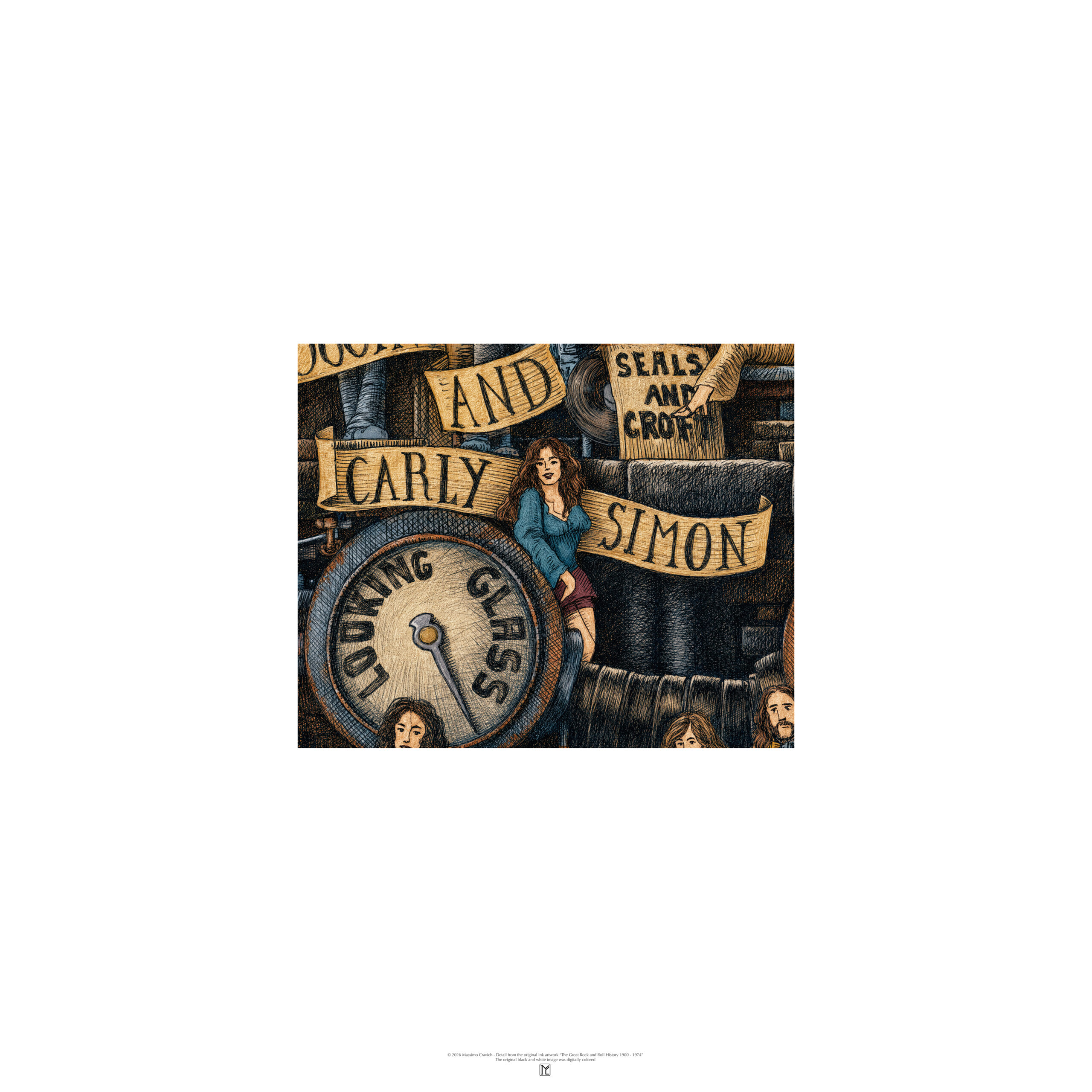
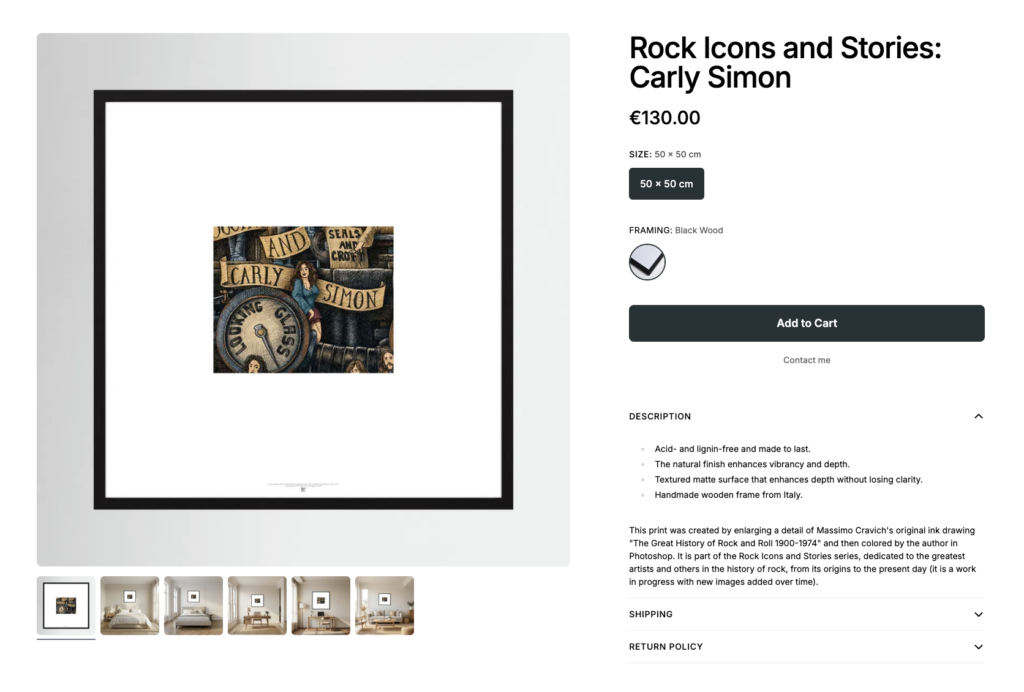
Selected artworks from Rock Icons and Stories are available as high-quality framed art prints. Printed on premium 230 gsm matte paper with excellent detail and colour reproduction, each print is professionally framed and delivered ready to hang.A carefully selected, high-quality alternative to the museum-grade Fine Art Giclée editions, offering an accessible way to own and display a reproduction of the original artwork. Printing, framing and worldwide fulfilment are handled by our specialist printing partner.
SOURCES
Carly Simon official website
Rock & Roll Hall of Fame
Encyclopaedia Britannica
Carly Simon is far more than the voice of You’re So Vain: she helped make 1970s songwriting more intimate, ambiguous and modern. Across folk, pop and film, her career connects artistic independence, complicated relationships and an unmistakable songwriting voice.