
Before becoming the intimate voice of Tapestry, Carole King had already helped write the language of American pop. From the Brill Building songwriting rooms to California’s singer-songwriter scene, her story spans rock and roll, vocal groups and the rise of the confessional album. In The Great Rock and Roll HistoryHistory, she is an essential link between the people who wrote hits for others and the artists who finally found the courage to sing their own stories.

Rock Icons: Carole King
From writing songs for others to finding her own voice.

Carole King transformed professional pop songwriting into a personal language: from her partnership with Gerry Goffin to Tapestry, she combined melody, vulnerability and remarkable storytelling.
Full name Carole Joan Klein
Born February 9, 1942, New York City
Roles Singer-songwriter, composer, pianist
Key Scenes Brill Building, New York; Laurel Canyon and Los Angeles
Collaborators Gerry Goffin, Lou Adler, James Taylor, Joni Mitchell
ARTIST OFFICIAL SITE: www.caroleking.com
LISTEN
(You Make Me Feel Like) A Natural Woman
More to discover…
A girl at the piano in pop music’s workshop
Carole Klein grows up in Brooklyn in a family that encourages music. She studies piano as a child and soon reveals something rarer than technical skill: an instinct for melodies that sound as though they have always existed. Still very young, she enters New York’s music circles, meets Paul Simon and Neil Sedaka, and encounters Gerry Goffin at Queens College.
They marry in 1959, become parents and begin writing songs at a time when pop is a collective trade involving publishers, arrangers, producers and performers. In and around the Brill Building, the pair combines Carole’s immediate, memorable music with Gerry’s lyrics, often capturing teenage uncertainty without talking down to teenagers. Behind the glitter of the hit singles is also a young woman balancing songwriting, motherhood and an increasingly complicated marriage.

Songs that belong to everyone, troubles kept private
Their breakthrough comes with Will You Love Me Tomorrow, recorded by the Shirelles: a startlingly candid romantic question that brings a new sensitivity to the top of the charts. Then come Take Good Care of My Baby for Bobby Vee, The Loco-Motion for Little Eva, Up on the Roof for the Drifters and (You Make Me Feel Like) A Natural Woman, immortalized by Aretha Franklin.
There is no single Goffin-King ‘sound’: their songs move from doo-wop to soul, from rhythmic exuberance to adult emotion. As their catalogue wins over the public, their relationship deteriorates. The distance between professional success and domestic fragility becomes a defining tension in Carole’s story. For years she has supplied the words and music through which others express their feelings, without yet establishing an artistic space entirely her own.
California and Tapestry: singing without a mask
By the late 1960s her marriage and regular writing partnership with Goffin have ended. King moves west and, following her work with the group the City, releases Writer. Her proximity to James Taylor, Joni Mitchell and California’s singer-songwriter community helps her move beyond the idea that she is simply a studio composer.
Released in 1971, Tapestry does not invent confessional songwriting; it makes it accessible to an enormous audience without sacrificing intimacy or rough edges. It’s Too Late, written with Toni Stern, addresses the end of a relationship without turning it into a battle; You’ve Got a Friend offers comfort without grand gestures; So Far Away captures the weight of distance.
Her voice makes no attempt at virtuoso display, and for that reason it seems to speak directly to the listener. The album’s extraordinary success also changes the industry’s perception of a woman who writes, plays and performs her own material.
Beyond the masterpiece: independence, memory and endurance
The danger of a monumental album is that it becomes an unfair measure of everything that follows. King continues recording, including Music and Rhymes & Reasons, while navigating personal changes, further marriages and artistic choices that refuse to repeat Tapestry mechanically.
Her life also includes painful periods in relationships, discussed with notable candour in her later memoir. In subsequent decades, renewed attention to her catalogue and the musical Beautiful bring both musical lives back into focus: the writer of songs everyone knew and the performer who showed that vulnerability could be a form of strength. Her legacy reaches beyond soft rock into songwriter-led pop and soul, demonstrating that an apparently simple melody can hold an entire biography.
Between the Brill Building and Tapestry, Carole King helped bridge the gap between commissioned pop songwriting and the personal voice of the modern singer-songwriter
Within The Great Rock and Roll History, Carole King also illuminates the often-invisible work of songwriters behind major performers: from the Shirelles to Aretha Franklin and onward to a generation that brought composers into the spotlight.
Influenced by
- Gershwin and the American songbook
- Rhythm and blues
- New York doo-wop
- Little Richard
- Buddy Holly
Influent For
- James Taylor
- Carly Simon
- Tori Amos
- Sara Bareilles
- Alicia Keys
Related Artists
Gerry Goffin
The Shirelles
Joni Mitchell
James Taylor
Get Your Rock Icon
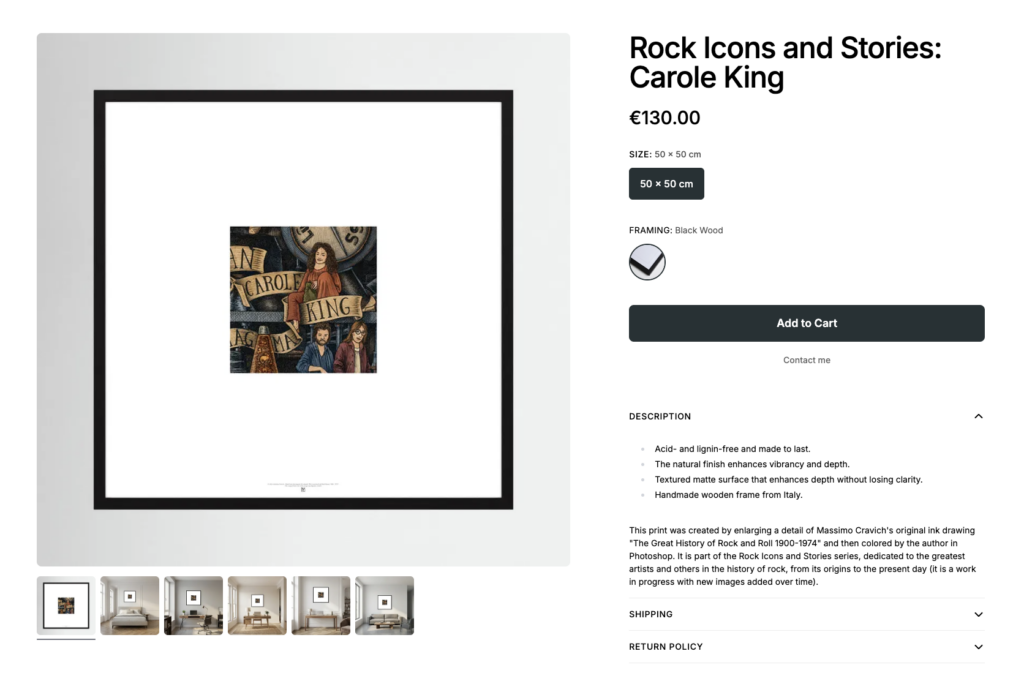
Selected artworks from Rock Icons and Stories are available as high-quality framed art prints. Printed on premium 230 gsm matte paper with excellent detail and colour reproduction, each print is professionally framed and delivered ready to hang.A carefully selected, high-quality alternative to the museum-grade Fine Art Giclée editions, offering an accessible way to own and display a reproduction of the original artwork. Printing, framing and worldwide fulfilment are handled by our specialist printing partner.

SOURCES
Carole King official: https://www.caroleking.com/
Songwriters Hall of Fame: https://www.songhall.org/
Rock & Roll Hall of Fame: https://rockhall.com/
Within the broader history of American counterculture, Country Joe McDonald represents one of the mostradical, ironic and influential figures of 1960s protest music. His work permanently reshaped the relationship between political folk, psychedelia and cultural activism.