
The Rolling Stones are an English rock band formed in 1962, widely regarded as one of the most influential groups in the history of rock music. This illustrated profile explores their musical evolution, cultural impact and enduring legacy within The Great Rock and Roll History, a large-scale illustrated timeline of modern music.
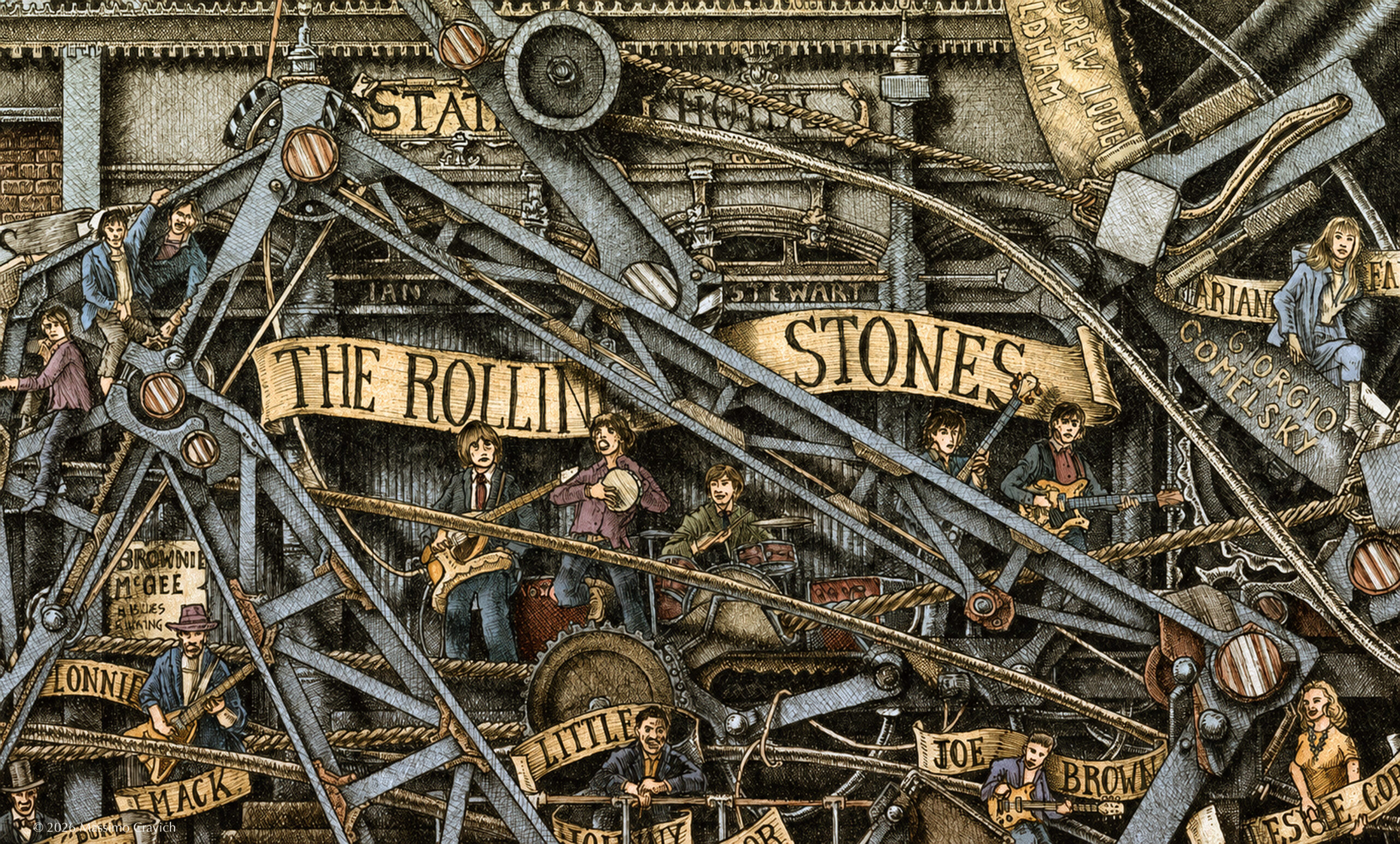
Rock Icons: The Rolling Stones
The British band that turned Chicago blues, Chuck Berry riffs, rhythm & blues and rebellious attitude into a permanent grammar of rock.

From their 1962 beginnings in London’s blues circuit to the Jagger-Richards songwriting partnership and the classic run from Beggars Banquet to Exile on Main St., the Rolling Stones became a crucial bridge between African-American roots music, the British Invasion and the later language of hard rock, punk and guitar-based rock.
Formed: 1962
Classic Line up: Mick Jagger, Keith Richards, Brian Jones, Charlie Watts, Bill Wyman – Mick Taylor – Ron Wood
Key Figures: Andrew Loog Oldham, Jimmy Miller, Anita Pallenberg
Genres: Blues Rock, Rock and Roll, Hard Rock
ARTIST OFFICIAL SITE: www.rollingstones.com
LISTEN
More to discover…
The blues apprentices who became the archetype of the rock band

The Rolling Stones began not by trying to invent rock from nothing, but by listening obsessively to American blues and R&B.; Muddy Waters, Chuck Berry, Jimmy Reed, Howlin’ Wolf and other Black American artists supplied a musical vocabulary that young British musicians could hear on imported records but rarely encounter in person.
Brian Jones was central to the band’s earliest blues identity; Mick Jagger brought a voice capable of moving fromimitation toward theatrical personality, while Keith Richards gradually transformed Berry-derived guitar figures into an unmistakable riff language.
Their importance lies in what happened next. The Stones did not remain revivalists. Under manager Andrew Loog Oldham, Jagger and Richards were pushed toward original songwriting, and the group developed a public identity deliberately rougher than the polished image associated with much early British pop. Across the late 1960s and early 1970s, the music absorbed country, gospel, soul, psychedelia and harder electric textures without losing its rhythmic center. The result became an archetype: dangerous-looking, blues-rooted, sexually charged, imperfect, durable and built around the chemistry of a band rather than studio cleanliness.
Albums such as Aftermath, Beggars Banquet, Let It Bleed, Sticky Fingers and Exile on Main St. established the Rolling Stones as a central reference point for blues rock, hard rock, roots rock and the enduring mythology of the guitar band.
Within The Great Rock and Roll History, the Rolling Stones occupy a decisive genealogical junction: American blues and R&B; pass through the British blues boom and return to the world as a new model of rock band, influencing generations from glam and punk to hard rock, alternative rock and garage revival.
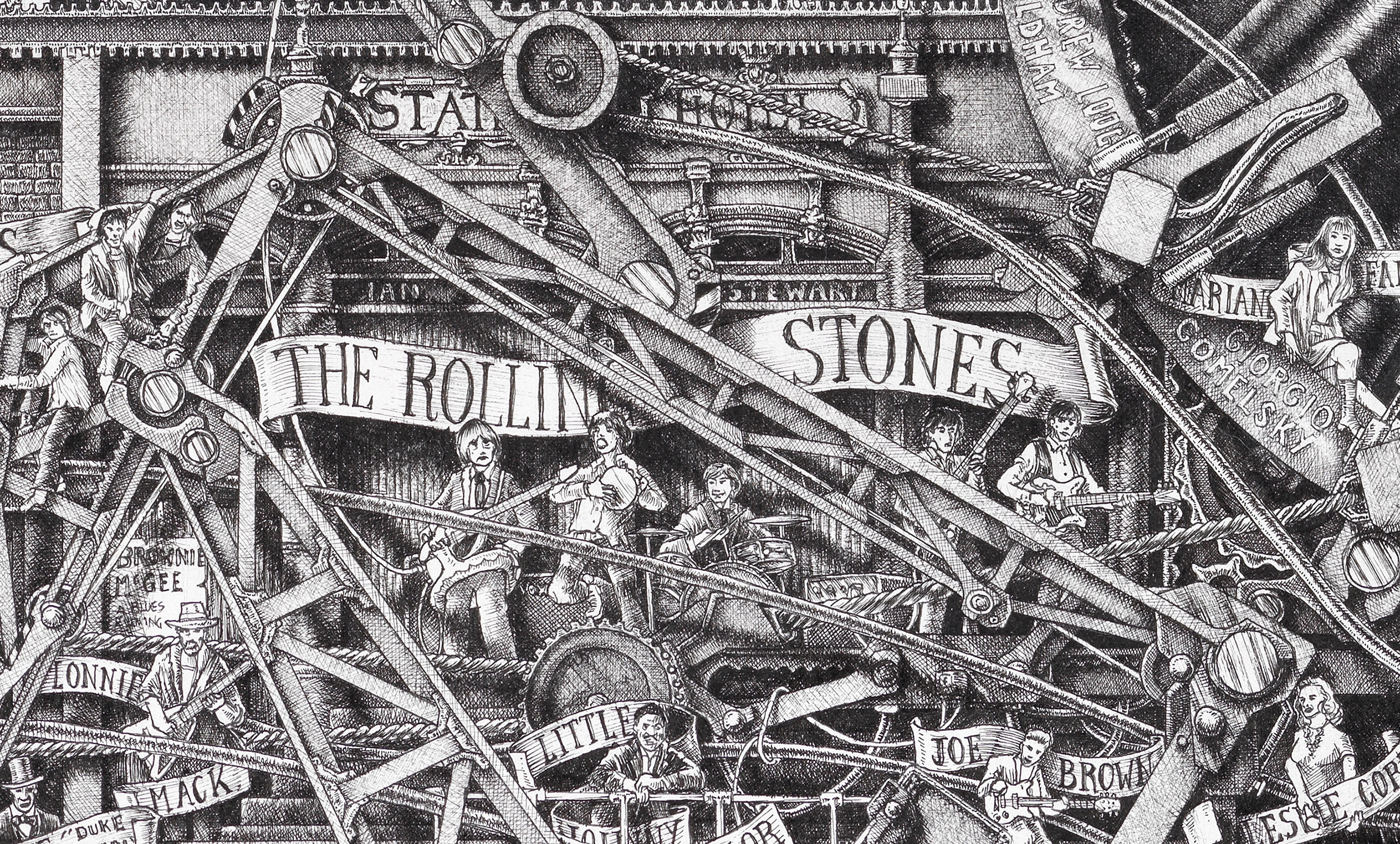
Influenced by
- Blues, Chicago Blues,
- John Lee Hooker
- Muddy Waters
- Chuck Berry
- Bo Diddley
- Rhythm and Blues e Soul
- Country Rock
Influent For
- Aerosmith – the Jagger-Richards model of singer/guitarist chemistry and blues-based hard rock.
- New York Dolls – Stones-derived swagger, visual provocation and loose rock and roll energy.
- The Clash – a model to react against and inherit at the same time: streetwise rock, rhythm and cultural friction.
- The White Stripes – the return to blues fundamentals filtered through stripped-down modern rock.
- They influenced subsequent genres, from punk rock to hair metal, maintaining a constant influence for over six decades
Related Artists
Get Your Rock Icon
Selected artworks from Rock Icons and Stories are available as high-quality framed art prints. Printed on premium 230 gsm matte paper with excellent detail and colour reproduction, each print is professionally framed and delivered ready to hang.A carefully selected, high-quality alternative to the museum-grade Fine Art Giclée editions, offering an accessible way to own and display a reproduction of the original artwork. Printing, framing and worldwide fulfilment are handled by our specialist printing partner.


SOURCES
• The Rolling Stones – official website: rollingstones.com
• Rock & Roll Hall of Fame – The Rolling Stones inductee profile: rockhall.com/inductees/rolling-stones/
• Rock & Roll Hall of Fame – 1989 Rolling Stones induction essay.
• Bill Wyman with Ray Coleman, Stone Alone, Viking, 1990.
• Keith Richards with James Fox, Life, Little, Brown, 2010.
• Philip Norman, The Stones, Sidgwick & Jackson, 1984.
Within the broader history of rock music, the Rolling Stones represent one of the most important transformations of American blues and R&B; into a global rock language. Their riffs, stage image, songwriting partnership and rhythmic looseness shaped blues rock and hard rock, while their longevity made the very idea of the enduring rock band part of popular culture.