
Reverend Gary Davis was one of the great masters of American fingerstyle guitar: a preacher, gospel singer and bluesman who fused ragtime, Piedmont blues, spiritual music and religious song with an almost orchestral command of the instrument.
This illustrated profile explores Reverend Gary Davis’ roots, guitar language and enormous legacy The Great Rock and Roll History, where he forms a crucial link between pre-war acoustic blues, gospel, the folk revival and later generations of guitarists.
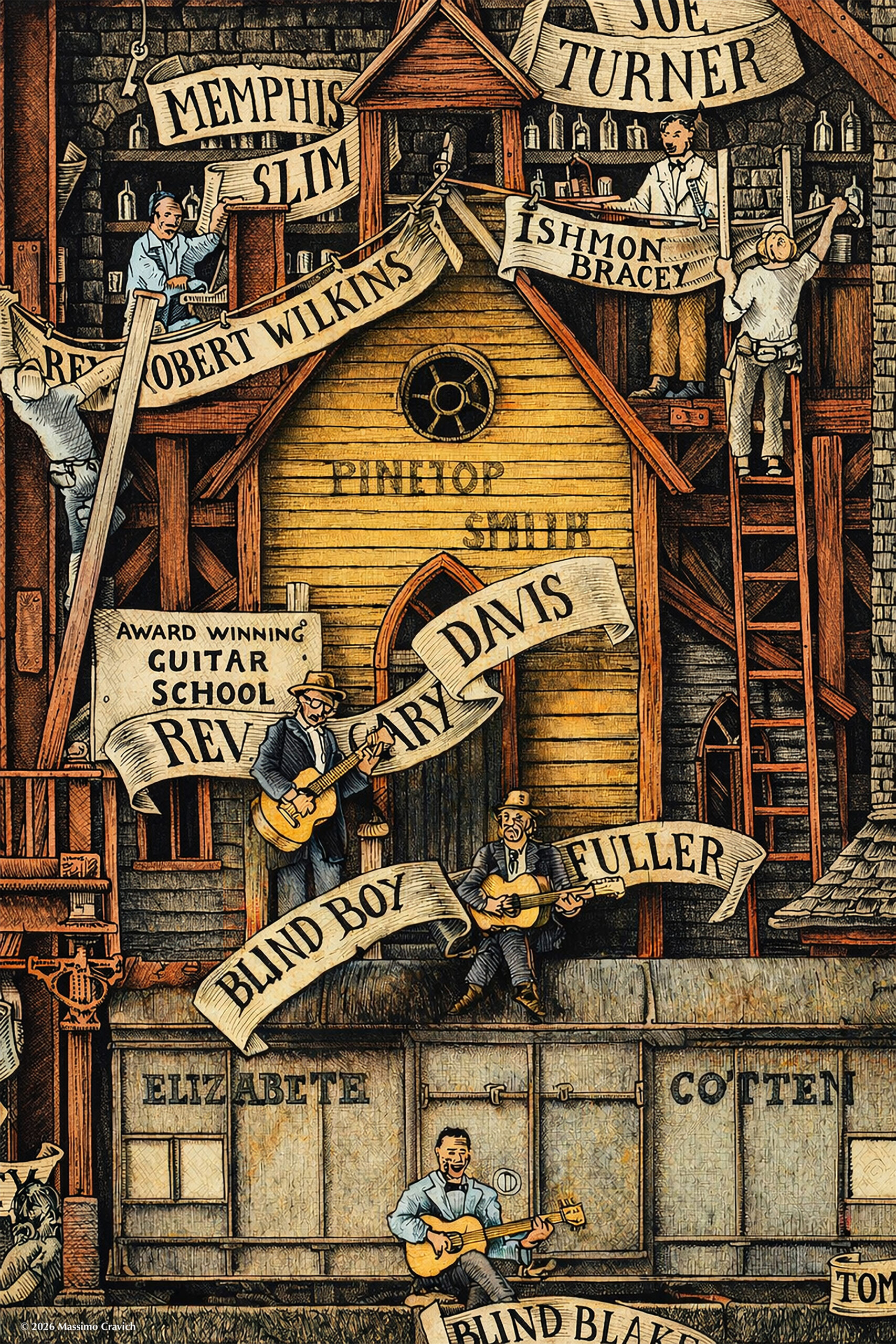
Rock Legends: Reverend Gary Davis
The blind preacher who turned one guitar into bass, rhythm, melody and counterpoint – and became a hidden master of folk and rock.
From Piedmont blues and ragtime to gospel music and the New York folk revival, Reverend Gary Davis developed an unmistakable fingerpicking style that profoundly influenced Dave Van Ronk, Jorma Kaukonen, Stefan Grossman and generations of folk, blues and rock guitarists.

Full name Gary D. Davis
Born: April 30, 1896, Laurens (South Carolina, USA)
Died: May 5, 1972, Hammonton (New Jersey, USA)
Genres: gospel blues, Piedmont blues, country blues, folk blues
Instruments: guitar, vocals (also banjo)
Occupation Musician, singer, preacher and guitar teacher
Key locations The Carolinas; later New York City
Historical role: a fingerpicking colossus: one-man orchestra bridging church music, ragtime and urban blues
LISTEN
Say No to the Devil (gospel with a blade in the pocket)
More to discover…
One guitar capable of containing an entire orchestra
Gary Davis belonged to a generation of African-American musicians for whom blues, ragtime, spirituals and religious music were not rigidly separated territories. Born in South Carolina and almost completely blind from childhood, he developed an extraordinary independence on the guitar.
The Piedmont blues tradition, with its alternating bass recalling ragtime piano, formed one basis of his language, but Davis pushed it much further: thumb and fingers could simultaneously create bass, chords, melody, syncopation and counterpoint, often giving the impression that several instruments were playing at once.
During the 1930s he recorded both blues and religious material, but after becoming an ordained Baptist minister gospel moved to the center of his life and repertoire. This did not erase the blues from his musical language; it transformed it. The same rhythmic tension, vocal inflections and guitar sophistication could support sung sermons, spirituals or sacred compositions. ‘Death Don’t Have No Mercy’ carries a gravity that exceeds genre categories, while pieces such as ‘Samson and Delilah’ show how biblical storytelling, groove and instrumental virtuosity could coexist naturally.
The second decisive chapter of his story unfolded in New York, where Davis became a crucial figure for the folk-revival generation. He was not simply rediscovered: he taught. Young musicians sought him out to learn tunings, fingerings, alternating bass patterns and, above all, a way of thinking about the guitar. Dave Van Ronk, Stefan Grossman and Jorma Kaukonen were among those who absorbed his lessons directly or profoundly; through them, and through performers such as Bob Dylan and the Grateful Dead who carried his songs to new audiences, his vocabulary entered folk rock and rock. Gary Davis is therefore a striking example of a musician who may appear peripheral in commercial history but becomes one of its major junctions when the genealogy is examined.
Recordings such as Death Don’t Have No Mercy, Samson and Delilah, Candyman and I Am the Light of This World show why Reverend Gary Davis remains an essential figure in Piedmont blues, gospel blues and the modern fingerstyle guitar tradition.
Within The Great Rock and Roll History, Reverend Gary Davis occupies a particularly valuable genealogical position: ragtime, Piedmont blues and African-American religious tradition converge in a guitar language that passes through the Greenwich Village folk revival and reaches directly into folk rock, modern acoustic music and guitarists connected even to San Francisco psychedelia.
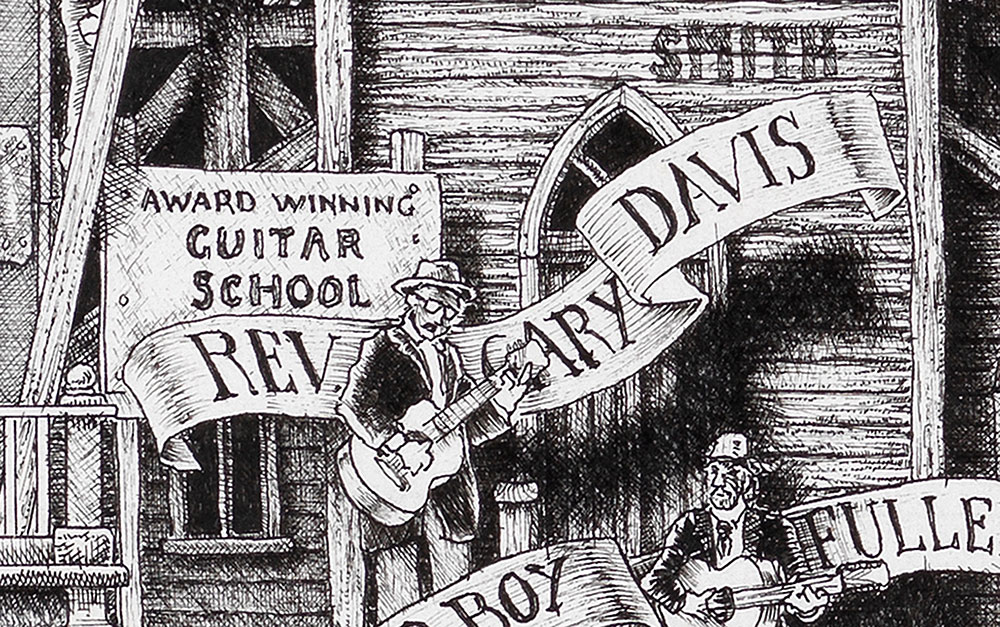
Influenced by
- Blind Blake
- Blind Willie Johnson
- Blind Boy Fuller
- Ragtime
- African-American gospel tradition
Influent For
- Dave Van Ronk
- Stefan Grossman
- Jorma Kaukonen
- Bob Dylan
- Grateful Dead
Reverend Gary Davis Declared or strongly recognized influence:
Jerry Garcia, Jorma Kaukonen, Ry Cooder, Taj Mahal
John Sebastian, Wizz Jones, Keb’ Mo’ (and many later fingerstyle scenes).
Documented students / lesson connections:
Stefan Grossman, Dave Van Ronk, David
Bromberg, Steve Katz, Roy Book Binder, Larry Johnson, Nick Katzman, Rory Block, Ernie Hawkins,
Larry Campbell, Bob Weir, Woody Mann, Tom Winslow (and others).
Related Artists
Brownie McGhee
Sonny Terry
Dave Van Ronk
Jorma Kaukonen
Get Your Rock Icon
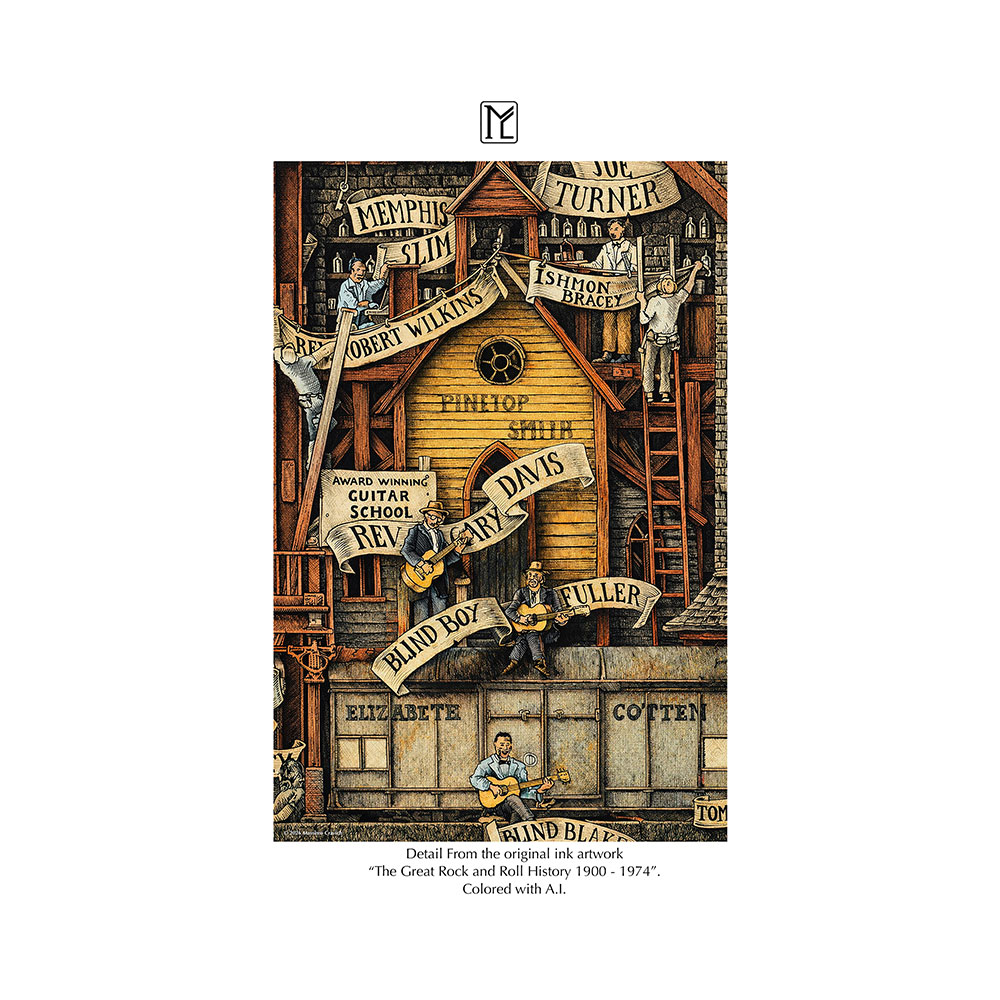
Selected artworks from Rock Icons and Stories are available as high-quality framed art prints. Printed on premium 230 gsm matte paper with excellent detail and colour reproduction, each print is professionally framed and delivered ready to hang.A carefully selected, high-quality alternative to the museum-grade Fine Art Giclée editions, offering an accessible way to own and display a reproduction of the original artwork. Printing, framing and worldwide fulfilment are handled by our specialist printing partner.

SOURCES
• Stefan Grossman – instructional materials and testimony on Reverend Gary Davis.
• Smithsonian Folkways – Reverend Gary Davis recordings and historical notes.
• American folk-revival histories concerning the Piedmont tradition and Greenwich Village scene.
• Ian Zack, Say No to the Devil: The Life and Musical Genius of Rev. Gary Davis, University of Chicago Press, 2015.
Within the broader history of rock, Reverend Gary Davis represents one of the hidden but essential links between early African-American music and modern guitar language. His synthesis of Piedmont blues, ragtime and gospel, transmitted in part through direct teaching to musicians of the folk revival, entered folk, folk rock, the blues revival and the guitar culture of later generations.