
Pink Floyd were an English rock band widely regarded as one of the most influential and visionary groups in the history of modern music. From the psychedelic London underground of the Syd Barrett years to the large-scale conceptual architecture of The Dark Side of the Moon, Wish You Were Here, Animals and The Wall, they transformed rock into a space for sound design, visual theatre, philosophical unease and social criticism.
This illustrated profile explores Pink Floyd’s sonic imagination, conceptual songwriting and cultural influence within The Great Rock and Roll History, a large-scale illustrated timeline of modern music.
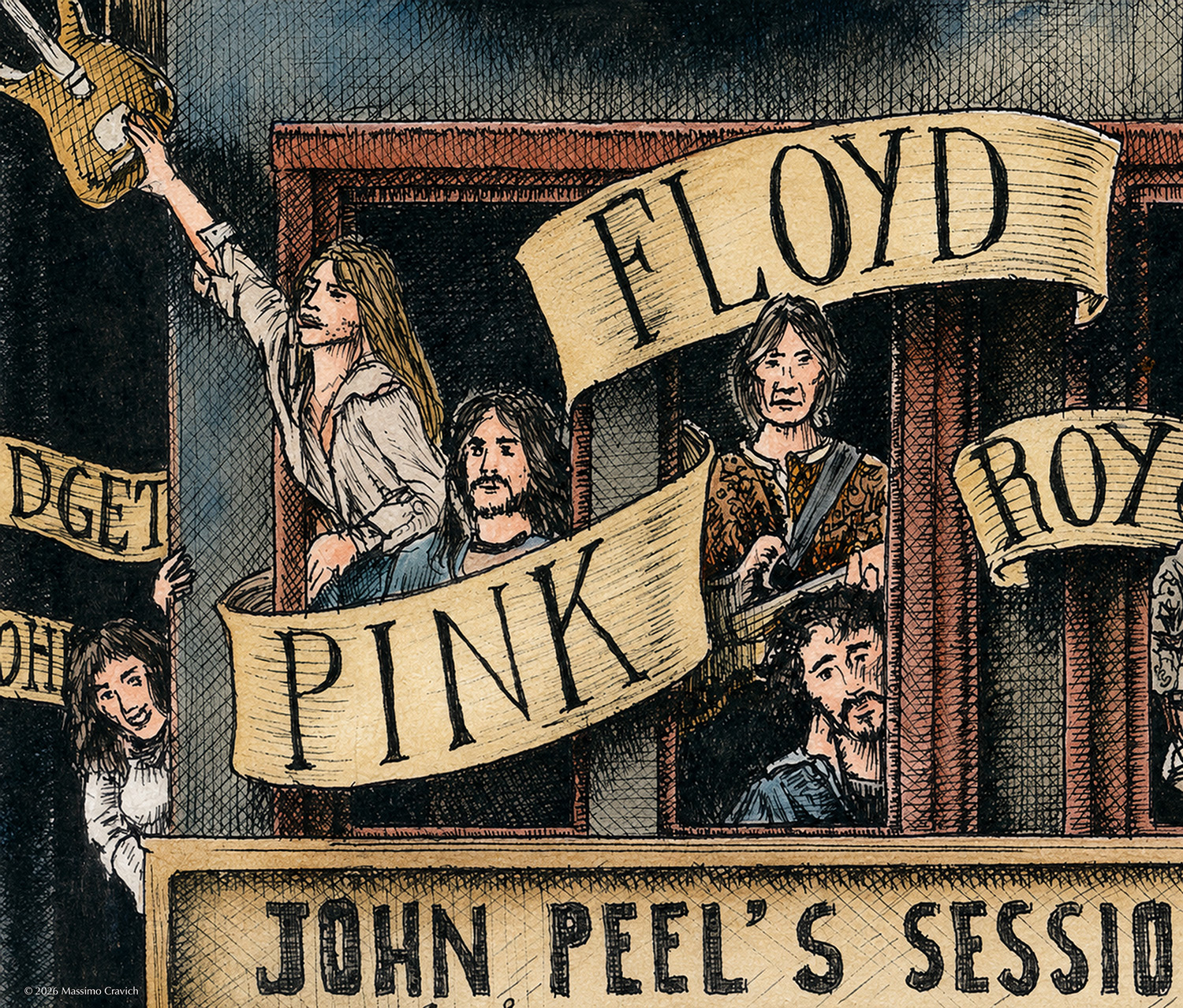
Rock Icons: Pink Floyd

English psychedelic and progressive rock band blending sonic experimentation, conceptual albums, visual theatre, philosophical lyrics and atmospheric guitar architecture.
By combining British psychedelia, studio experimentation, extended instrumental structures and concept-album narratives, Pink Floyd helped redefine rock music as an immersive visual, psychological and philosophical experience.
Founded: London, England – 1965
Status: Inactive as a continuing band; last major reunion with the classic Waters/Gilmour/Mason/Wright line-up at Live 8 in 2005; later studio activity without Roger Waters and the 2022 single Hey, Hey, Rise Up!
Classic Core:Syd Barrett, Roger Waters, Richard Wright, Nick Mason, David Gilmour
Genres: Psychedelic rock, progressive rock, art rock, space rock, experimental rock, blues-influenced rock
ARTIST OFFICIAL SITE: www.pinkfloyd.com
LISTEN
•Astronomy Domine – the Syd Barrett-era portal into London psychedelia and space-rock imagination.
• Echoes – the long-form bridge between early experimentation and mature progressive architecture.
• Time – the existential center of The Dark Side of the Moon and one of the band’s most universal statements.
• Shine On You Crazy Diamond – the elegiac monument to Syd Barrett and to the ghost inside the group’s history.
• Comfortably Numb – the Gilmour/Waters tension transformed into one of rock’s most iconic guitar and narrative moments.
More to discover…
The band that turned inner space into rock architecture
Pink Floyd did not simply expand rock music; they changed the scale on which rock could operate. In the beginning they were part of the London psychedelic underground, with Syd Barrett turning nursery-rhyme imagination, acid culture, science fiction and English eccentricity into short, strange pop visions.
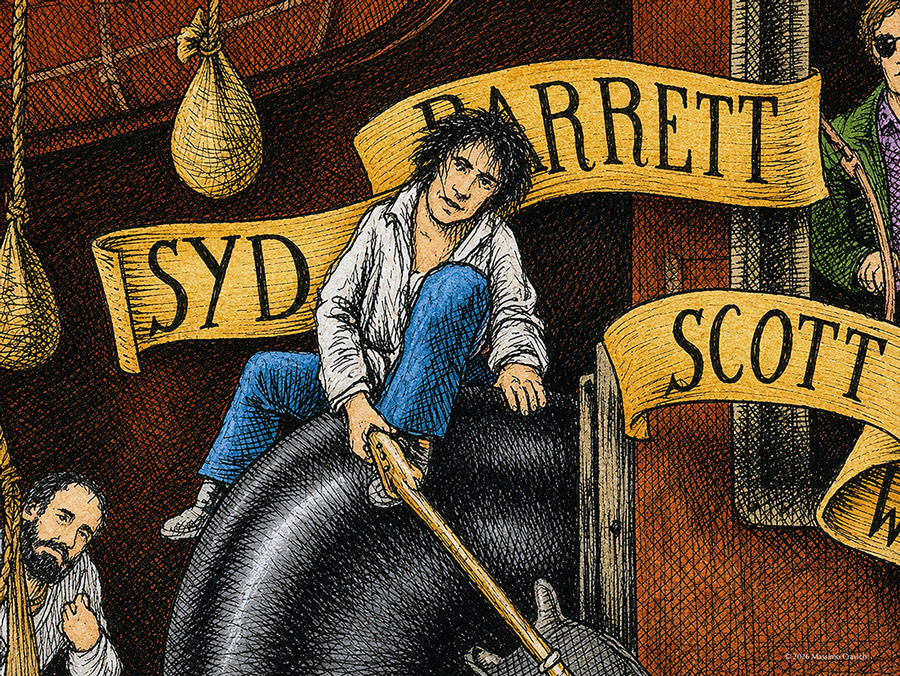
After Barrett’s collapse and David Gilmour’s arrival, the group slowly mutated into something very different: lesswhimsical, more architectural, more obsessed with space, time, absence, madness, alienation and control.
Their importance lies in the combination of opposites. Pink Floyd could be minimal and monumental, cold and emotional, technologically ambitious and deeply human. Roger Waters gave the band conceptual severity and political anger; David Gilmour gave it lyrical guitar and vocal melancholy; Richard Wright supplied harmonic mist and atmospheric depth; Nick Mason provided a restrained, unmistakable rhythmic pulse. The result was not virtuosity in the usual progressive-rock sense, but an art of atmosphere and psychological pressure.
In rock genealogy, Pink Floyd connect the underground experiments of the UFO Club and British psychedelia to progressive rock, stadium spectacle, ambient sound design, concept albums, post-punk gloom, electronic textures and later alternative music. Their records became not only collections of songs, but environments: worlds to enter, inhabit and remember.
Albums such as The Piper at the Gates of Dawn, The Dark Side of the Moon, Wish You Were Here, Animals and The Wall became defining landmarks of psychedelic rock, progressive rock, art rock and concept-album culture.
Pink Floyd’s music occupies a central position within the broader visual narrative of The Great Rock and Roll History, where psychedelic experimentation, progressive structures, visual culture and social critique become part of a larger genealogy of modern music.

Influenced by
- Syd Barrett-era British psychedelia and the London underground – for visual imagination, improvisation and acid-pop eccentricity.
- Blues and early electric guitar traditions – for the slow, expressive basis of David Gilmour’s language.
- Musique concrete, tape experiments and studio technology – for sound effects, loops, clocks, voices and sonic collage.
- Classical and cinematic atmosphere – for long-form architecture, dramatic pacing and thematic continuity.
- Social alienation, war memory and post-war Britain – especially through Roger Waters’s lyrical worldview.
Influent For
- Radiohead – for alienation, studio experimentation and the emotional use of sound texture.
- Porcupine Tree / Steven Wilson – for progressive rock, melancholy atmospheres and album-scale structure.
- Tool – for conceptual ambition, darkness and large-scale sonic architecture.
- The Flaming Lips – for psychedelic spectacle, studio imagination and surreal pop expansion.
- Ambient, post-rock and electronic artists – for treating sound as space, environment and psychological landscape.
Related Artists
- Syd Barrett – founder, songwriter and permanent ghost of the Pink Floyd mythology.
- Roger Waters – conceptual architect of the band’s darkest and most political phase.
- David Gilmour – guitarist and vocalist whose tone became central to the mature Pink Floyd sound.
- Alan Parsons – engineer on The Dark Side of the Moon and important figure in the album’s sonic identity.
- Storm Thorgerson / Hipgnosis – visual collaborators who helped define the band’s iconic imagery.
SOURCES
Pink Floyd official website and archive: https://www.pinkfloyd.com/ and https://archive.pinkfloyd.com/history/biography
• Rock & Roll Hall of Fame – Pink Floyd inductee profile: https://rockhall.com/inductees/pink-floyd/
• AllMusic – Pink Floyd biography and discography: https://www.allmusic.com/artist/pink-floyd-mn0000346336
• Nick Mason, Inside Out: A Personal History of Pink Floyd, 2004.
• Mark Blake, Comfortably Numb: The Inside Story of Pink Floyd, 2008.
• Glenn Povey, Echoes: The Complete History of Pink Floyd, 2007.
Within the broader narrative of rock history, Pink Floyd represent one of the most influential transformations of psychedelic rock into conceptual, visual and philosophical art rock.
Their influence extends across progressive rock, stadium spectacle, ambient music, alternative rock, post-rock and every artist who has treated the studio, the stage and the album not merely as containers for songs, but as complete imaginative worlds.