
Cisco Houston was one of American folk music’s clearest voices and Woody Guthrie’s closest travelling companion. A singer, guitarist and interpreter of traditional ballads, he lived through the Great Depression, served in the merchant marine and helped shape the folk revival without becoming a household name. In The Great Rock and Roll History, his life reveals how travelling songs became a socially conscious tradition that later nourished generations of songwriters.
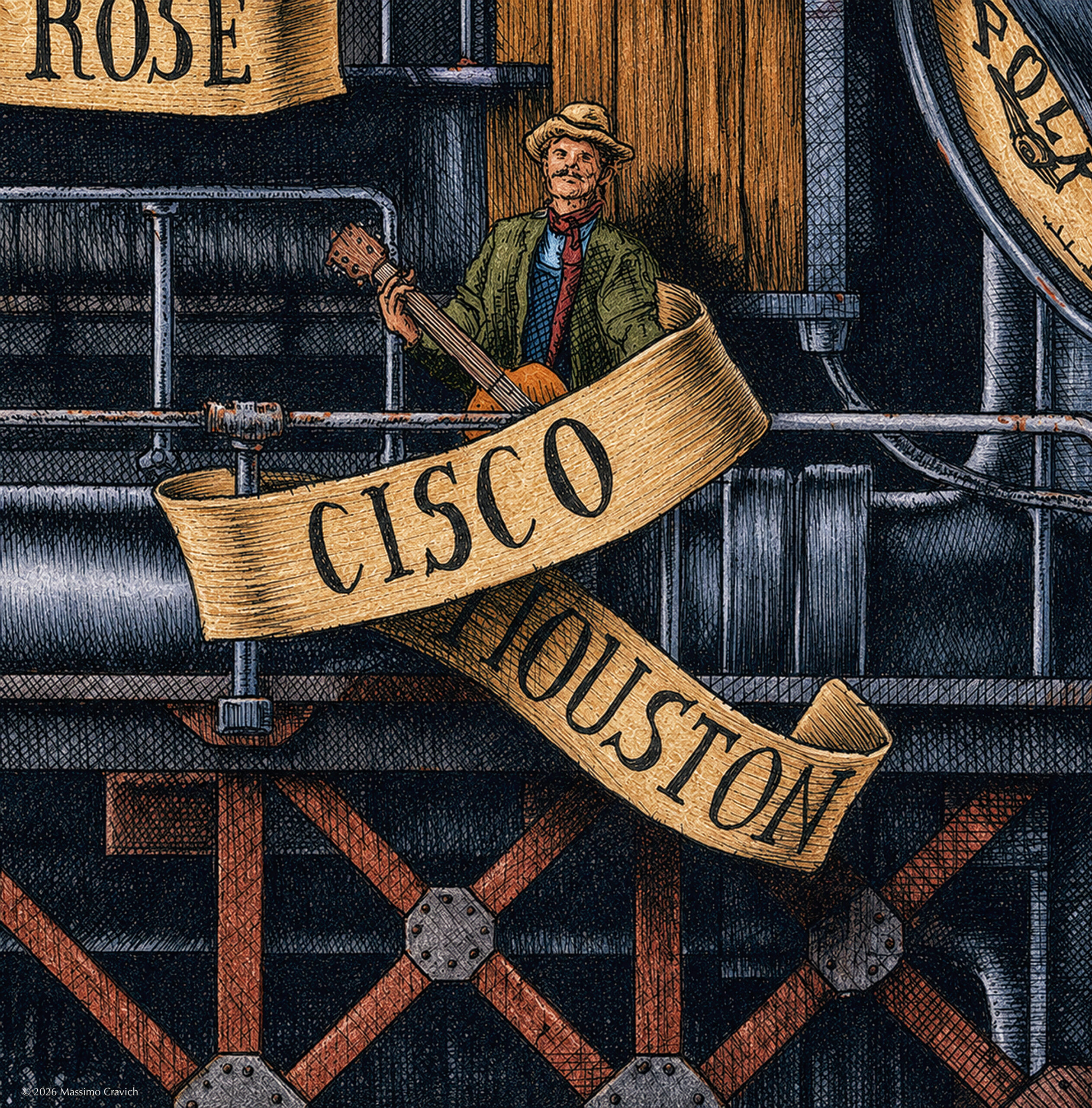
Rock Icons: Cisco Houston
The voice beside Woody Guthrie: friendship, American roads and songs worth saving.

From workers’ ballads to New York’s folk revival, Cisco Houston helped preserve a repertoire crucial to the later American singer-songwriter tradition.
Birth name Gilbert Vandine Houston
Born August 18, 1918, Wilmington, Delaware
Died April 29, 1961, San Bernardino, California
Work Folk singer, guitarist, interpreter of ballads
Collaborations Woody Guthrie, Pete Seeger, Almanac Singers
Context Traditional folk, labor songs, folk revival
ARTIST OFFICIAL SITE: ciscohouston.com
LISTEN
More to discover…
A traveller before he was a singer
Gilbert “Cisco” Houston learned about insecurity early in life. Growing up amid economic hardship and frequent moves, he found in the guitar and traditional songs something he could carry anywhere. He travelled through Depression-era America, encountering seasonal workers and people looking for jobs along roads and railways. This was not a romantic pose: the songs spoke about people he actually met.
His clear, measured voice stood apart from the rougher delivery of many traditional performers. Houston did not need to dramatize every verse; his natural phrasing allowed the stories to emerge. For him, folk music was already a meeting point between collective memory and individual sensibility.
Woody Guthrie: two voices and a friendship
Meeting Woody Guthrie transformed Houston’s path. The two shared songs, journeys, performances and a belief that music belonged close to ordinary lives. Their personalities differed: Guthrie was a restless creative force who could turn current events into lyrics, while Houston supplied musical balance, a reliable voice and an unusually attentive ear for tradition.
In New York’s politically engaged folk circles they encountered Pete Seeger and the Almanac Singers. Houston was more than “Woody’s friend”: he helped give musical shape to a repertoire that would outlive them both. Their partnership also illustrates how much music history owes to collaborators whom audiences tend to leave in the background.
The sea, the war and folk music’s contradictions
During the Second World War, Houston served in the merchant marine and sailed with Guthrie. It was a real and dangerous experience, far removed from the image of a folk singer confined to small clubs. After the war he returned to performing and recording in an America where left-wing associations and union activism increasingly attracted suspicion.
His connection with protest-song circles never erased his love of traditional ballads, wanderers’ tales and humorous songs. That combination makes Houston compelling: he did not draw a rigid line between political commitment and musical curiosity. As the music business searched for new stars, he continued to work primarily as a performer who preserved and passed on songs.
The voice the folk revival rediscovered
In the 1950s Houston recorded extensively and became an important figure for audiences rediscovering folk music. His approachable vocal style, economical guitar playing and repertoire connected the itinerant performers of the 1930s with a younger coffeehouse generation. He did not live to witness the revival’s full commercial breakthrough: cancer took his life in 1961, when he was forty-two. His legacy cannot be measured in chart positions.
Through recordings, performances and his partnership with Guthrie, Houston helped preserve an approach to singing in which a shared story mattered more than stardom. When a new generation carried those songs onto international stages, he had already travelled part of that road.
Cisco Houston forms an often-overlooked link between American oral tradition, Woody Guthrie and the folk revival that would influence rock and the songwriters of the 1960s.
Within the genealogy of The Great Rock and Roll History, Houston occupies a quiet but essential place: he shows that rock inherited from folk not just melodies but also an urge to sing about work, migration, war and the contradictions of American life.
Influenced by
- Woody Guthrie
- Traditional American ballads
- Migrant workers’ songs
- Rural blues
- Sea songs
Influent For
- Pete Seeger
- Bob Dylan
- Dave Van Ronk
- Phil Ochs
- The American folk revival
Related Artists
Pete Seeger
Almanac Singers
Ramblin’ Jack Elliott
Get Your Rock Icon
Selected artworks from Rock Icons and Stories are available as high-quality framed art prints. Printed on premium 230 gsm matte paper with excellent detail and colour reproduction, each print is professionally framed and delivered ready to hang.A carefully selected, high-quality alternative to the museum-grade Fine Art Giclée editions, offering an accessible way to own and display a reproduction of the original artwork. Printing, framing and worldwide fulfilment are handled by our specialist printing partner.


SOURCES
Smithsonian Folkways – Cisco Houston: https://folkways.si.edu/
Library of Congress – American Folklife Center: https://www.loc.gov/folklife/
Encyclopedia of Popular Music / published biographical accounts
Cisco Houston never tried to become a folk prophet: he preferred to keep songs alive. His friendship with Woody Guthrie, years of travel and instantly recognizable voice make him essential to American folk music’s story. His legacy lives on in generations that learned how a ballad could become social testimony.