
Fats Domino was one of rock and roll’s great founding figures, although he preferred to point out that the music was essentially the rhythm and blues he had been playing all along. A New Orleans pianist and singer, he turned boogie, blues and the Crescent City’s distinctive rhythmic language into a string of hits that crossed racial barriers in 1950s America.
Within The Great Rock and Roll History, his presence is essential to understanding how deeply rock grew from Black music.
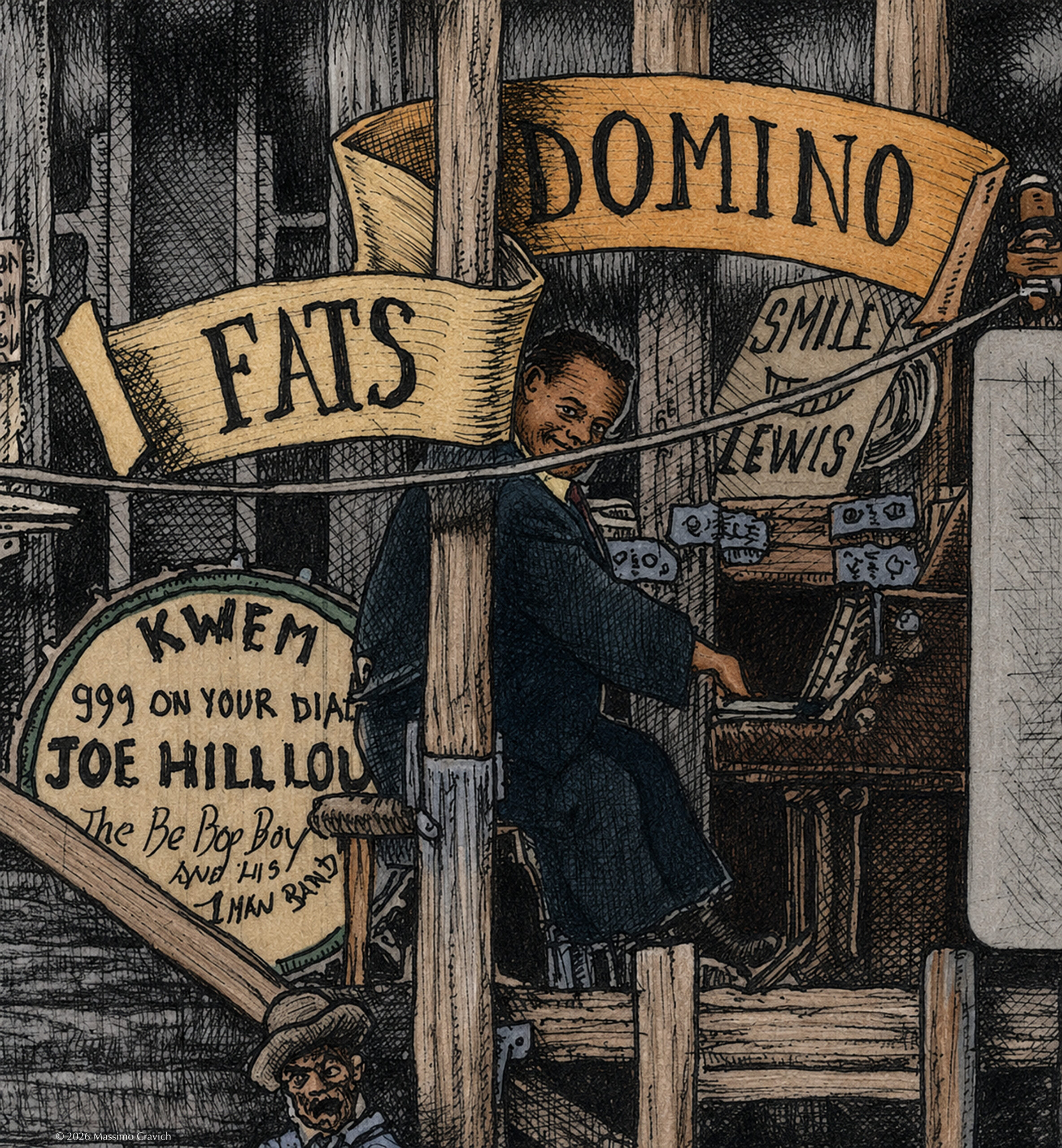
Rock Icons: Fats Domino
The quiet smile of a revolution: New Orleans enters rock and rolll

With his rolling piano, warm voice and New Orleans beat, Fats Domino carried African American rhythm and blues into the heart of the pop market and played a decisive role in the birth of rock and roll.
Real name: Antoine Dominique Domino Jr.
Born: February 26, 1928, New Orleans, Louisiana
Died: October 24, 2017, Harvey, Louisiana
Instruments: Singer, pianist, songwriter
Genres: Rhythm and blues, rock and roll, New Orleans R&B;
ARTIST OFFICIAL SITE: fatsdominoofficial.com
LISTEN
More to discover…
New Orleans before rock and roll
Antoine Domino grew up in New Orleans’s Lower Ninth Ward in a large French-speaking Creole family. Piano entered his life early, and the language he absorbed did not yet belong to a category called rock and roll: it was a local mixture of blues, boogie-woogie, jazz, rhythm and blues and syncopated rhythms. Professor Longhair was a crucial presence in the city’s musical environment, while Domino developed a pounding yet supple piano style built on triplets and insistent bass figures.
When trumpeter, arranger and producer Dave Bartholomew encountered him, he recognized the possibility of turning that intensely local sound into records that could travel. In 1949 The Fat Man sold enormously. Rock and roll did not yet possess a settled commercial identity, but many of its ingredients were already there.
Success crosses the color line
During the 1950s Domino became one of the most successful Black recording artists in the United States. Ain’t That a Shame, Blue Monday, I’m Walkin’ and especially Blueberry Hill crossed from the R&B; market into pop. His image was far removed from Little Richard’s sexual provocation or Jerry Lee Lewis’s stage ferocity: Fats smiled, sat at the piano and allowed the rhythm to disturb the established order.
That apparent gentleness can obscure how radical it was for white teenagers to buy and dance to music made by a Black artist in segregated America. Tours could generate tension and disorder; the music was crossing social boundaries that society itself stubbornly continued to defend.
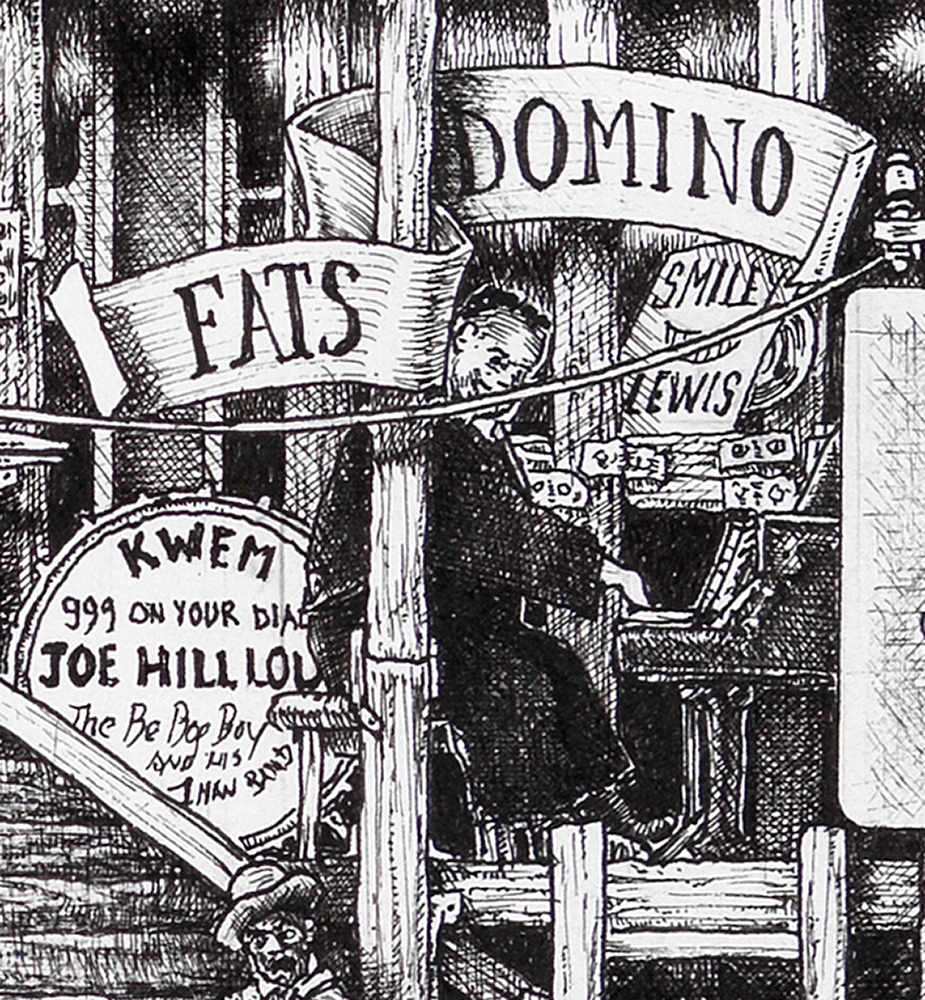
Fats, Elvis and a fatherhood without proclamations
Elvis Presley’s explosion changed the public face of rock and roll, but Presley himself expressed respect for Domino and the Black roots of the music. Fats showed little interest in fighting for the title of the genre’s inventor. His position was essentially straightforward: what people now called rock and roll was the rhythm and blues he had been playing for years. The idea punctures any myth of rock being born suddenly.
Domino belonged to the generation that built the bridge before the bridge had a name. His partnership with Bartholomew, the saxophones, backbeat and New Orleans piano supplied a vocabulary absorbed by countless musicians, from the Beatles to later roots-rock performers, without Fats ever needing to become an ideologue of his own importance.
Home, hurricane and loyalty to New Orleans
Despite international fame, Domino remained deeply attached to New Orleans and the Lower Ninth Ward. His public personality was private and domestic, far removed from the turbulent lives of many contemporary stars. When Hurricane Katrina devastated the city in 2005, he was initially feared missing before being rescued from his flooded home. Many possessions and awards were lost, with some later recovered or replaced. The episode almost symbolically condensed his relationship with the city: he could have lived elsewhere, but New Orleans was inseparable from his identity.
He died in 2017 after becoming, almost without proclamation, one of the longest-lived witnesses to rock’s birth. His revolution had always sounded more like a conversation than a manifesto.
Fats Domino demonstrates that rock and roll was not born from a sudden rupture, but from the national emergence of African American musical languages already mature within rhythm and blues and New Orleans culture.
Within The Great Rock and Roll History, Fats Domino occupies a fundamental junction between boogie-woogie, New Orleans R&B; and rock and roll, making the new music’s Black roots visible before its commercial explosion.
Influenced by
- Albert Ammons
- Amos Milburn
- Professor Longhair
- Meade Lux Lewis
- New Orleans rhythm and blues
Influent For
- Elvis Presley
- The Beatles
- Randy Newman
- Dr. John
- Paul McCartney
Related Artists
Dave Bartholomew
Lloyd Price
Professor Longhair
Huey ‘Piano’ Smith
Get Your Rock Icon
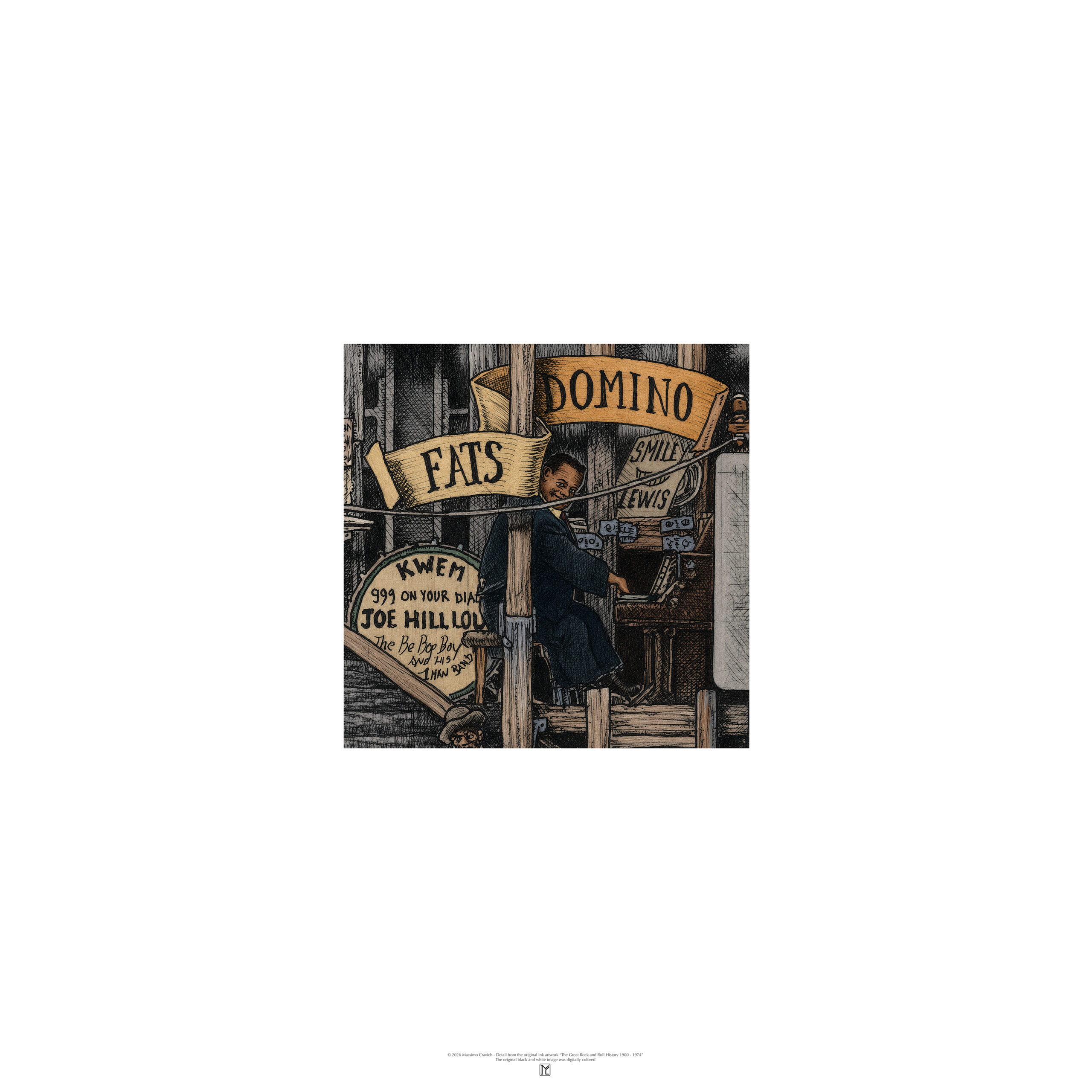
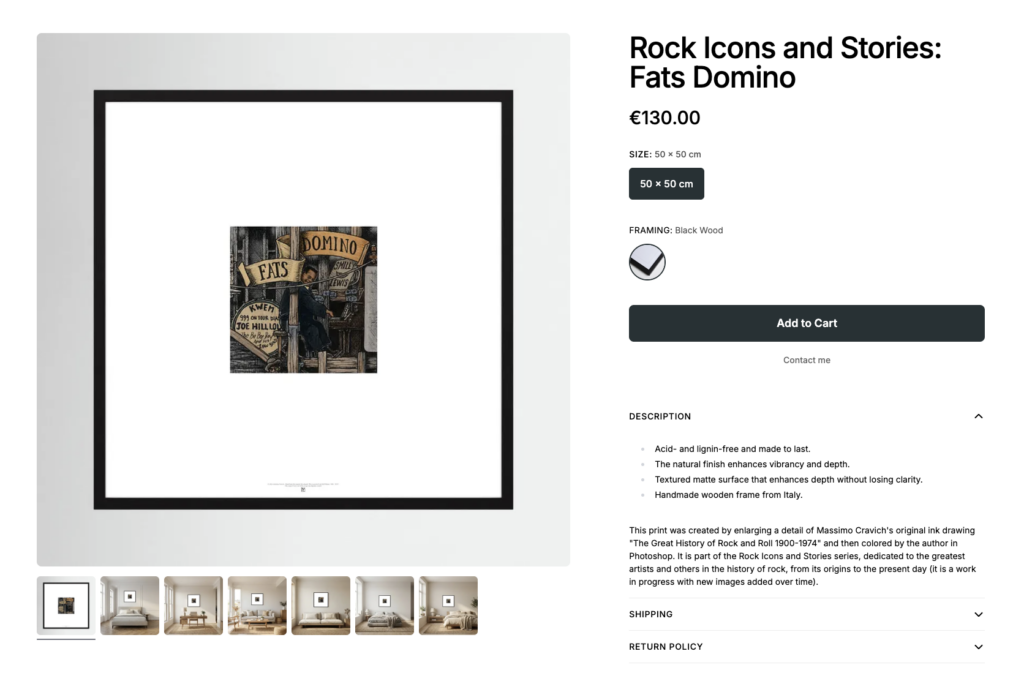
Selected artworks from Rock Icons and Stories are available as high-quality framed art prints. Printed on premium 230 gsm matte paper with excellent detail and colour reproduction, each print is professionally framed and delivered ready to hang.A carefully selected, high-quality alternative to the museum-grade Fine Art Giclée editions, offering an accessible way to own and display a reproduction of the original artwork. Printing, framing and worldwide fulfilment are handled by our specialist printing partner.
Key sources
Rock & Roll Hall of Fame – Fats Domino
Encyclopaedia Britannica – Fats Domino
Louisiana Music Hall of Fame – Fats Domino
Fats Domino did not need to set pianos on fire, scandalize audiences or proclaim himself the inventor of rock and roll. His power lay in the natural way a local African American tradition became universal music. His piano, relaxed voice and New Orleans rhythm helped change the American audience while he appeared simply to continue doing what he had always done. That apparent simplicity is precisely what makes him one of rock’s most authentic founding fathers.