
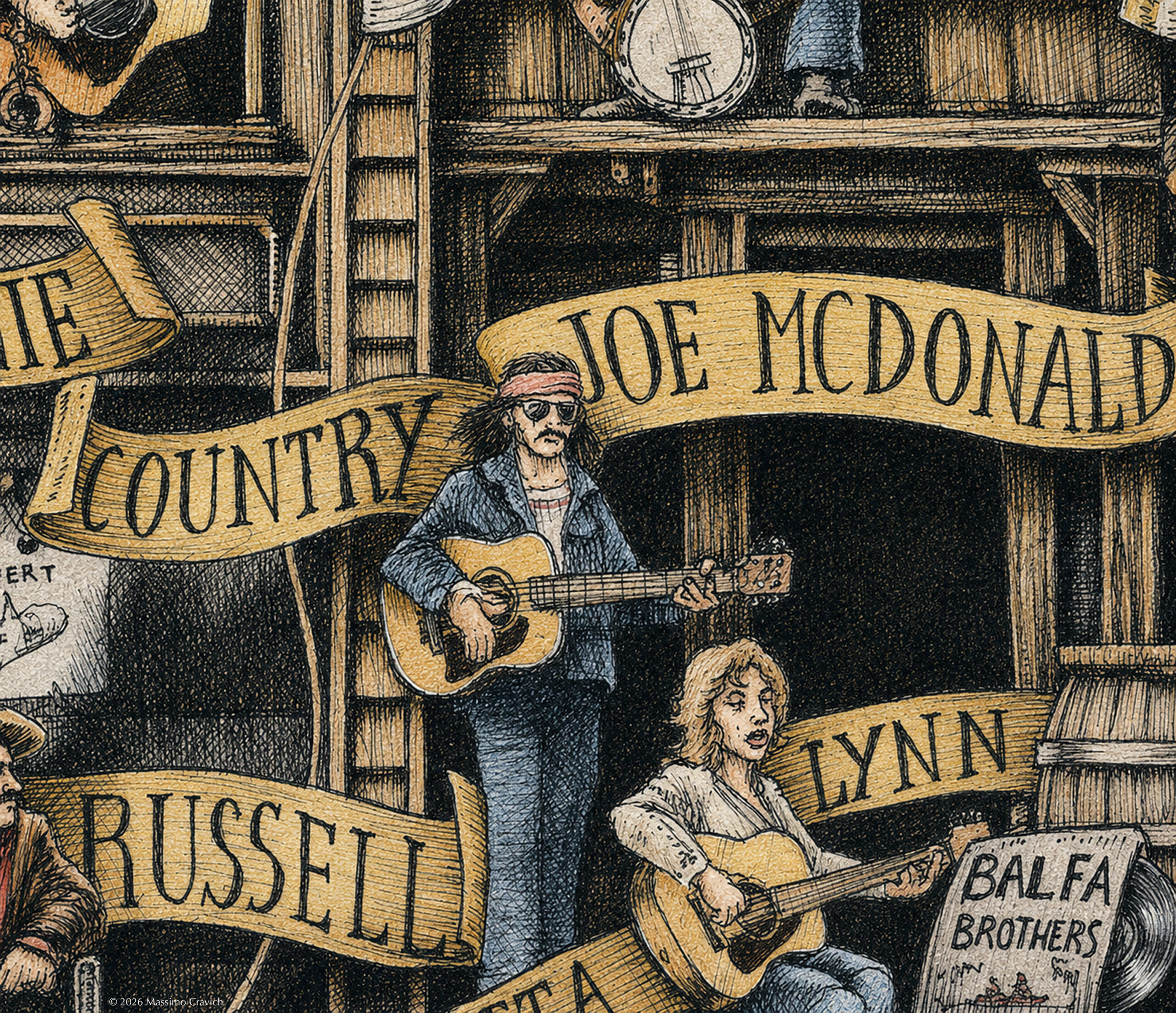
Country Joe McDonald was one of the defining figures of the American counterculture of the 1960s, a musician capable of blending protest folk, psychedelia, political satire and antiwar activism into a uniquely radical musical language. This illustrated profile explores his music, activism and cultural impact within The Great Rock and Roll History, a large-scale illustrated timeline of modern music.
Rock Icons: Country Joe McDonald
American psychedelic songwriter suspended between protest folk, acid rock and radical political satire. By combining protest folk, psychedelia and antiwar activism, Country Joe McDonald helped redefine the political role of American rock music during the 1960s.

Real Name: Joseph Allen McDonald
Born: January 1, 1942 — Washington D.C., USA
Status: Active
Instruments Guitar, vocals
Genres: Folk rock, psychedelic rock, protest music
ARTIST OFFICIAL SITE: www.countryjoe.com
LISTEN
I-Feel-Like-I’m-Fixin’-to-Die Rag
More to discover…
When political protest became collective psychedelia
Country Joe McDonald occupies a unique position within American music history. He was not simply a political folk songwriter: he transformed antiwar satire and radical protest into collective psychedelic spectacle. With Country Joe and the Fish he created one of the most explicitly political forms of San
Francisco psychedelia.
While many hippie bands focused on spirituality or escapism, Country Joe directly confronted Vietnam, militarism and American hypocrisy. His style combined sharp irony, acoustic folk, acid rock and theatrical performance. That mixture made his music deeply connected to the spirit of the California counterculture. His Woodstock performance of I-Feel-Like-I’m-Fixin’-to-Die Rag remains one of the defining symbols of American protest music.

From Beatnik culture to hippie counterculture
Even before the hippie explosion, Country Joe McDonald was already immersed in beatnik circles and American protest folk traditions. His artistic mentality emerged equally from radical folk culture and the sarcastic irreverence of the Beat Generation. The name “Country Joe and the Fish” itself originated as an ironic reference to a Mao Tse-Tung quote. From the beginning the band combined psychedelia, improvisation and political satire in ways radically different from most California contemporaries.
I-Feel-Like-I’m-Fixin’-to-Die Rag
Few songs represent the Vietnam era more powerfully than “I-Feel-Like-I’m-Fixin’-to-Die Rag”. The song used cheerful melody and savage irony to attack war, propaganda and the military system itself. Country Joe’s Woodstock performance permanently entered American cultural mythology. Before performing “I-Feel-Like-I’m-Fixin’-to-Die Rag”, he led the audience in the legendary “Fish Cheer”, transforming hundreds of thousands of people into a giant antiwar chorus. Unlike many solemn protest songwriters, Country Joe constantly used humor and sarcasm. Laughing at war became a way of dismantling patriotic rhetoric itself.
Janis Joplin and the San Francisco scene
Country Joe remained deeply connected to the San Francisco psychedelic world alongside artists such as Janis Joplin, Jefferson Airplane and Grateful Dead. Yet he maintained a much more openly political perspective than many of his peers. One of the strangest paradoxes of his life is that after becoming a symbol of antiwar protest, Country Joe later performed for American soldiers in Vietnam. This complicated his public image in unexpected ways.
As the 1960s ended and hippie idealism began collapsing, Country Joe’s cultural centrality diminished. Yet this very fact makes him today one of the most authentic and least commercialized symbols of the American counterculture.
Living archive of the 1960s
Over the decades McDonald gradually became almost a living historian of San Francisco counterculture through interviews, performances and autobiographical reflections. Country Joe McDonald’s uniqueness came from combining seemingly incompatible elements: political satire, acid rock, traditional folk and hippie collectivism. That mixture made him one of the most distinctive figures in American music history.
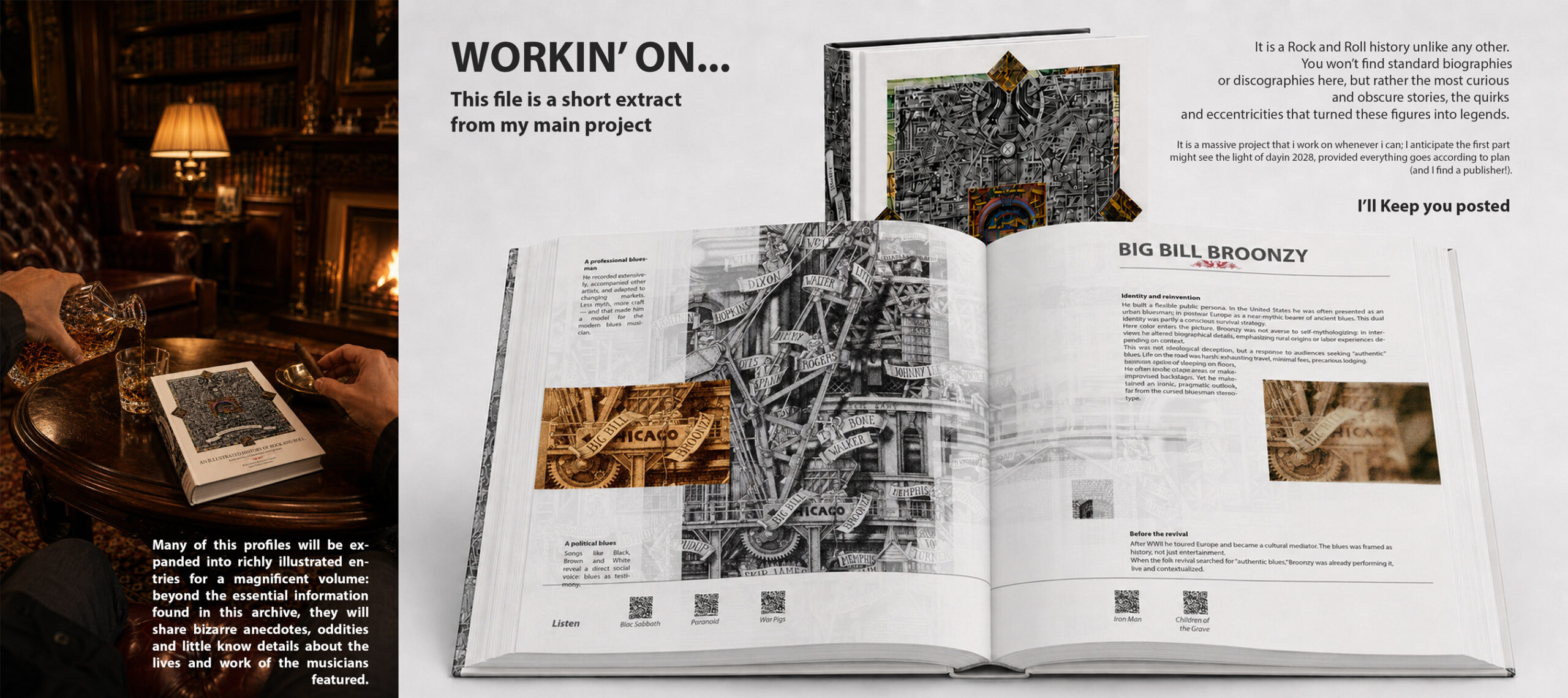
His music occupies a fundamental place within the countercultural narrative explored in The Great Rock and Roll History.
Influenced by
- Woody Guthrie
- Beat Generation
- American folk revival
- Traditional blues
- San Francisco psychedelia
Influent For
- 1970s protest music
- American musical activism
- Psychedelic folk
- Political alternative songwriting
- Contemporary satirical rock
Related Artists
Phil Ochs
Buffalo Springfield
Get Your Rock Icon
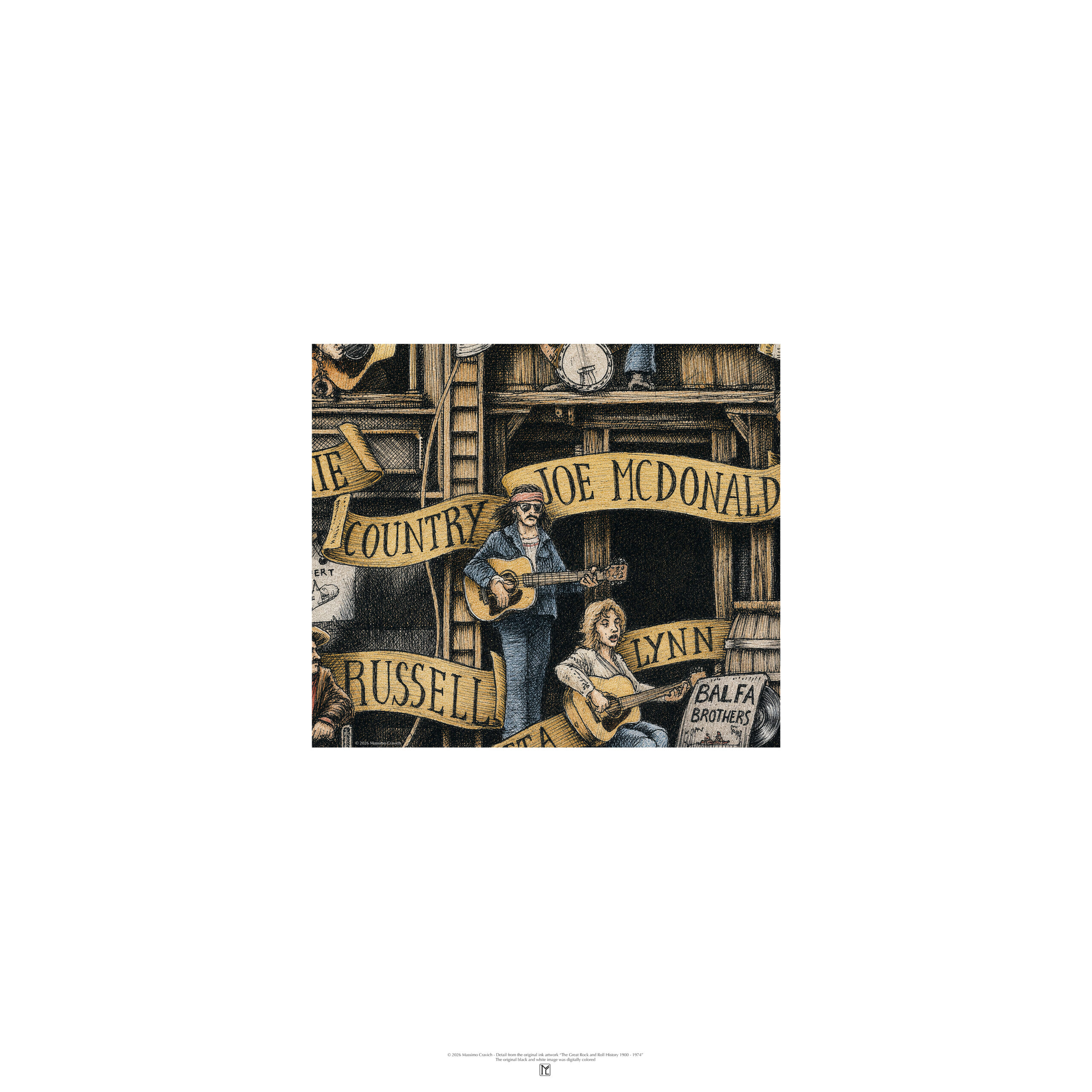
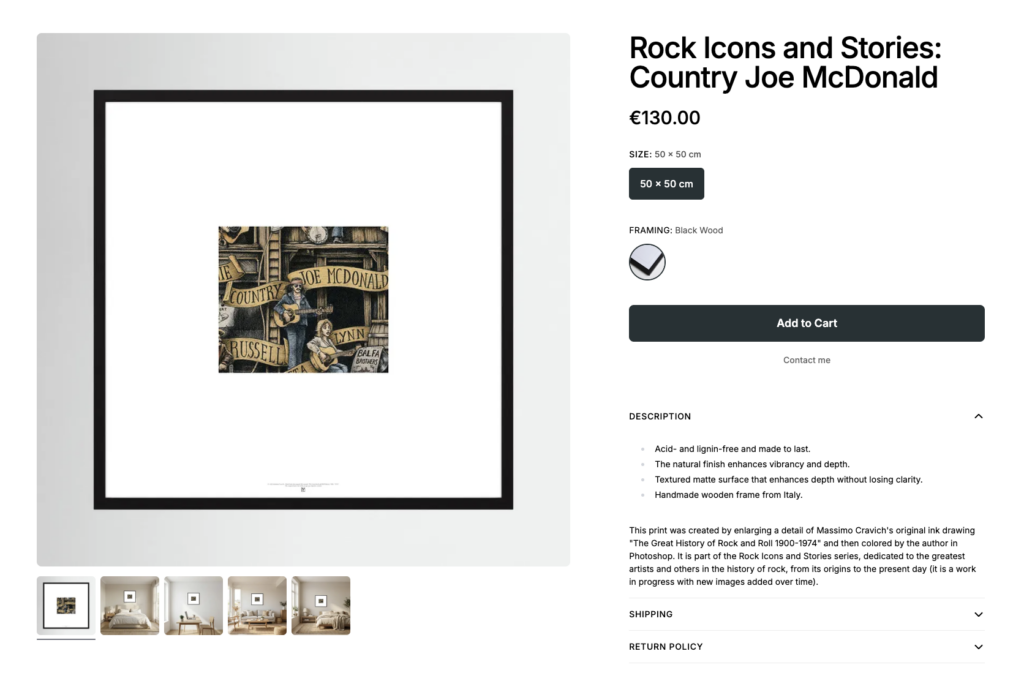
Selected artworks from Rock Icons and Stories are available as high-quality framed art prints. Printed on premium 230 gsm matte paper with excellent detail and colour reproduction, each print is professionally framed and delivered ready to hang.A carefully selected, high-quality alternative to the museum-grade Fine Art Giclée editions, offering an accessible way to own and display a reproduction of the original artwork. Printing, framing and worldwide fulfilment are handled by our specialist printing partner.
SOURCES
Official Country Joe Website
Woodstock archives
San Francisco psychedelic archives
Vietnam protest music archives
Within the broader history of American counterculture, Country Joe McDonald represents one of the mostradical, ironic and influential figures of 1960s protest music. His work permanently reshaped the relationship between political folk, psychedelia and cultural activism.