
Neil Young is one of the most influential, unpredictable and essential figures in the history of modern rock music: a Canadian songwriter, visionary guitarist and creator of musical worlds suspended between folk, country rock, abrasive electricity, proto-grunge and personal confession. This illustrated profile explores Neil Young’s songwriting, guitar language and cultural impact within The Great Rock and Roll History, a large-scale illustrated timeline of modern music.
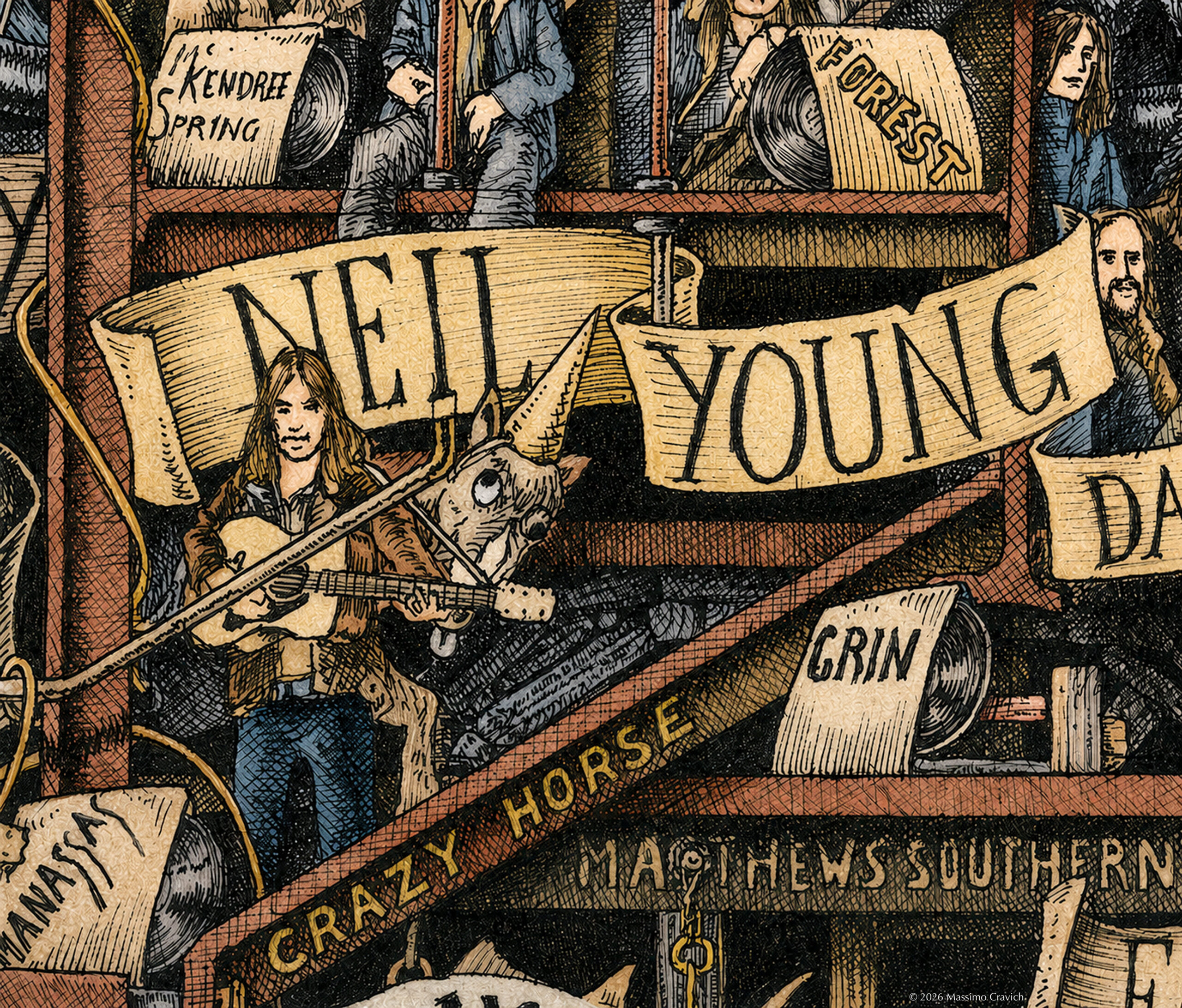
Rock Icons: Neil Young
Canadian singer-songwriter blending folk fragility, distorted guitars, country rock, electric improvisation and political conscience.

By combining folk roots, California country rock, acoustic balladry and long electric journeys with Crazy Horse, Neil Young helped define one of the deepest and most contradictory paths in North American rock music from the 1960s and 1970s to later alternative generations. His role is central to understanding the passage from Buffalo Springfield’s folk rock to the raw emotional intensity that would later feed grunge.
Name: Neil Percival Young
Birth: November 12, 1945 – Toronto, Ontario, Canada
Status: Active
Main instruments: Vocals, electric and acoustic guitar, harmonica, piano, organ, occasional banjo
Genres: Folk rock, country rock, hard rock, psychedelic rock, roots rock, proto-grunge, singer-songwriter, experimental rock
ARTIST OFFICIAL SITE: neilyoungarchives.com
LISTEN
• Down by the River – the electric hypnosis of Crazy Horse and the birth of his expanded guitar language.
• Heart of Gold – the acoustic, fragile and universal face of Harvest.
• Cortez the Killer – a historical ballad turned into electric trance, both epic and ambiguous. (Live from “Live Rust”)
• Like a Hurricane – one of the peaks of his guitar as emotional storm.
• Rockin’ in the Free World – the political and abrasive Neil Young, able to cross the 1980s and speak directly to alternative rock.
More to discover…
The electric loner who turned imperfection into language
Neil Young built his story as a continuous escape from definitions. Whenever the audience seemed to have identified one of his faces – the folk songwriter, the electric rocker, the country poet, the psychedelic survivor, the godfather of grunge – he moved elsewhere. This instability is not a minor flaw in his career: it is the center of the character. Young is one of the artists who proved that coherence can come not from repeating a style, but fromstubborn loyalty to an inner urgency. His music lives on contrasts: acoustic sweetness and feedback, elementary melodies and very long solos, fragile singing and brutal guitar, rural nostalgia and political anger. With Buffalo Springfield he entered the mythology of California folk rock; with Crosby, Stills, Nash & Young he became part of a generational supergroup; with Crazy Horse he invented a primitive, emotional and almost shamanic form of rock in which error, noise and repetition became expressive material.
From this perspective Neil Young occupies a crucial point in rock genealogy: he connects Bob Dylan and the folk revival to garage-rock electricity, country rock to post-hippie unease, and confessional balladry to the rougher spirit of the 1990s. His importance lies not only in the famous albums, but in the ability to show that a rock artist can remain alive only by accepting contradiction.
Albums such as Harvest, After the Gold Rush, Tonight’s the Night, On the Beach, Rust Never Sleeps and Everybody Knows This Is Nowhere became fundamental landmarks for folk rock, country rock, emotionally charged hard rock and alternative rock.
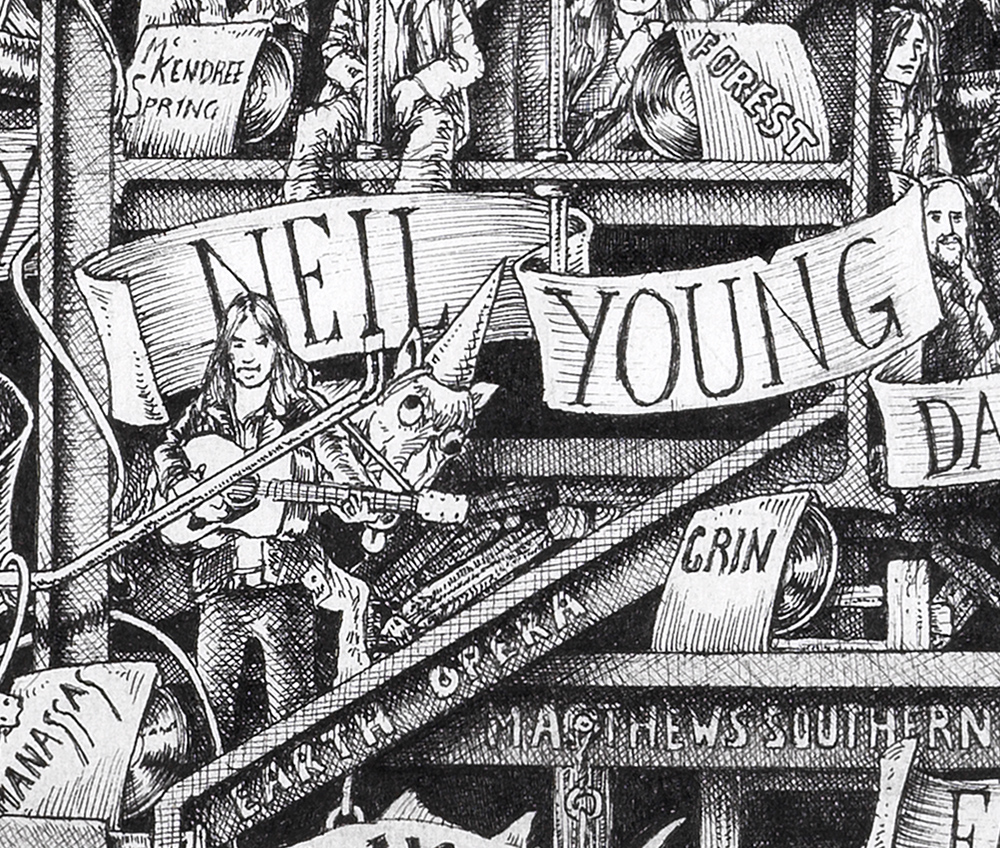
Neil Young’s music occupies a central position within the broader visual narrative of The Great Rock and Roll History, where rock is read as a network of genealogies, deviations, returns and generational breaks.
Influenced by
- Bob Dylan – for electrified folk songwriting and freedom in handling song form.
- Hank Williams and the country tradition – for melodic directness, rural pain and emotional nakedness.
- The Shadows, Link Wray and instrumental rock – for the physical relationship with electric guitar sound.
- The Beatles and 1960s psychedelia – for the album as a moving territory, not just a container of singles.
- Woody Guthrie and North American political folk – for the union of social storytelling, travel and popular identity.
- Bert Jansch
Influent For
- Pearl Jam / Eddie Vedder – for emotional ethics, electric roughness and direct live intensity.
- Nirvana / Kurt Cobain – for exposed fragility and the tension between simple melody and noise.
- R.E.M. and American college rock – for the model of artistic integrity outside mainstream rules.
- Wilco, Son Volt and alternative country – for the fusion of rural roots, electricity and modern melancholy.
- Dinosaur Jr., Sonic Youth and indie guitar rock – for distortion used as an emotional voice, not merely as a sound effect.
Related Artists
Buffalo Springfield – the folk-rock matrix with Stephen Stills, Richie Furay, Bruce Palmer and Dewey Martin.
Crazy Horse – the most instinctive and recognizable electric body of his music.
Crosby, Stills, Nash & Young – the supergroup that placed Young at the heart of American counterculture.
Pearl Jam – collaborators and spiritual descendants, especially during the Mirror Ball era.
Joni Mitchell – Canadian parallel, friend and related figure in the transformation of North American songwriting.
Get Your Rock Icon
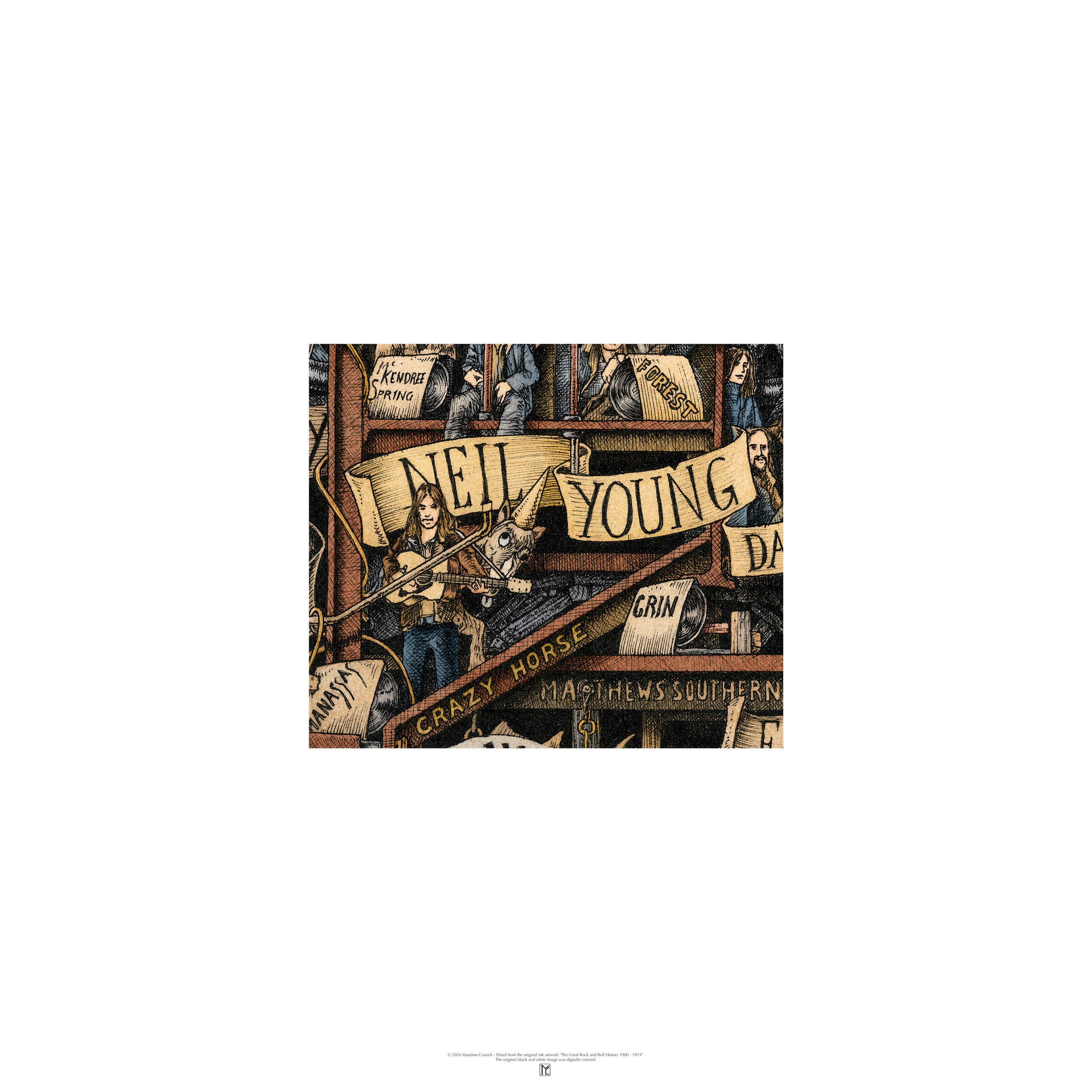
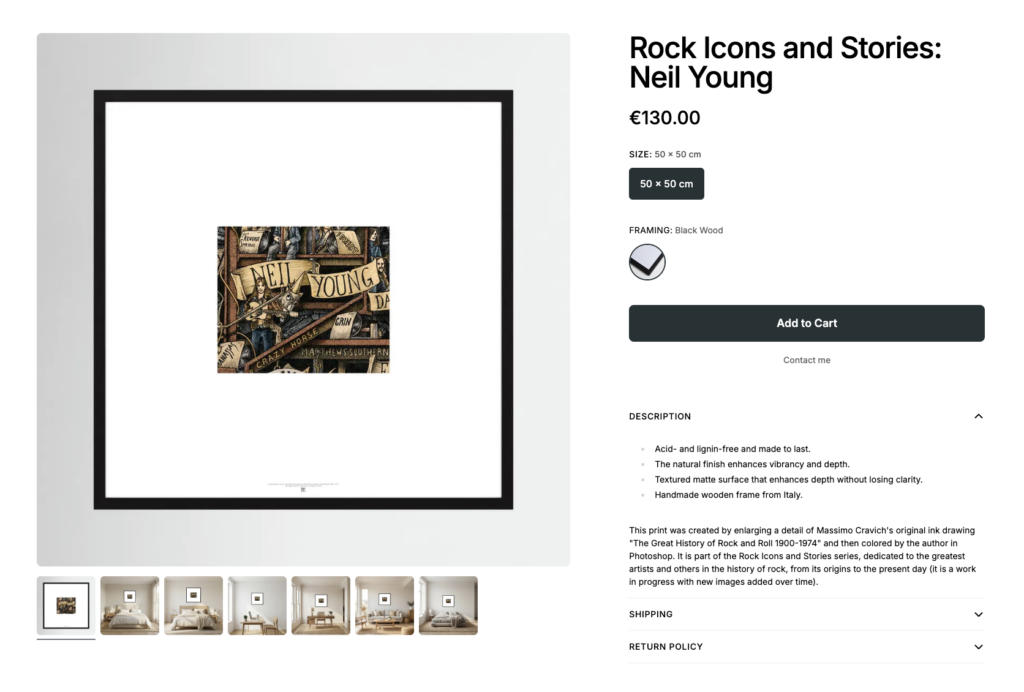
Selected artworks from Rock Icons and Stories are available as high-quality framed art prints. Printed on premium 230 gsm matte paper with excellent detail and colour reproduction, each print is professionally framed and delivered ready to hang.A carefully selected, high-quality alternative to the museum-grade Fine Art Giclée editions, offering an accessible way to own and display a reproduction of the original artwork. Printing, framing and worldwide fulfilment are handled by our specialist printing partner.
LINKABLE SOURCES
• Neil Young Archives – official site and archive: https://neilyoungarchives.com/
• Rock & Roll Hall of Fame – Neil Young inductee profile: https://rockhall.com/inductees/neil-young/
• AllMusic – Neil Young biography and critical discography: https://www.allmusic.com/artist/neil-young-mn0000379125
• Neil Young, Waging Heavy Peace: A Hippie Dream, Blue Rider Press, 2012.
• Jimmy McDonough, Shakey: Neil Young’s Biography, Random House, 2002.
• David Downing, A Dreamer of Pictures: Neil Young, the Man and His Music, Bloomsbury, 1994.
Within the broader narrative of rock history, Neil Young represents one of the most important connections between folk revival, country rock, electric psychedelia, confessional songwriting and modern alternative rock.
His influence crosses different generations: from 1970s singer-songwriters to grunge, from indie rock to alternative country, and to every artist who has seen imperfection, fragility and noise not as limits, but as a form of musical truth.