
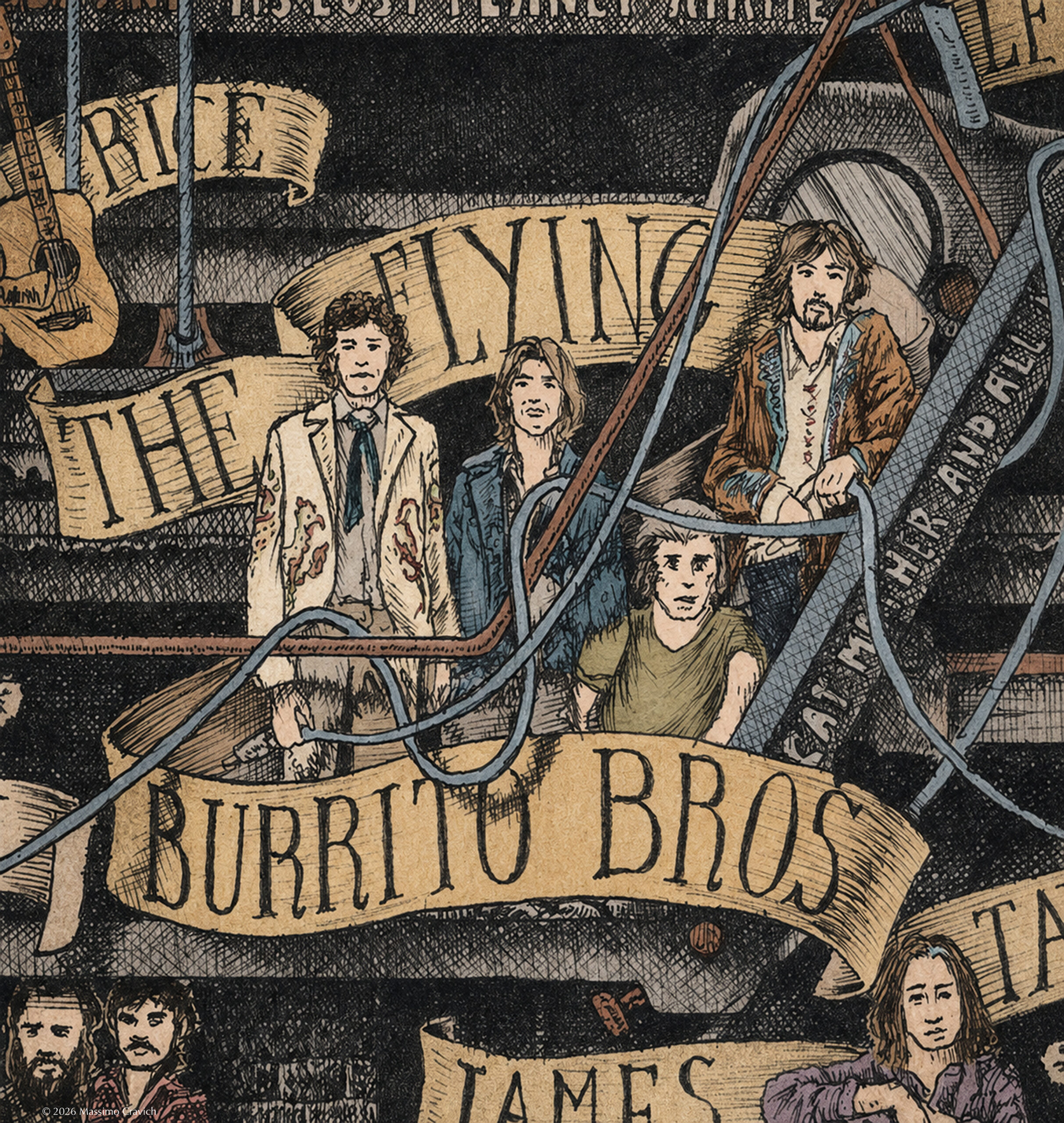
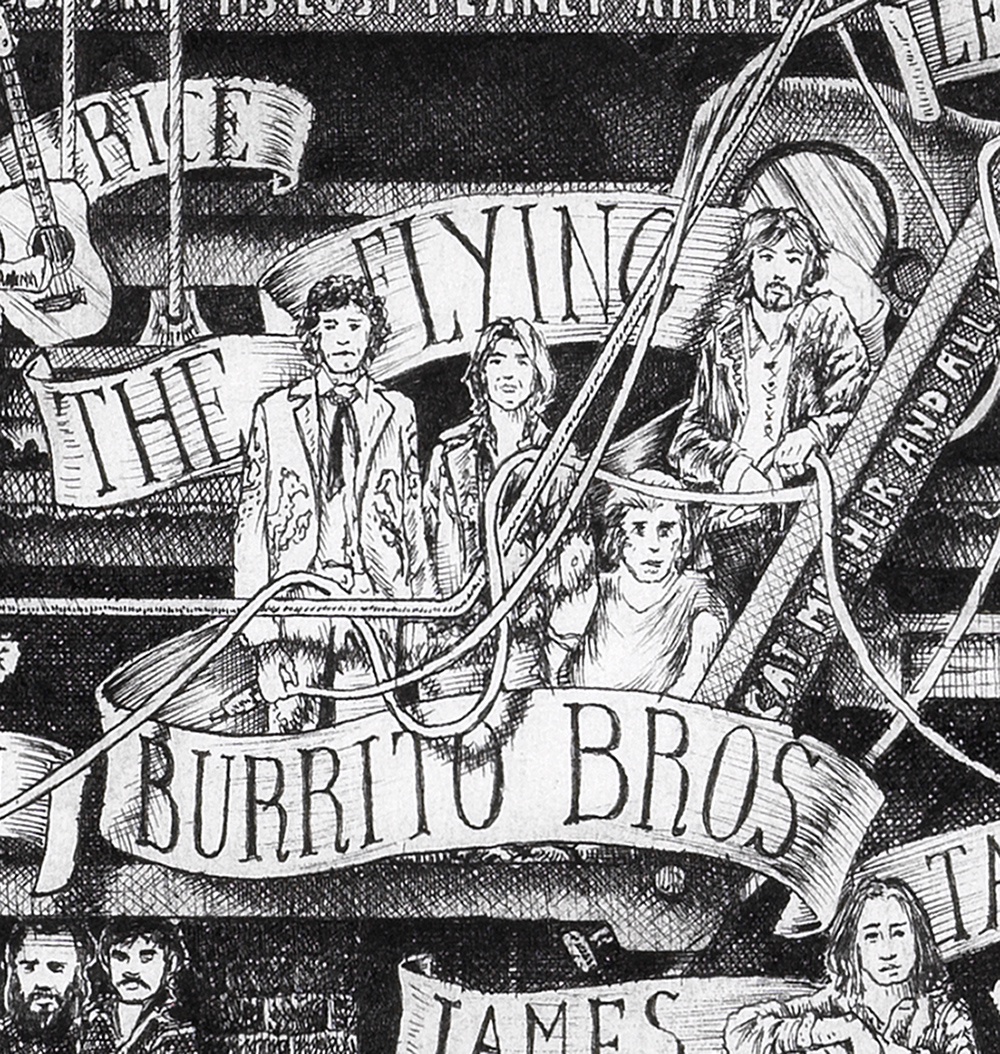
The Flying Burrito Brothers were one of the decisive hinges between country and rock at the end of the 1960s. Formed around Gram Parsons and Chris Hillman after their time in the Byrds, they brought honky-tonk, pedal steel and country harmony into California rock culture, clothing them in psychedelia, counterculture and disillusionment. Within The Great Rock and Roll History, they mark the moment when two supposedly separate American traditions discover that they belong to the same family.
Rock Icons: The Flying Burrito Brothers
Country music in Nudie suits: Gram Parsons, Chris Hillman and the fragile dream of Cosmic American Music.

With The Gilded Palace of Sin, the Flying Burrito Brothers joined country, soul and rock in a synthesis that became fundamental to country rock and generations of American musicians.
Founded: Los Angeles, California, 1968
Status: disbanded
Core genres: Country rock, country, roots rock
Classic core: Gram Parsons, Chris Hillman Sneaky Pete Kleinow, Chris Ethridge
ARTIST OFFICIAL SITE: no official site. This is the Link to Chris Hillman dedicated page
LISTEN
More to discover…
From the Byrds to a new American music
The Burritos’ story grew largely from the meeting of Gram Parsons and Chris Hillman in the Byrds. On Sweetheart of the Rodeo, Parsons had helped push one of folk rock’s major bands toward Nashville and country, but the relationship was brief. Parsons left; Hillman followed soon afterward. In Los Angeles they built something less disciplined and more personal.
With bassist Chris Ethridge and Sneaky Pete Kleinow’s pedal steel, a sound emerged in which Buck Owens, George Jones and the Bakersfield sound coexisted with soul, rock and hippie sensibility. Parsons imagined it within a broader idea he called ‘Cosmic American Music’: not a rigidly defined genre, but a belief that country, blues, gospel, soul and rock were communicating branches of the same American music.
The Gilded Palace of Sin: a masterpiece almost ignored
In 1969 came The Gilded Palace of Sin. Commercially disappointing, it would become an artistic landmark. Christine’s Tune, Sin City, Hot Burrito #1 and Hot Burrito #2 addressed desire, betrayal, corrupted cities and vulnerability with country instruments but contemporary emotional language. Covers associated with soul writers Dan Penn and Chips Moman showed that the project reached far beyond a simple cowboy-rock fusion. Image mattered too: the famous Nudie suits, embroidered with marijuana leaves, pills, crosses and personal symbols, turned country iconography into countercultural declaration. The album sold poorly perhaps because it arrived too early; precisely for that reason, it became one of those commercial failures that eventually change music.
Gram Parsons: charisma, friendship and self-destruction
The band’s emotional center was also its greatest centrifugal force. Parsons possessed vision, charm and talent, but drugs, financial privilege and restlessness made him increasingly unreliable. His friendship with Keith Richards drew him toward the Rolling Stones and intensified an already unstable life. Chris Hillman, more pragmatic, often had to hold together what Parsons scattered.
After the second album, Burrito Deluxe, and a series of troubled performances, Parsons was dismissed in 1970. Wild Horses, obtained through the Stones connection and released by the Burritos before the Rolling Stones issued their own version, perfectly symbolizes the period: musical worlds cross-pollinating through personal friendships, alongside a band unable to turn its influence into stability.
After Gram: a band becomes a genealogy
Parsons’s departure did not immediately end the story. Hillman continued with a lineup including Bernie Leadon, Rick Roberts, Sneaky Pete Kleinow and Michael Clarke; 1971’s The Flying Burrito Bros presented a more orderly but less visionary band. Soon the members’ individual paths became almost more important than the group. Leadon helped found the Eagles; Hillman moved through Manassas and later the Desert Rose Band; Parsons, with Emmylou Harris, carried his cosmic-country vision into two solo albums before his death in 1973.
The Flying Burrito Brothers name would continue through various incarnations. Their deepest legacy, however, is genealogical: Americana, alt-country and roots rock owe an enormous debt to that brief collision of Nashville, Bakersfield and countercultural Los Angeles.
The Flying Burrito Brothers proved that country could enter the counterculture without becoming parody, and that rock could rediscover its rural roots without surrendering modernity.
Within The Great Rock and Roll History, the Flying Burrito Brothers connect the Byrds, the Bakersfield sound and Nashville to the later Eagles-Americana-alt-country lineage: modest in sales, enormous as a genealogical junction.
Influenced by
- The Byrds
- Buck Owens
- George Jones
- The Louvin Brothers
- Southern soul
Influent For
- Eagles
- Emmylou Harris
- Uncle Tupelo
- The Jayhawks
- Wilco
Related Artists
Gram Parsons
Chris Hillman
Manassas
Get Your Rock Icon
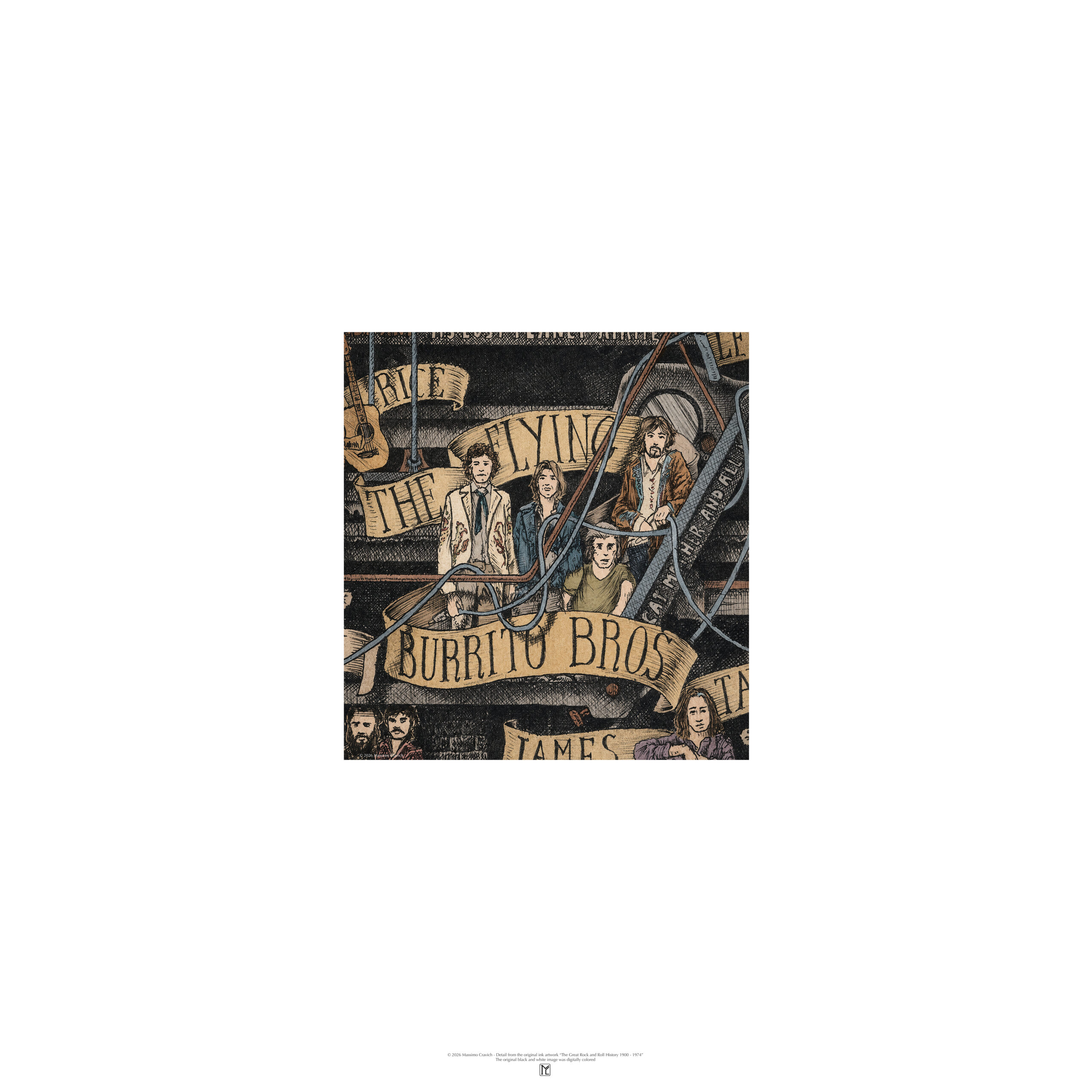
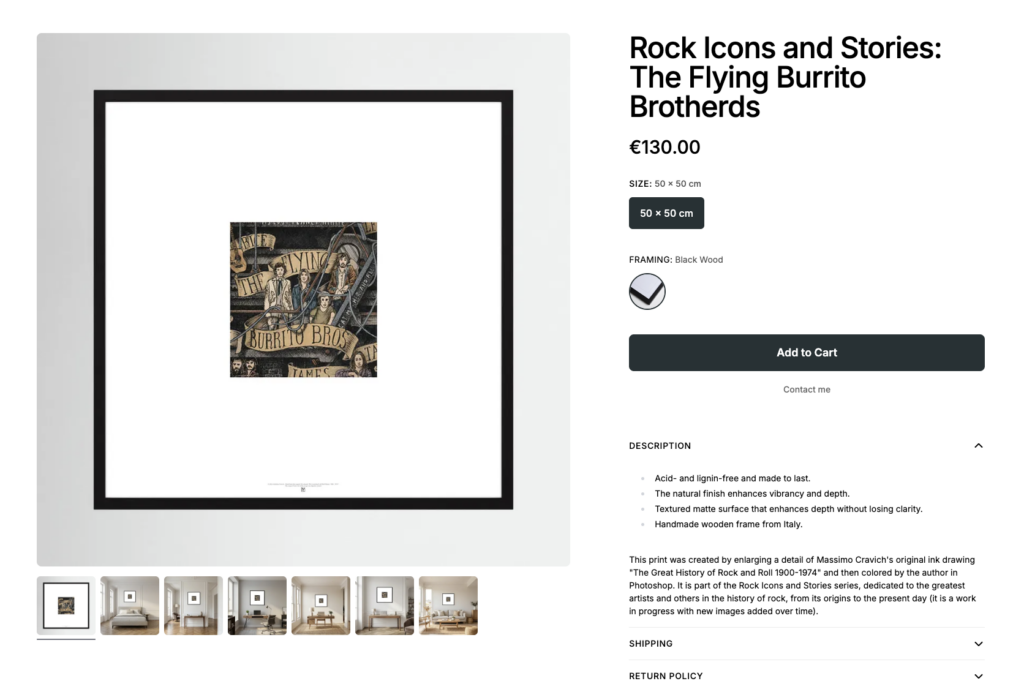
Selected artworks from Rock Icons and Stories are available as high-quality framed art prints. Printed on premium 230 gsm matte paper with excellent detail and colour reproduction, each print is professionally framed and delivered ready to hang.A carefully selected, high-quality alternative to the museum-grade Fine Art Giclée editions, offering an accessible way to own and display a reproduction of the original artwork. Printing, framing and worldwide fulfilment are handled by our specialist printing partner.
SOURCES
Country Music Hall of Fame – Gram Parsons / country-rock history
Rock & Roll Hall of Fame – The Byrds / Eagles
AllMusic – The Flying Burrito Brothers
The Flying Burrito Brothers lasted only briefly in their most important form and were never a major commercial machine. That fragility is part of their fascination. Gram Parsons and Chris Hillman took country music that many young rock listeners regarded as belonging to the past and revealed it as living, painful, rebellious and entirely contemporary. The Gilded Palace of Sin became a doorway: not many people walked through it in 1969, but an entire genealogy of American music eventually followed