
Big Mama Thornton was one of the great connecting voices between blues, rhythm & blues and the rock and roll to come: a singer of overwhelming physical and vocal presence who turned the blues into something hard, rhythmic and modern. This profile explores Big Mama Thornton’s musical language and influence within The Great Rock and Roll History, tracing the path from Southern blues and gospel through Hound Dog and onward to the blues revival and the rock generation that rediscovered her music.
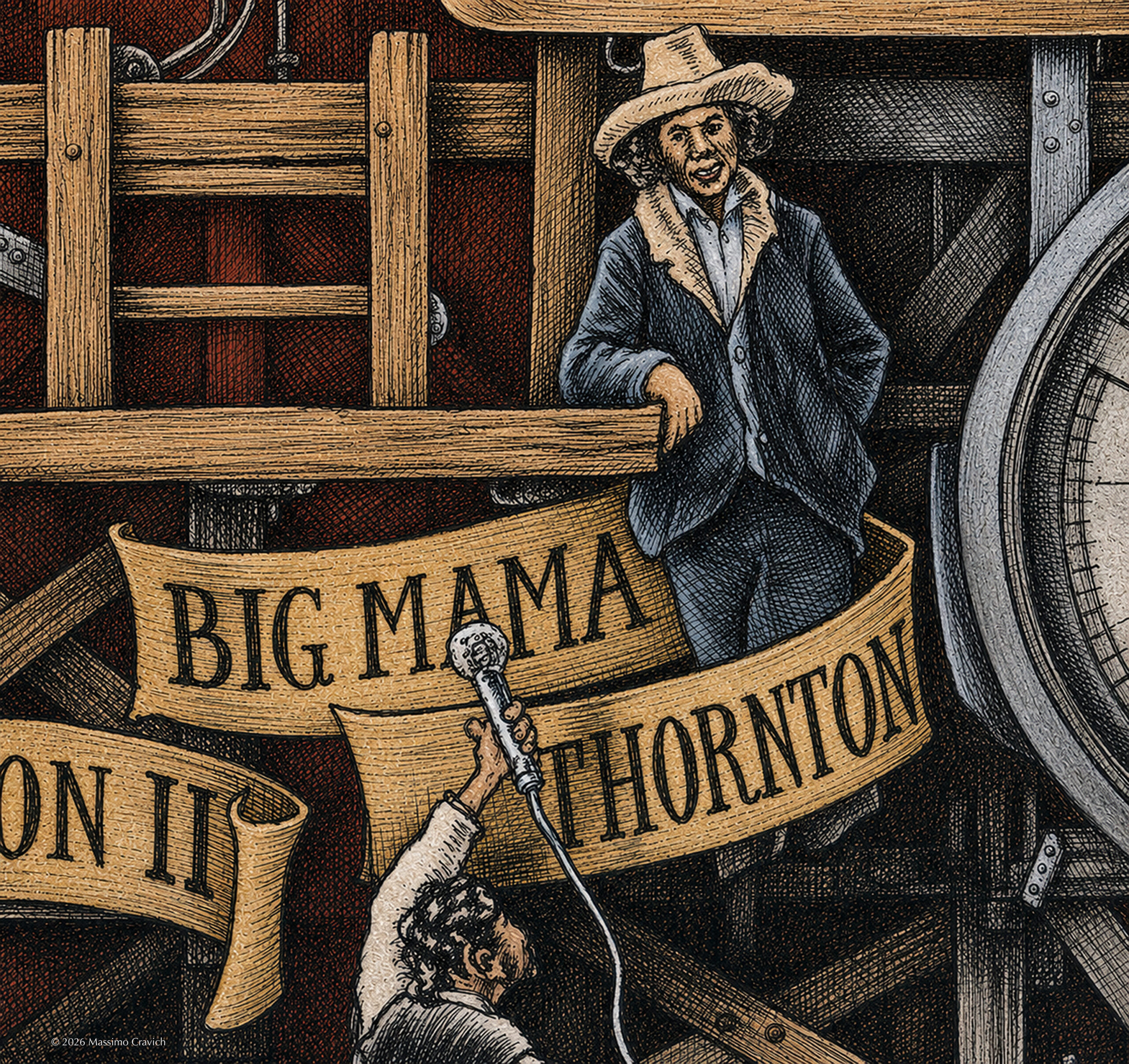
Rock Icons: Big Mama Thornton
A huge, rough and independent voice: blues anticipating rock and roll before rock and roll had a name.
From her gospel background and the African-American Southern touring circuit to the 1953 R&B; success of Hound Dog, Big Mama Thornton brought a vocal, rhythmic and stage power to the blues that anticipated crucial aspects of rock and roll and directly influenced the later blues-rock generation.

Name: Willie Mae Thornton
Born: December 11, 1926 — Montgomery, Alabama, USA
Dead: July 25, 1984 — Los Angeles, California, USA
Core genres: blues, rhythm and blues, electric blues
ARTIST RELATED SITE: There is no official site, here the page on Rock and Roll Hall of Fame rockhall.com/inductees/big-mama-thornton/
LISTEN
More to discover…
Before Elvis and Janis: a voice at the crossroads of blues and rock screamed rock and roll before Elvis
Willie Mae Thornton emerged musically from gospel and grew up on African-American touring circuits, where a singer had to command an audience without protection. From that school came a voice that was powerful and deliberately unpolished, but above all a way of performing blues that rejected conventional vulnerability.
Thornton sang with authority, humor, aggression and rhythmic control; she could growl a phrase, shift its accents or turn it into a challenge. In her music, the female blues tradition of earlier generations met postwar rhythm & blues and a physical stage presence that already belonged partly to the future of rock and roll.
Two exceptional junctions: Hound Dog and Ball and Chain
The decisive historical moment is Hound Dog, written by Jerry Leiber and Mike Stoller and recorded by Thornton in 1952, then released to major R&B; success in 1953. Her performance is very different from the version Elvis Presley would make globally famous three years later: slower, bluesier, ironic and sexually assertive, it is built around Thornton’s personality. Presley’s later success made the song part of emerging global rock culture, but Thornton’s recording makes especially clear how much of the new language was already present in African-American rhythm & blues.
Rock Icons: Big Mama Thornton
A second major genealogical line runs through Ball and Chain. Thornton wrote and recorded it before Janis Joplin made it one of her signature performances with Big Brother and the Holding Company. Joplin openly acknowledged her debt to major blues singers, and Thornton offered a model of intensity, freedom and vocal force. Big Mama therefore occupies two exceptional junctions: Hound Dog leads from R&B; toward early rock and roll; Ball and Chain leads from blues toward 1960s psychedelic and blues rock. Her story reveals an often obscured genealogy: gospel and blues -> rhythm & blues -> rock and roll -> blues revival -> rock.
With Hound Dog and Ball and Chain, Big Mama Thornton occupies two crucial points in rock genealogy: at the roots of 1950s rock and roll and, a decade later, at the foundation of blues rock and Janis Joplin’s vocal expression.
Within The Great Rock and Roll History, Big Mama Thornton connects Southern blues and gospel -> postwar rhythm & blues -> Hound Dog and the birth of rock and roll -> blues revival -> Janis Joplin, blues rock and psychedelic rock.
Influenced by
- African-American gospel
- Southern blues
- Bessie Smith
- Ma Rainey
- Jump blues
Influent For
- Janis Joplin
- Elvis Presley
- Primitive rock and roll
- Blues rock
- Aggressive soul singers

Related Artists
- Janis Joplin
- Elvis Presley
- Bessie Smith
- Muddy Waters
- Howlin’ Wolf
References
Official Big Mama Thornton archives
American blues archives
Rhythm and blues historical archives
Women in blues archives
In the genealogy of rock, Big Mama Thornton is far more important than her level of mainstream fame might suggest. Her voice joins blues, gospel and rhythm & blues to a stage presence and interpretive aggression that anticipate rock and roll. Hound Dog reveals how deeply early rock was rooted in African-American music, while Ball and Chain connects that same tradition to Janis Joplin’s generation. Thornton is not merely a precursor: she is one of the points where the blues enters directly into rock’s DNA.