
Bo Diddley is one of the fundamental architects of rock and roll: a guitarist, singer and songwriter who turned rhythm, repetition and electric sound into an instantly recognizable grammar. The famous “Bo Diddley beat” runs through rock, rhythm & blues, garage, British beat and many later forms of riff-based music. This profile explores Bo Diddley’s roots and legacy within The Great Rock and Roll History, tracing the path from African-American rhythmic traditions and Chicago blues to a conception of guitar and groove that would influence generations of rock bands.
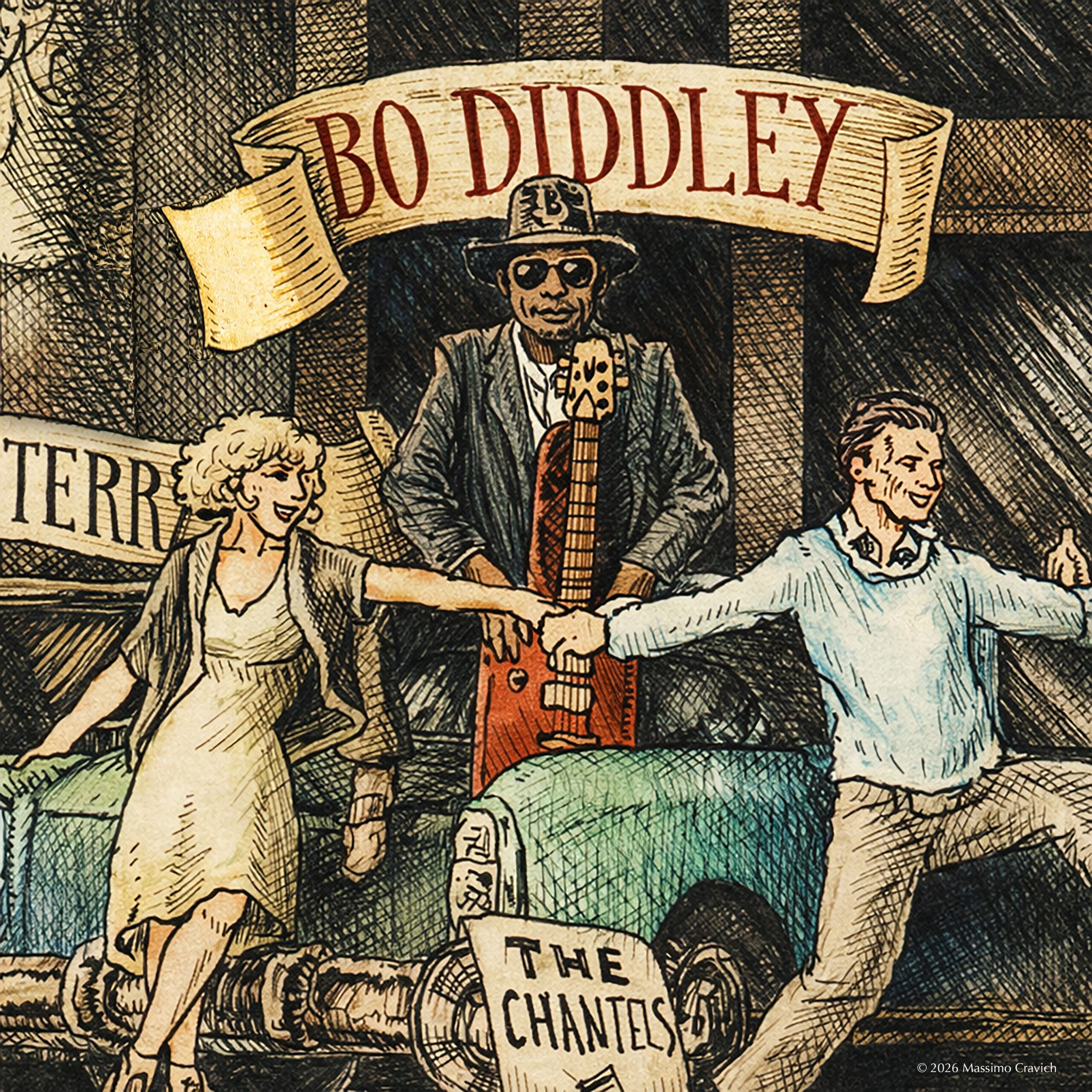
Rock Icons: Bo Diddley
Before the riff became rock’s engine, Bo Diddley turned rhythm itself into a riff. His signature “Bo Diddley beat”, a syncopated rhythmic pattern rooted in African and Latin traditions, became one of the most influential grooves in rock music.

From his 1955 Chess debut with Bo Diddley and I’m a Man to later recordings built around tremolo, maracas, distorted guitars and repetitive patterns, Bo Diddley developed one of the most influential rhythmic languages in early rock and roll.
Name: Ellas McDaniel
Born: December 30, 1928, Mississippi — raised in Chicago
Dead: June 2, 2008 — Archer, USA
Genres: Rhythm & blues, Early rock and roll
ARTIST RELATED SITE: www.bodiddley.com
LISTEN
More to discover…
Rhythm becomes riff: from Chicago blues to rock’s DNA
Bo Diddley emerged musically from postwar African-American Chicago, but his language was never simply identical to the city’s electric blues. His music brought together blues, gospel, rhythm & blues and, above all, a strongly percussive conception of rhythm. The pattern that became known as the “Bo Diddley beat” belongs to a rhythmic family related to Afro-Cuban clave and older African-diasporic traditions: five accents that Diddley turned into a personal signature, reinforced by maracas, drums and guitar.
The result does not merely accompany the song; it becomes the song. In 1955, Bo Diddley and I’m a Man already revealed two ideas that would spread throughout rock. One was the hypnotic, repetitive groove; the other was an electric guitar treated as a rhythmic and sonic machine, using tremolo, distortion, tunings and hard attacks. His image mattered too: the famous rectangular guitars strengthened an immediately identifiable persona. Instead of following the harmonic flow of traditional blues, Diddley often reduced harmony and concentrated everything on pulse, timbre and repetition. That principle would become essential to garage rock and, later, many forms of minimal and aggressive rock.

Rock Icons: Bo Diddley
His genealogy is enormous. Buddy Holly openly used the rhythm in Not Fade Away; the Rolling Stones, the Animals and numerous British Invasion groups absorbed his repertoire, attitude and pulse; garage rock intensified its simplicity, while punk and later rock inherited the idea that a few powerful rhythmic figures could sustain an entire song. The line is remarkably clear: African-diasporic rhythms + Chicago blues/R&B; -> Bo Diddley -> rock and roll and British beat -> garage -> punk and riff-based rock. In this history, Bo Diddley is not merely a precursor: he is one of the great inventors of the way rock walks.
Songs such as Bo Diddley, I’m a Man, Who Do You Love? and Mona turned groove, electric guitar and repetition into structural elements of rock, directly influencing Buddy Holly, the Rolling Stones, the British Invasion and garage rock.
Within The Great Rock and Roll History, Bo Diddley occupies a fundamental genealogical junction: African-diasporic rhythmic traditions + blues and R&B; -> Bo Diddley beat and rhythmic guitar -> rock and roll -> British beat -> garage rock -> punk and later riff-based rock.
Influenced by
- Afro-Caribbean traditions
- Hambone
- Chicago urban blues
Influent For
- Rolling Stones
- Buddy Holly
- The Who
- Underground
- Garage Rock
- British Punk
- Minimal Funk
Related Artists
Get Your Rock Icon
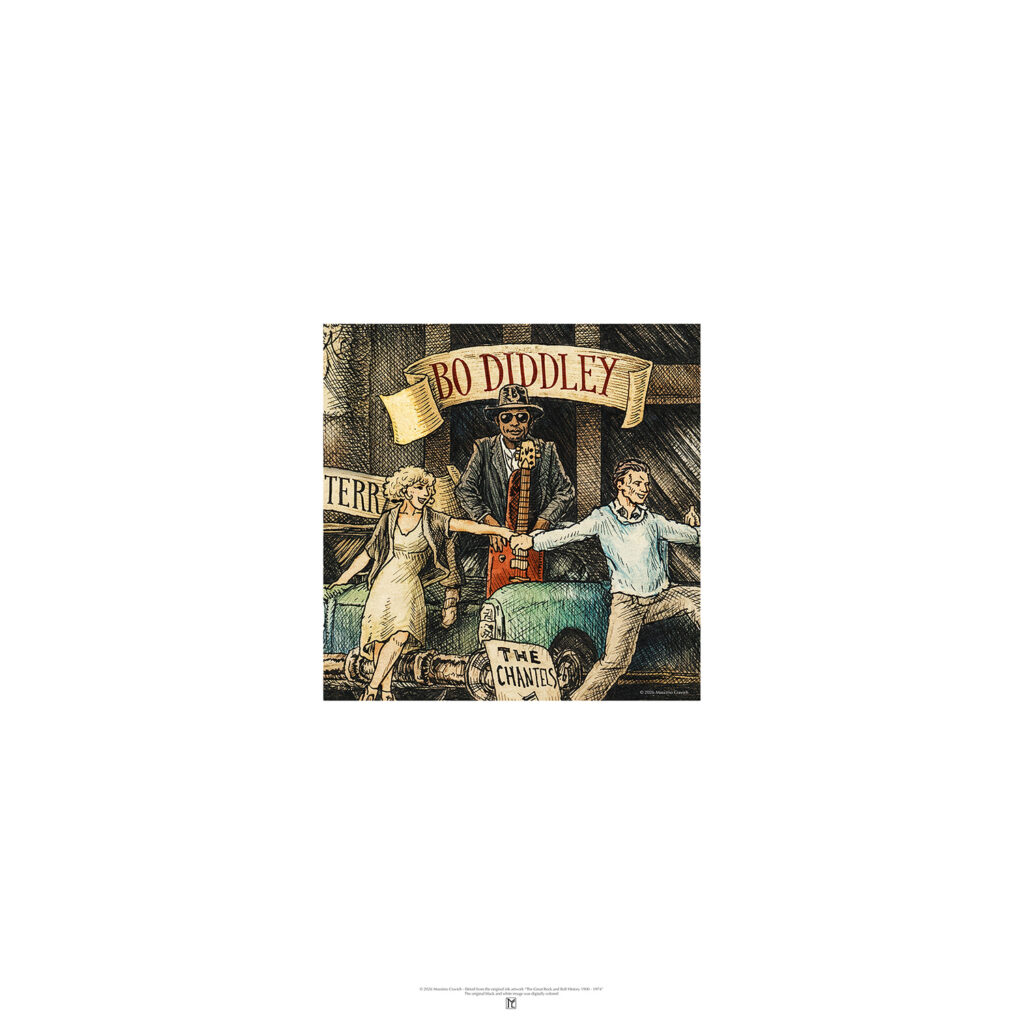
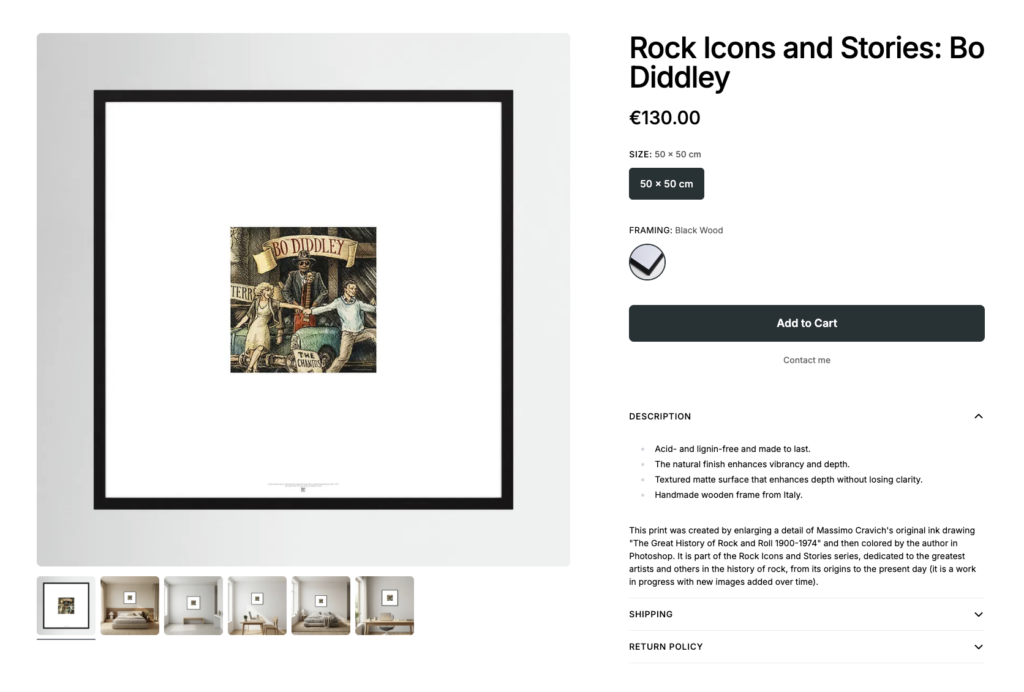
Selected artworks from Rock Icons and Stories are available as high-quality framed art prints. Printed on premium 230 gsm matte paper with excellent detail and colour reproduction, each print is professionally framed and delivered ready to hang.A carefully selected, high-quality alternative to the museum-grade Fine Art Giclée editions, offering an accessible way to own and display a reproduction of the original artwork. Printing, framing and worldwide fulfilment are handled by our specialist printing partner.
In the genealogy of rock, Bo Diddley represents the moment when rhythm became one of the music’s main generative forces. His beat, percussive guitar, tremolo and repetition reduced rock and roll to its most physical elements while opening new possibilities. From Buddy Holly to the Rolling Stones, from garage to punk, his imprint runs across decades of music. If Chuck Berry helped define the vocabulary of rock guitar, Bo Diddley helped define its heartbeat.