
Peter Green was one of British blues’ most expressive guitarists and the founder of Fleetwood Mac. His economical phrasing, vulnerable singing and journey from electric blues to increasingly personal compositions place him at a crucial point in The Great Rock and Roll History: where African American blues traditions met British blues and new rock sensibilities.
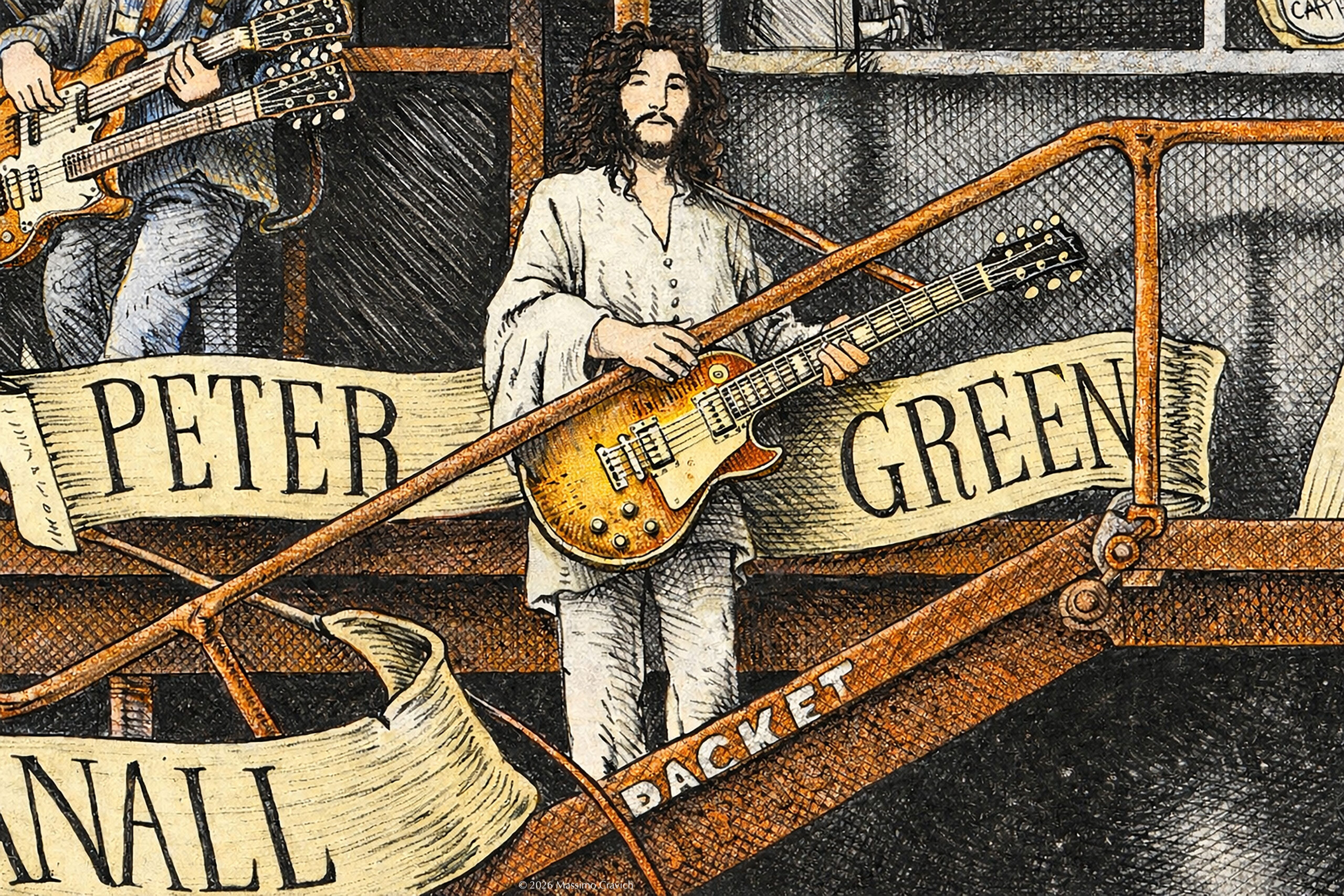
Rock Icons: Peter Green
The note left hanging: talent, vulnerability and freedom in British blues.

His guitar playing was characterized by emotional phrasing, subtle dynamics and a deep connection to traditional blues, influencing the development of British blues rock. From John Mayall’s Bluesbreakers to early Fleetwood Mac, Peter Green reshaped electric blues through songs including Black Magic Woman, Albatross and Oh Well, opening new expressive possibilities for blues rock.
Birth: October 29, 1946, London
Death: July 25, 2020
Period covered: 1967–1970s
Genres: Blues Rock, Rock, Hard Rock
ARTIST OFFICIAL SITE: there’s no official site, you can visit this www.manoftheworldmusic.com
LISTEN
The Green Manalishi (With the Two Prong Crown).
More to discover…
A tragedy without romanticism
Beyond Clapton’s shadow: finding his own voice
Raised in a working-class London family, Peter Green absorbed the blues while playing in local groups. When he replaced Eric Clapton in John Mayall’s Bluesbreakers in 1966, comparisons were unavoidable. Green responded by moving away from displays of virtuosity: short phrases, pauses, measured vibrato and an almost vocal ability to make each note speak. A Hard Road captures his early maturity. Mayall gave him visibility, but Green soon wanted a band whose music and personal relationships would more closely reflect his own ideas.
Fleetwood Mac: friendship, leadership and the blues
In 1967 Green founded Fleetwood Mac, naming the group after the rhythm section he hoped would join him: Mick Fleetwood and John McVie. McVie initially stayed with Mayall, so Bob Brunning played bass in the new band’s earliest phase. With Jeremy Spencer and later Danny Kirwan, Fleetwood Mac developed a remarkably varied language: Chicago blues, slide guitar, melancholy melodies and psychedelic departures.
Although its principal writer and public face, Green seemed uncomfortable with conventional stardom. Black Magic Woman revealed his restrained, sensual songwriting; Albatross showed how his blues sensibility could become a soundscape. Success did not resolve the pressures of money, expectations and responsibility.
The sound of silence and the crisis
Across Oh Well, Man of the World and The Green Manalishi, increasingly troubled emotions came to the surface. Green explored psychedelic rock and questioned material success; he also experienced serious psychological difficulties during a period when psychedelic drug use and the pressures of fame complicated his circumstances. His story should not be reduced to one cause or one incident. He left Fleetwood Mac in 1970, creating a major artistic rupture for the band and beginning a long personal journey involving withdrawal, difficulties and attempts to return to music.

Rock Icons: Peter Green
Returns, friendships and a quiet legacy
Over subsequent decades Green moved through periods away from performance and periods of treatment, alongside intermittent recordings and collaborations. In the late 1990s, the Peter Green Splinter Group marked an important return, supported by fellow musicians.
His influence rests less on the number of notes he played than on the space he left between them: Gary Moore paid tribute to him, while Santana’s version of Black Magic Woman brought one of his compositions to an even wider audience. In rock genealogy, Green connects B.B. King and Chicago blues to British blues rock, demonstrating how intensity and vulnerability can become a distinctive musical signature.
Black Magic Woman, Albatross, Oh Well and Man of the World trace Peter Green’s evolution from electric blues toward a personal, atmospheric rock language marked by emotional tension.
Within The Great Rock and Roll History, Peter Green also embodies a late-1960s contradiction: as rock became an ever-larger industry, one of its most original musicians sought expression less tied to commercial success and personal stardom.
Influenced by
- B.B. King
- Freddie King
- Otis Rush
- Elmore James
- John Mayall
Influent For
- Gary Moore
- Carlos Santana
- Billy Gibbons
- Joe Perry
- Noel Gallagher

Influent For
- John Mayall
- Mick Fleetwood
- John McVie
- Jeremy Spencer
- Danny Kirwan
SOURCES
Fleetwood Mac, official history – https://www.fleetwoodmacofficial.com/
Rock & Roll Hall of Fame, Fleetwood Mac – https://rockhall.com/inductees/fleetwood-mac/
BBC Music, Peter Green retrospective – https://www.bbc.com/Martin Celmins, Peter Green: Founder of Fleetwood Mac
In blues-rock history, Peter Green holds a distinctive place: he helped define British blues without turning guitar playing into a contest of power. Founder of Fleetwood Mac and writer of Black Magic Woman and Albatross, he brought rock a sensibility built on silence, melancholy and expressive restraint. His personal difficulties neither