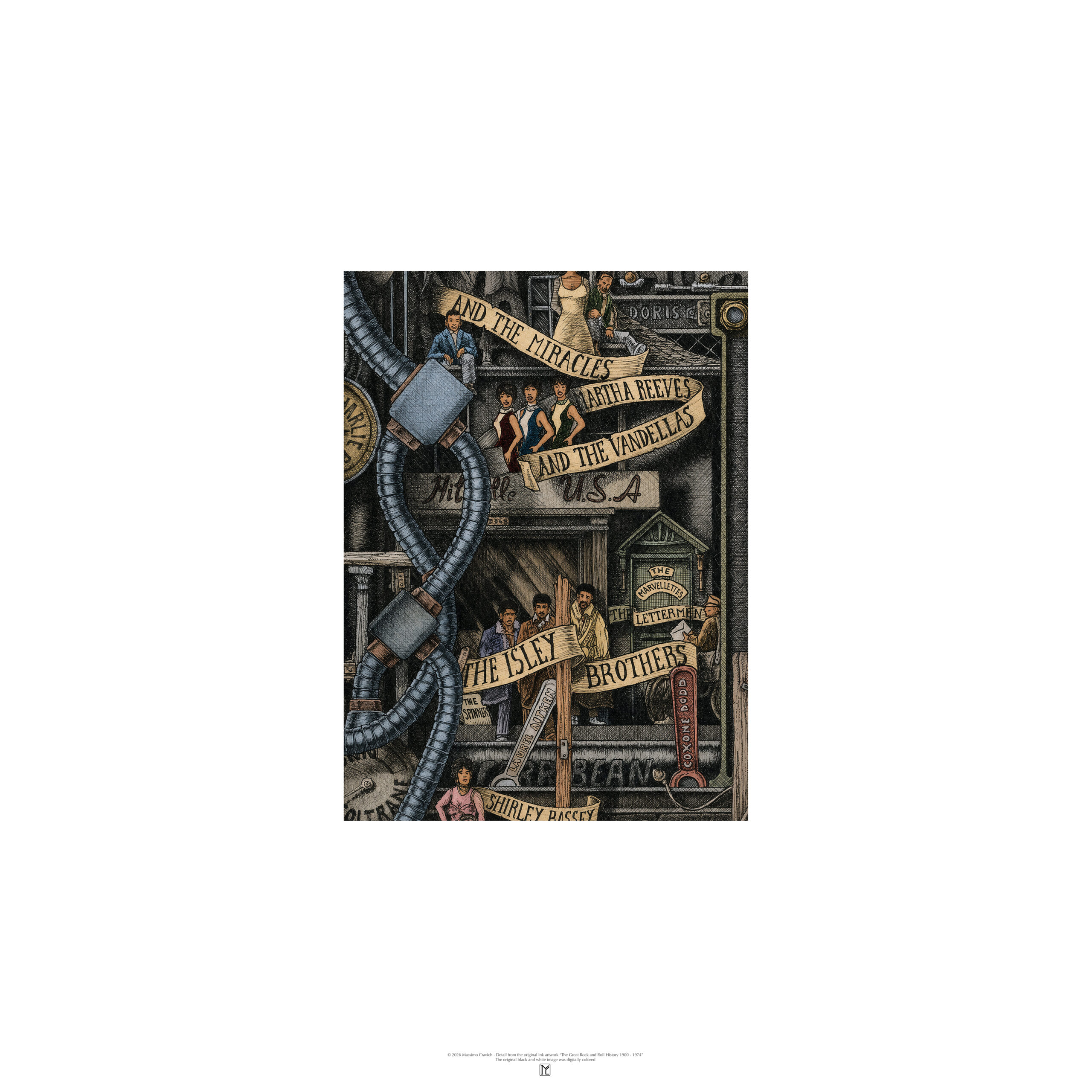
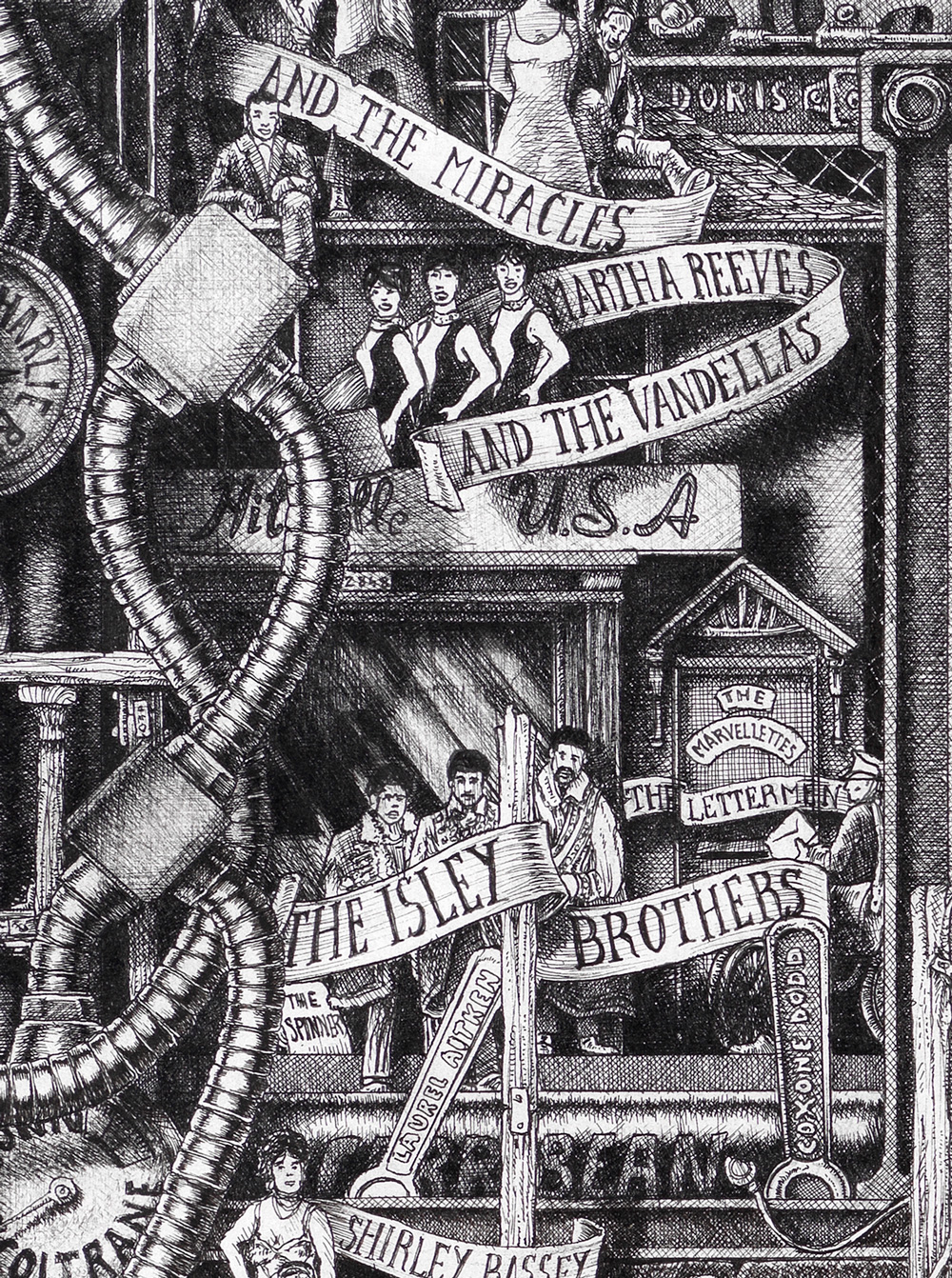
Motown Records transformed Detroit into one of the great centers of twentieth-century popular music. Founded by Berry Gordy in 1959, it created a system in which songwriting, arranging, production, studio musicians and artist development worked together, carrying African American soul and rhythm & blues into the center of the international pop market without erasing their roots.
This illustrated profile explores the cultural impact and the legacy within The Great Rock and Roll History, a large-scale illustrated timeline of modern music.
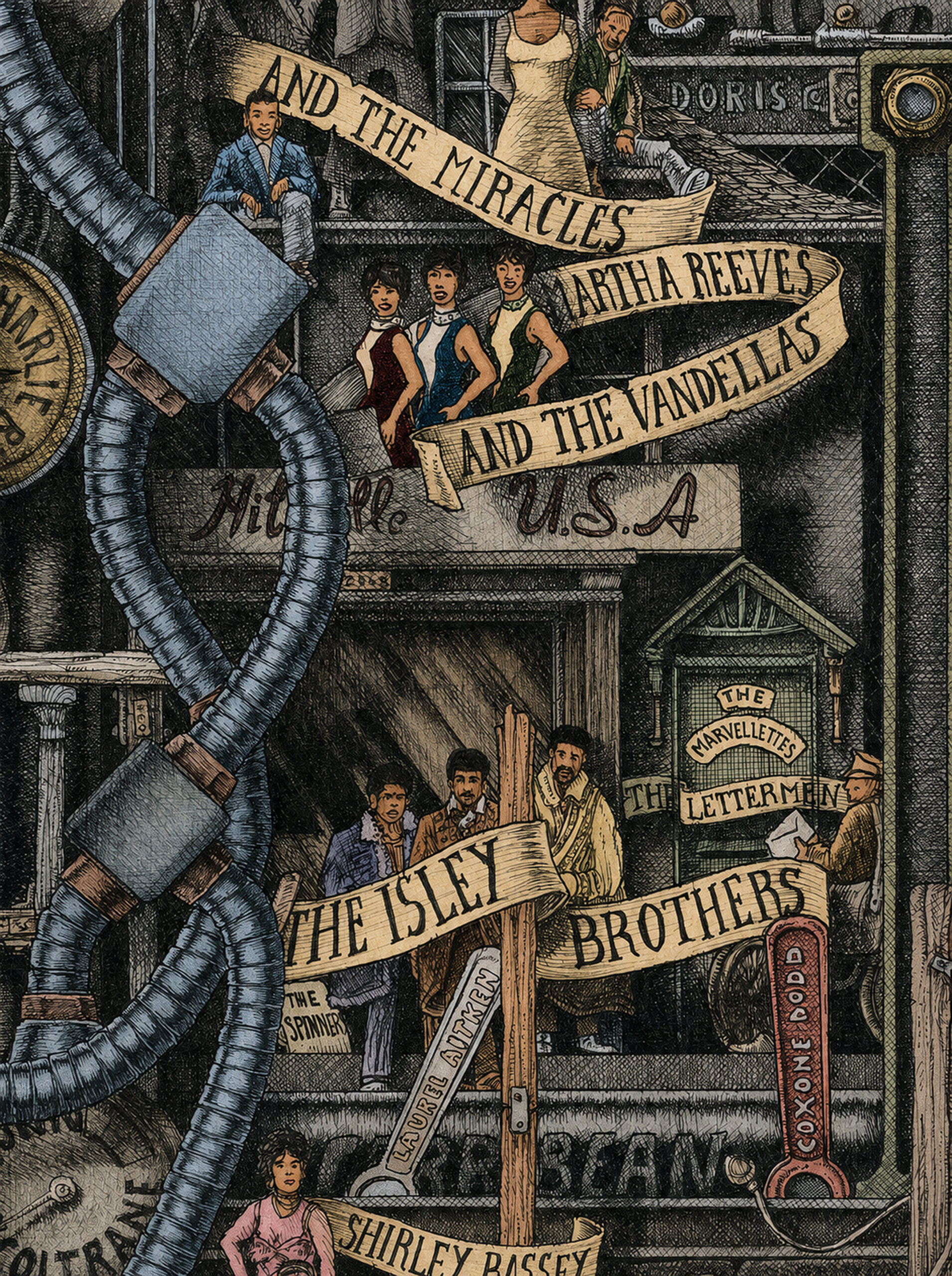
Rock Icons: Motown Records

NAME Motown Records / Motown Record Corporation
FOUNDED 1959, Detroit, Michigan
FOUNDER Berry Gordy Jr.
FIRST LABEL Tamla Records, launched in 1959
HISTORIC HEADQUARTERS Hitsville U.S.A., 2648 West Grand Boulevard, Detroit
CLASSIC DETROIT PERIOD 1959-1972
CORE GENRES Soul, rhythm & blues, pop, funk
HOUSE BAND The Funk Brothers
KEY ARTISTS The Supremes, Marvin Gaye, Stevie Wonder, The Temptations, Four Tops, Martha and the Vandellas, Smokey Robinson & the Miracles, The Jackson 5
SONGWRITING / PRODUCTION Holland-Dozier-Holland, Smokey Robinson, Norman Whitfield, Barrett Strong, Ashford & Simpson, Berry Gordy
PRODUCTION SYSTEM Integrated songwriting, production, quality control, artist development and house band
RELOCATION Main headquarters moved from Detroit to Los Angeles in 1972
LEGACY The Motown Sound and an African American industrial model with international reach
STAX OFFICIAL SITE: motownrecords.com
LISTEN
MOTOWN: DETROIT, THE SOUND AND THE CREATIVE MACHINE
Hitsville U.S.A.: a different kind of factory
Motown grew from Berry Gordy’s determination to organize music with unusual discipline. After working on a Ford assembly line and gaining experience as a songwriter and small businessman, he launched Tamla in 1959 with a family loan and bought a house on West Grand Boulevard that became Hitsville U.S.A.: offices upstairs, studio below, activity continuing almost around the clock. The comparison with Detroit’s assembly lines is unavoidable, but misleading if taken literally. Motown standardized parts of the process, not creativity itself: writers, producers, arrangers and musicians competed, collaborated and repeatedly reshaped songs before they survived the company’s internal quality-control meetings.
Within that system grew a largely African American community learning to operate inside a record industry still dominated by white-owned structures. Gordy wanted the broadest possible audience and also developed an artist-development department: clothing, stage presence, interviews and choreography were treated alongside music. The discipline could be strict, but for young Detroit performers it also provided a professional machine capable of carrying them from local stages to national television and international markets.
The Motown Sound: rhythm, melody and precision
The Motown Sound was never a single formula, yet it had instantly recognizable characteristics. At its center were the Funk Brothers, the remarkable house band whose changing membership included James Jamerson, Benny Benjamin, Earl Van Dyke, Robert White and many others. Jamerson transformed the role of electric bass through mobile melodic lines; drums and tambourine reinforced the beat; piano, guitars and percussion created rhythmic interlocks; strings and horns widened the palette without weakening the pulse.
The result was sophisticated music that retained the immediacy required of a pop single.Songwriting operated as another laboratory. Holland-Dozier-Holland created many of the defining hits for the Supremes and Four Tops; Smokey Robinson brought a different melodic and narrative sensitivity; Norman Whitfield and Barrett Strong later pushed the Temptations toward extended arrangements, psychedelia and funk. Vocals remained connected to gospel and R&B; but were placed inside structures designed to cross radio formats and charts. Where Stax often preserved the physical sensation of musicians playing together in a room, Motown generally placed greater emphasis on refinement, layering and repeatable results: two different routes by which soul entered mass pop culture.
Crossing America: success, integration and new tensions
Motown’s success meant more than chart positions. In an America still shaped by segregation and the civil-rights struggle, African American performers became familiar presences in the homes of millions of white listeners. The Supremes, Temptations, Four Tops, Marvin Gaye and Stevie Wonder did not erase racial barriers, but they materially changed what the American mainstream saw and heard. Gordy deliberately pursued a language capable of crossing those barriers, condensed in the phrase “The Sound of Young America.”
By the late 1960s, however, both the country and the artists were changing. The 1967 Detroit uprising, the Vietnam War, the civil-rights movement and a new political consciousness made it increasingly difficult for pop to remain in an apparently neutral space. Norman Whitfield introduced social themes and psychedelic production into the Temptations; Marvin Gaye gained creative autonomy with What’s Going On; Stevie Wonder progressively secured unprecedented control over composition, instrumentation and production. The same structure that had disciplined its artists now had to make room for their growth as authors.
From Detroit to the world: transformation and legacy
In 1972 Motown moved its main headquarters to Los Angeles. The relocation symbolically closed the era of Hitsville as a concentrated community occupying a handful of houses on West Grand Boulevard, but it did not end the label’s history. The Jackson 5, Diana Ross, Marvin Gaye and Stevie Wonder now belonged to an international pop culture; in later years the catalog continued to evolve while the company gradually entered larger corporate structures.
In the genealogy of rock and popular music, Motown occupies an essential junction between gospel, R&B;, doo-wop and soul on one side and pop, funk, disco and modern R&B; on the other. Its influence extends beyond songs: to electric bass, the house-band model, the relationship between songwriter and producer, the construction of an artist’s visual identity and the possibility of an African American enterprise controlling a significant part of cultural production for a mass audience. Motown demonstrated that accessibility and complexity are not opposites: behind many three-minute singles stood an extraordinarily sophisticated network of musicians, writers, arrangers and technicians. This combination of industrial organization, collective talent and social transformation made Hitsville U.S.A. not simply a hit factory, but one of the places where American music redefined its center.
For all this reasons, Motownrecords occupies a fundamental position within the rock and pop genealogy explored in The Great Rock and Roll History
Get Your Rock Icon
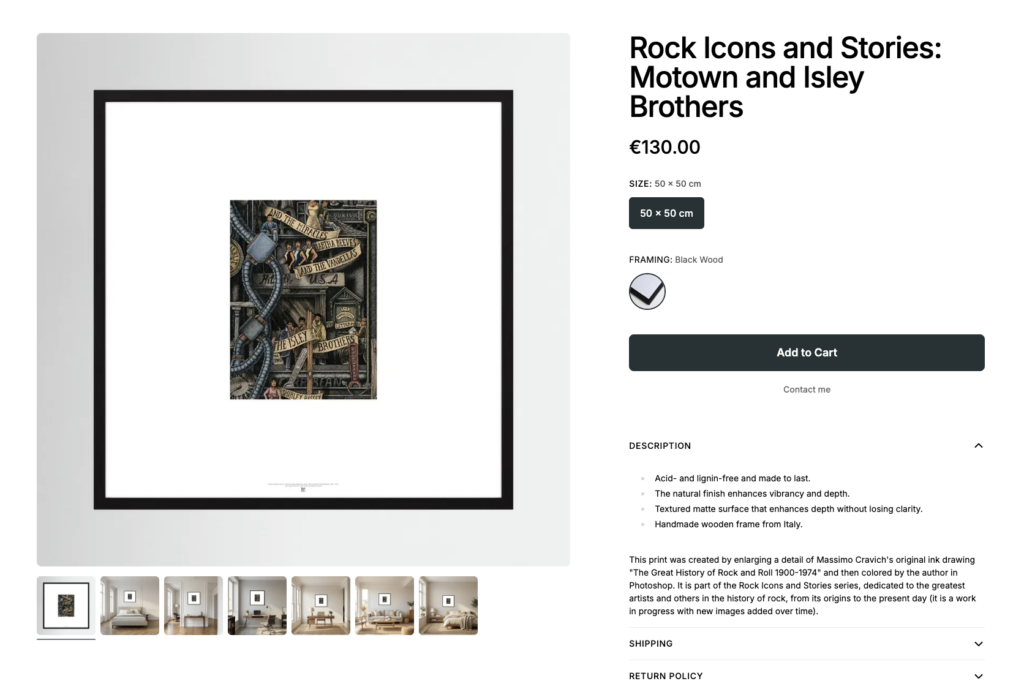
Selected artworks from Rock Icons and Stories are available as high-quality framed art prints. Printed on premium 230 gsm matte paper with excellent detail and colour reproduction, each print is professionally framed and delivered ready to hang.A carefully selected, high-quality alternative to the museum-grade Fine Art Giclée editions, offering an accessible way to own and display a reproduction of the original artwork. Printing, framing and worldwide fulfilment are handled by our specialist printing partner.