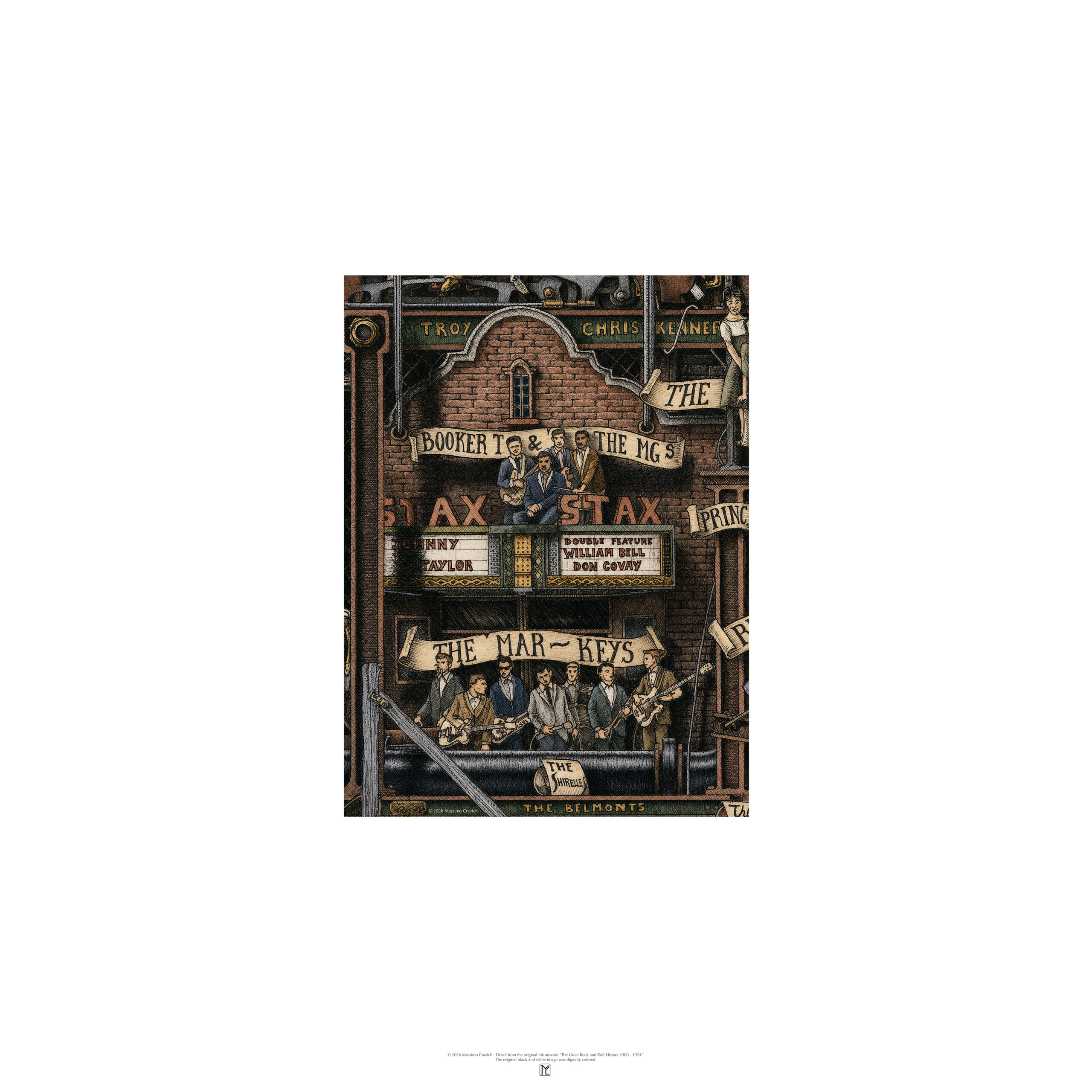
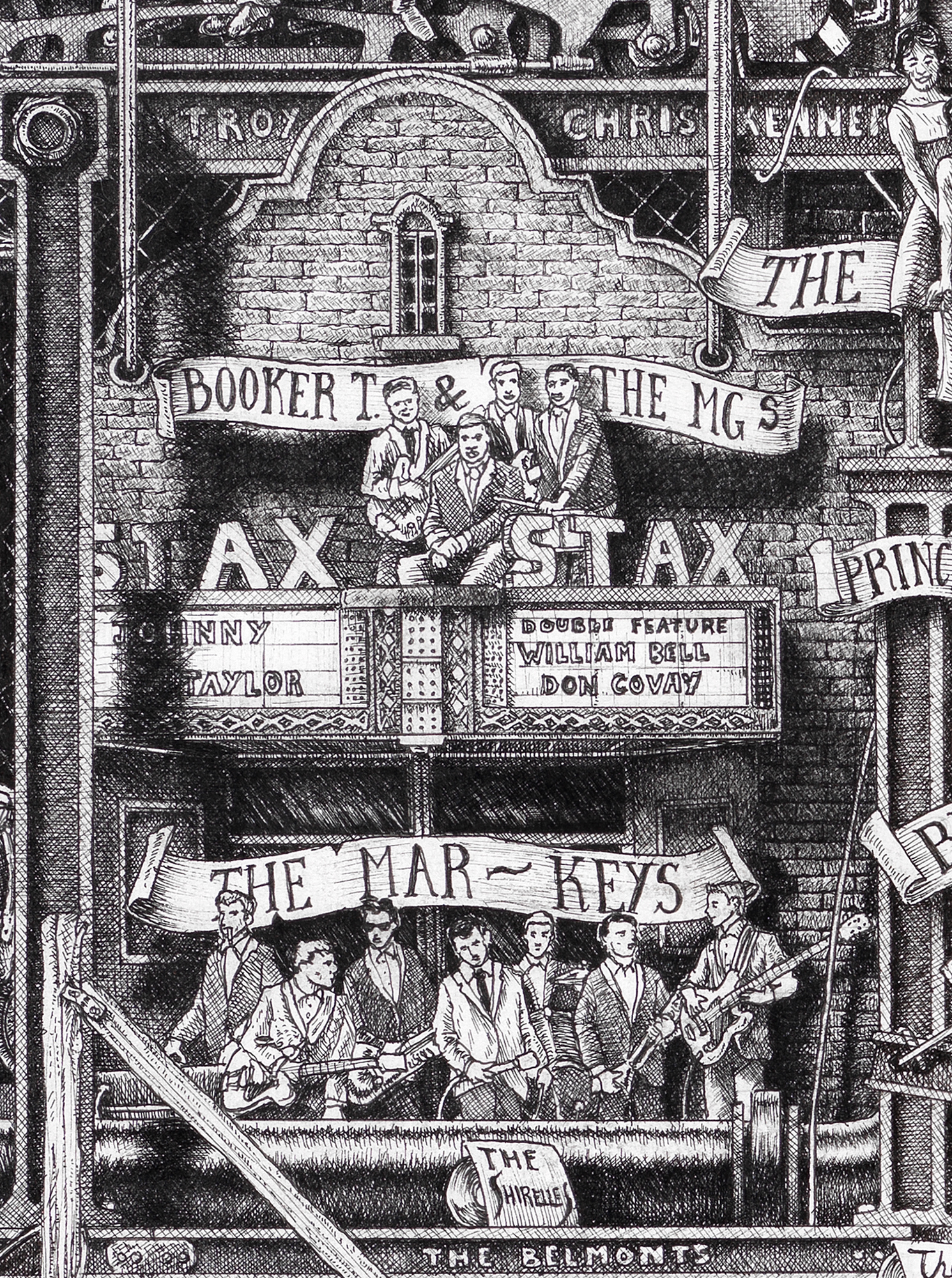
Stax began almost by trial and error, far from the idea of a major record company designed according to a business plan…
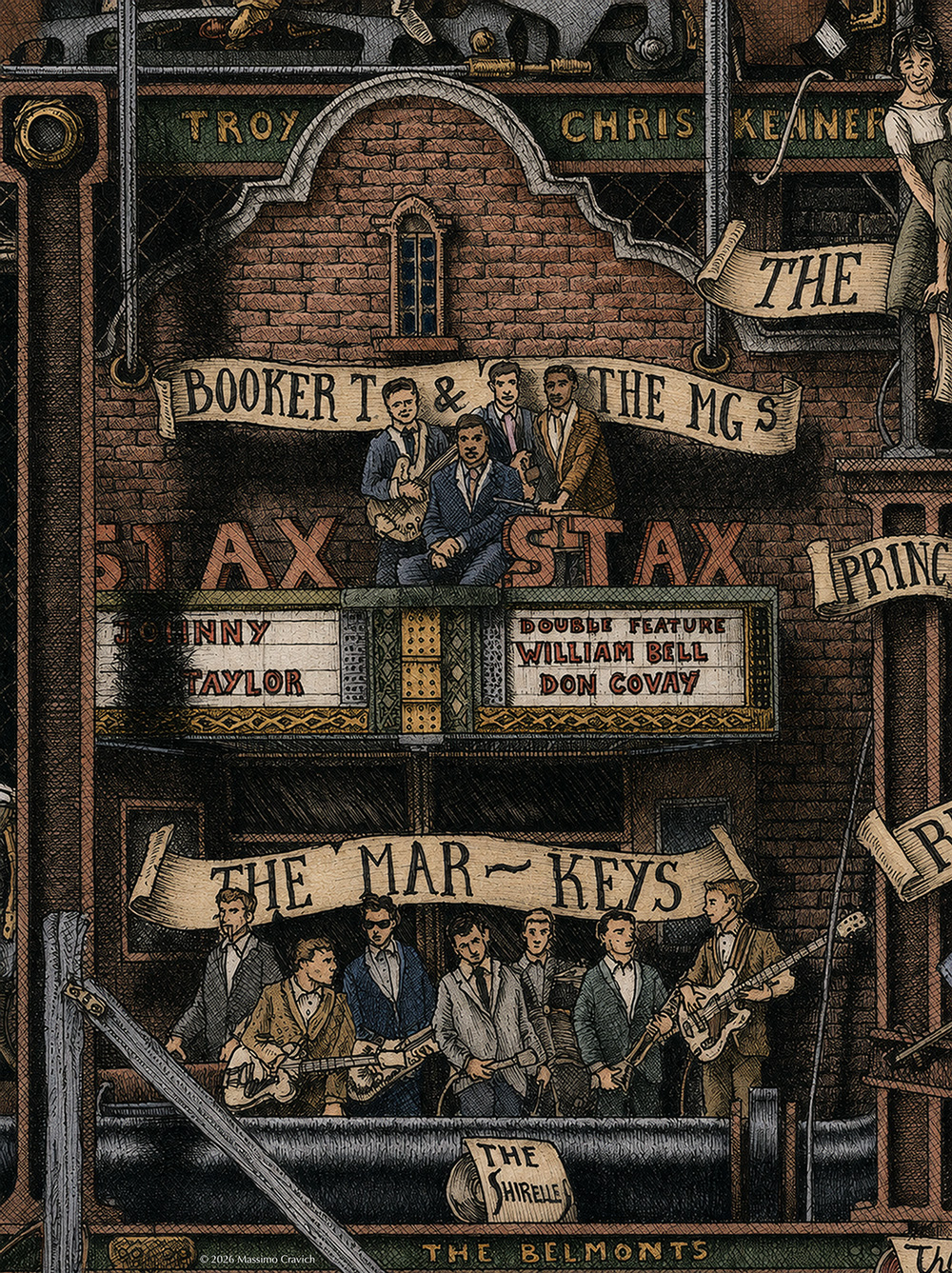
This illustrated profile explores the cultural impact and the legacy within The Great Rock and Roll History, a large-scale illustrated timeline of modern music.
Rock Icons: Stax Records

NAME Stax Records
ORIGIN Satellite Records, founded in 1957
FOUNDERS Jim Stewart; Estelle Axton joined shortly afterward as partner
HISTORIC ADDRESS 926 East McLemore Avenue, Memphis, Tennessee
NAME STAX From the first two letters of Stewart + Axton
CLASSIC PERIOD 1960-1975
CORE GENRES Soul, rhythm & blues, funk, gospel, blues
HOUSE BAND Booker T. & the M.G.’s; with musicians from the Stax studio circle
KEY ARTISTS Otis Redding, Carla and Rufus Thomas, Sam & Dave, Isaac Hayes, Staple Singers, Johnnie
Taylor, Albert King, Bar-Kays
SONGWRITING /PRODUCTION Isaac Hayes, David Porter, Steve Cropper, Jim Stewart, Al Bell
HISTORIC DISTRIBUTION Atlantic Records during the 1960s; separation in 1968
SYMBOLIC EVENT Wattstax, Los Angeles, 1972
CRISIS AND CLOSURE Involuntary bankruptcy, 1975
STAX OFFICIAL SITE: staxrecords.com
LISTEN
STAX: MEMPHIS, SOUL AND A COMMUNITY INSIDE THE STUDIO
Stax began almost by trial and error, far from the idea of a major record company designed according to a business plan. Jim Stewart, a bank employee and country fiddler, founded Satellite Records in 1957; his sister Estelle Axton mortgaged her home to finance new equipment and became an essential part of the enterprise. After moving to Memphis, the operation found a home in a former movie theater at 926 East McLemore Avenue, in the heart of an African American neighborhood. The room was adapted with modest means: the sloping cinema floor, irregular space, imperfect acoustics and empirical placement of instruments and microphones eventually contributed to a sound no designer had planned.
The encounter with Rufus Thomas
and the very young Carla Thomas shifted Stewart’s attention decisively from country toward rhythm & blues. A community rather than a simple production line soon formed around the studio. The record shop Estelle Axton opened in the old theater lobby brought the neighborhood’s tastes directly into the building; musicians, writers and young people moved from the street into the shop and sometimes from the shop into the studio. Booker T. & the M.G.’s became the instrumental center of many sessions: Booker T. Jones’s organ, Steve Cropper’s economical guitar, Donald “Duck” Dunn’s bass and Al Jackson Jr.’s drums created a grammar based on space, syncopation, economy and groove.
The Memphis Sound
Unlike the carefully orchestrated precision of much contemporary pop, the Memphis Sound often grew from direct interaction among musicians in the room. There was also a human and social dimension that cannot be separated from the music. In the segregated Memphis of the 1960s, Stax brought Black and white musicians, writers, technicians and employees together every day in an integrated working environment sharply at odds with life outside its doors. This did not mean that the surrounding racism disappeared; precisely the opposite made the experience so unusual. The assassination of Martin Luther King Jr. in Memphis in 1968, after years of increasing racial tension, also changed the atmosphere around the studio. The small creative free zone could no longer feel isolated from the city and the history surrounding it.
A new form of Soul
Musically, Stax transformed gospel, blues and rhythm & blues into a form of soul distinct from the more controlled elegance of other major productions of the period. Voices remained close to the language of church and blues; horns and rhythm section answered the singer; bass did more than fill the harmony and instead propelled the song; pauses and imperfections became part of the character. Otis Redding pushed this language toward an almost physical vocal tension; Sam & Dave, with songs by Isaac Hayes and David Porter, emphasized itscall-and-response structure; Eddie Floyd, Carla Thomas and William Bell revealed other possibilities within the same system. Stax did not create Southern soul by itself, but it became one of its most recognizable laboratories.
The relationship with Atlantic Records
allowed those recordings to reach national and international distribution, but it also contained the seed of a future crisis. When the agreement ended in 1968, Stax discovered that it did not own much of the master material Atlantic had distributed during the previous years. Shortly before, in December 1967, the death of Otis Redding and four members of the Bar-Kays in a plane crash had already deprived the label of its most important artist and deeply affected the studio community. The old Stax was forced almost literally to begin again.
Under Al Bell’s growing leadership
the response was expansion rather than retreat. The 1969 “Soul Explosion” was designed to rebuild the catalog rapidly, while Isaac Hayes moved from behind-the-scenes work toward a new conception of the soul artist. Hot Buttered Soul stretched songs through orchestration, long instrumental development and a freedom incompatible with the traditional length of the single; Shaft carried that transformation into international popular culture. The Staple Singers, Johnnie Taylor, the Dramatics, the Emotions and others widened the label’s territory further, while funk, gospel and new forms of soul entered its vocabulary ever more clearly.
Wattstax
Wattstax, organized in 1972 at the Los Angeles Memorial Coliseum, made visible something that had grown beyond the identity of a record company. The concert, film and wider initiative placed Stax within contemporary African American culture, at the intersection of pride, community, entertainment and political change. It was an enormous distance from the improvised little studio of Jim Stewart and Estelle Axton fifteen years earlier: Stax had become both a national enterprise and a cultural symbol. That growth, however, brought increasingly fragile financial and distribution structures. Rapid expansion, distribution problems, banking difficulties and financial disputes eventually led to involuntary bankruptcy in 1975.
The Legacy
The end of the original company did not mean the end of its musical language. The catalog survived, the name was later revived, and the old McLemore Avenue address became the site of Stax memory. In the history of rock and popular music, Stax therefore served a function broader than that of a major soul label. It was a point where African American traditions rooted in gospel, blues and rhythm & blues entered an almost makeshift studio and were transformed through a community of musicians, writers and producers. That sound flowed into soul, funk and rock, influenced the way rhythm sections were conceived, and demonstrated how a recording could retain the physical character of people playing together in a room. But the Stax story also tells something more: interracial collaboration born in the segregated South, the possibilities and limits of a small independent company, and the moment when one specific place in Memphis managed, for a few years, to become one of the centers of world music.
For all this reasons, Stax records occupies a fundamental position within the rock and pop genealogy explored in The Great Rock and Roll History
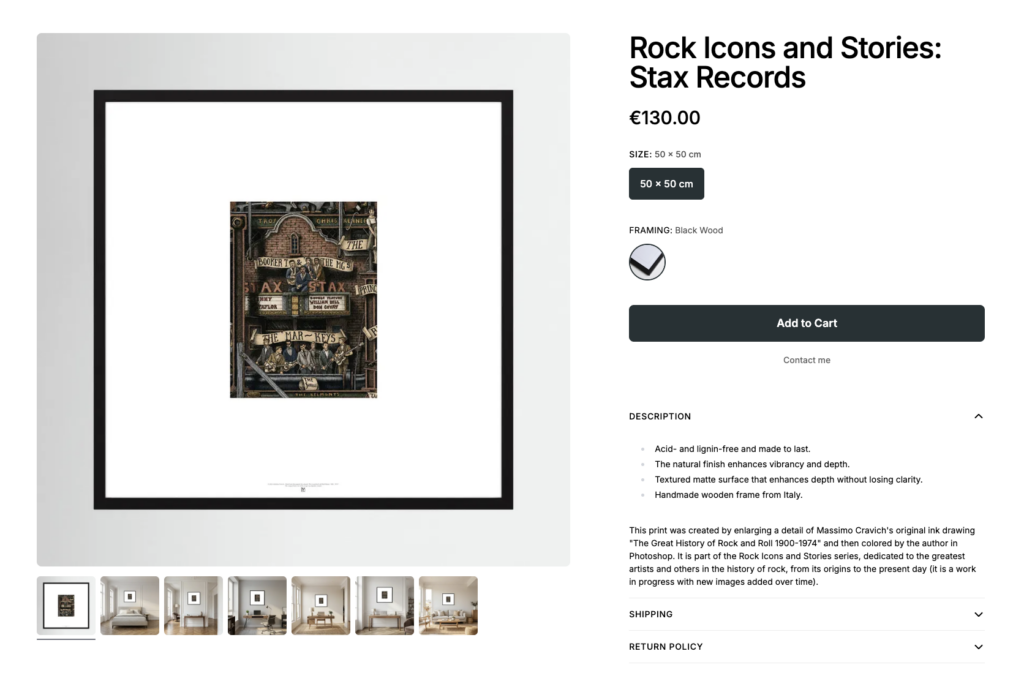
Get Your Rock Icon
Selected artworks from Rock Icons and Stories are available as high-quality framed art prints. Printed on premium 230 gsm matte paper with excellent detail and colour reproduction, each print is professionally framed and delivered ready to hang.A carefully selected, high-quality alternative to the museum-grade Fine Art Giclée editions, offering an accessible way to own and display a reproduction of the original artwork. Printing, framing and worldwide fulfilment are handled by our specialist printing partner.