
Black Sabbath are one of the decisive bands in the birth of heavy metal. Starting from late-1960s British blues rock, they transformed riffs, volume, heavy tunings and dark atmosphere into a new language that would generate entire families of rock and metal. This profile explores Black Sabbath’s roots and legacy within The Great Rock and Roll History (a large-scale illustrated timeline of modern music), tracing the path from blues and British hard rock to a slower, darker and more massive music built around Tony Iommi’s riffs and Ozzy Osbourne’s unmistakable voice.
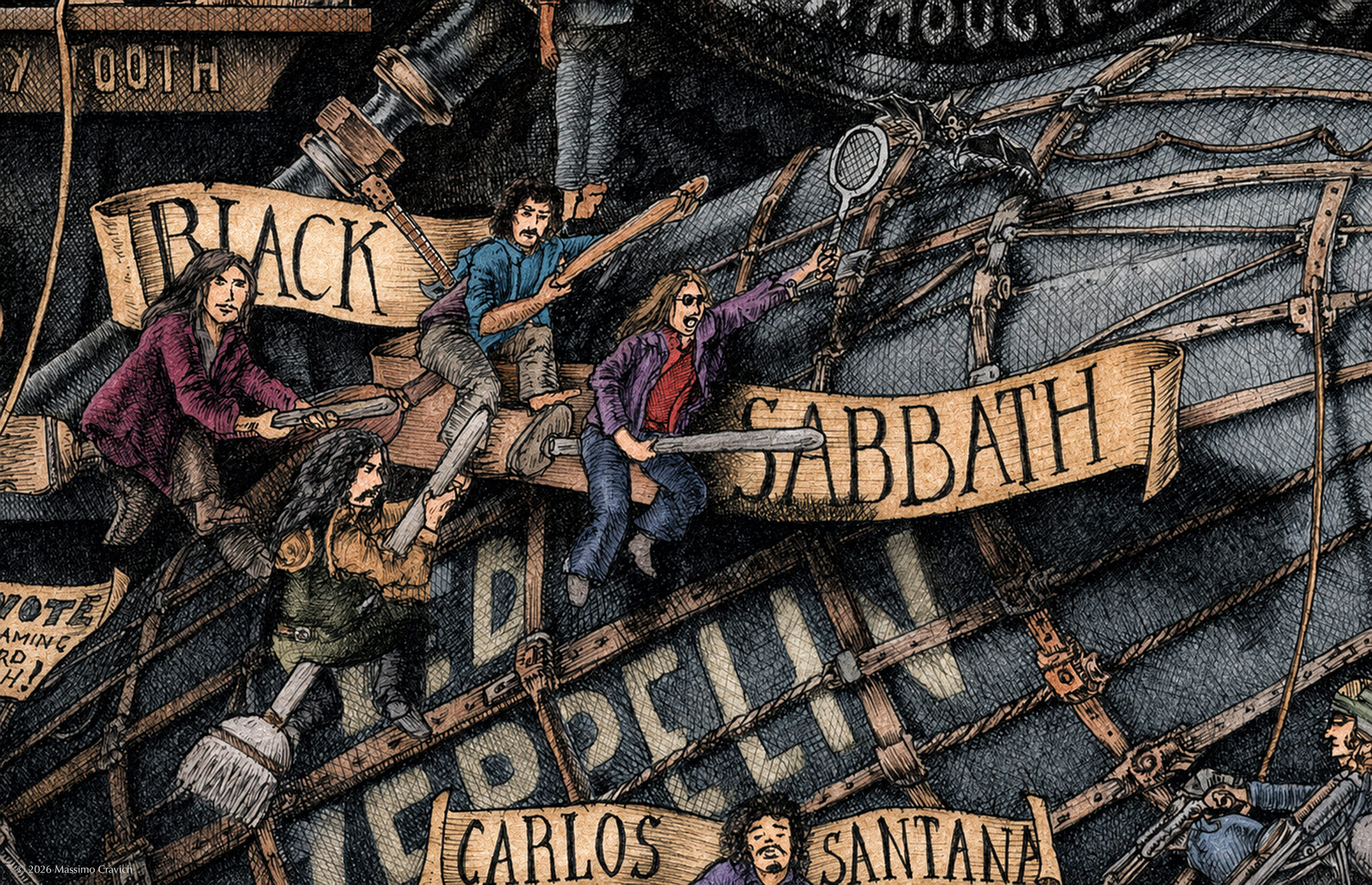
Rock Icons: Black Sabbath
When the blues became slower, heavier and darker: four musicians from Birmingham opened the door to heavy metal.

From industrial Birmingham and the blues-rock roots of Earth to the early albums Black Sabbath, Paranoid and Master of Reality, Tony Iommi, Ozzy Osbourne, Geezer Butler and Bill Ward defined a new vocabulary of monolithic riffs, tension, volume and dark themes.
Black Sabbath did not emerge from Californian hippie psychedelia or 1960s optimism. Black Sabbath emerged from the industrial landscape of Birmingham carrying a radically darker sound than most late-1960s rock bands. Their music replaced psychedelic optimism with fear, repetition and existential heaviness. Tony Iommi’s down-tuned riffs, Geezer Butler’s dark lyrical imagination, Bill Ward’s jazz-influenced drumming and Ozzy Osbourne’s spectral voice created a completely new musical language.
Founded: 1968 — Birmingham, England
Status: disbanded
Classic Core: Ozzy Osbourne-vocal, Tony Iommi-guitar, Geezer Butler-bass, Bill Ward-drums
Genres: Heavy metal, doom metal, hard rockexperimental rock, art rock, proto-punk, avant-garde rock, drone rock, noise rock.
ARTIST OFFICIAL SITE: www.blacksabbath.com
LISTEN
• Paranoid
• War Pigs
• Iron Man
More to discover…
From blues to heavy metal: the weight of the riff becomes a new language
Black Sabbath emerged from the same blues matrix that fed much of British hard rock. Before them came Cream, Jimi Hendrix, John Mayall, Led Zeppelin and the wider British rediscovery of American blues. But in industrial Birmingham at the end of the 1960s that material acquired a different character.
Tony Iommi built music around simple, massive riffs; Geezer Butler often reinforced the guitar with bass lines that multiplied its weight; Bill Ward retained a rhythmic mobility surprisingly close to jazz and blues; Ozzy Osbourne sang clear, almost ritual melodies above a sound mass that seemed to come from another world.

The first album, Black Sabbath, released in 1970, suddenly made recognizable something that had previously existed only in fragments. The famous opening of the title track, built in part around the tension of the tritone, brought a sense of menace into rock that depended on more than volume. Paranoid broadened the formula: War Pigs confronted war and power, Iron Man built a monument around the riff, while the title track showed that heaviness could also be concise and immediate. Master of Reality, with lowered tunings and an even denser sound, pushed the music further toward territories later called doom, stoner and sludge.
Their genealogical importance lies precisely here: Sabbath did not create heavy music from nothing, but gathered blues, hard rock, psychedelia and social unease and reorganized them around the riff. From that point, heavy metal possessed a recognizable grammar. Judas Priest would develop a more metallic and faster form; doom retained the slowness and darkness; stoner and sludge inherited weight and repetition; generations of metal bands would continue returning to Iommi’s riffs.
The line is clear: blues -> British blues rock -> hard rock -> Black Sabbath -> heavy metal -> doom, stoner, sludge and many later branches of metal.Albums and songs such as Paranoid, War Pigs and Black Sabbath became defining landmarks of heavy metal and dark guitar-driven rock culture.
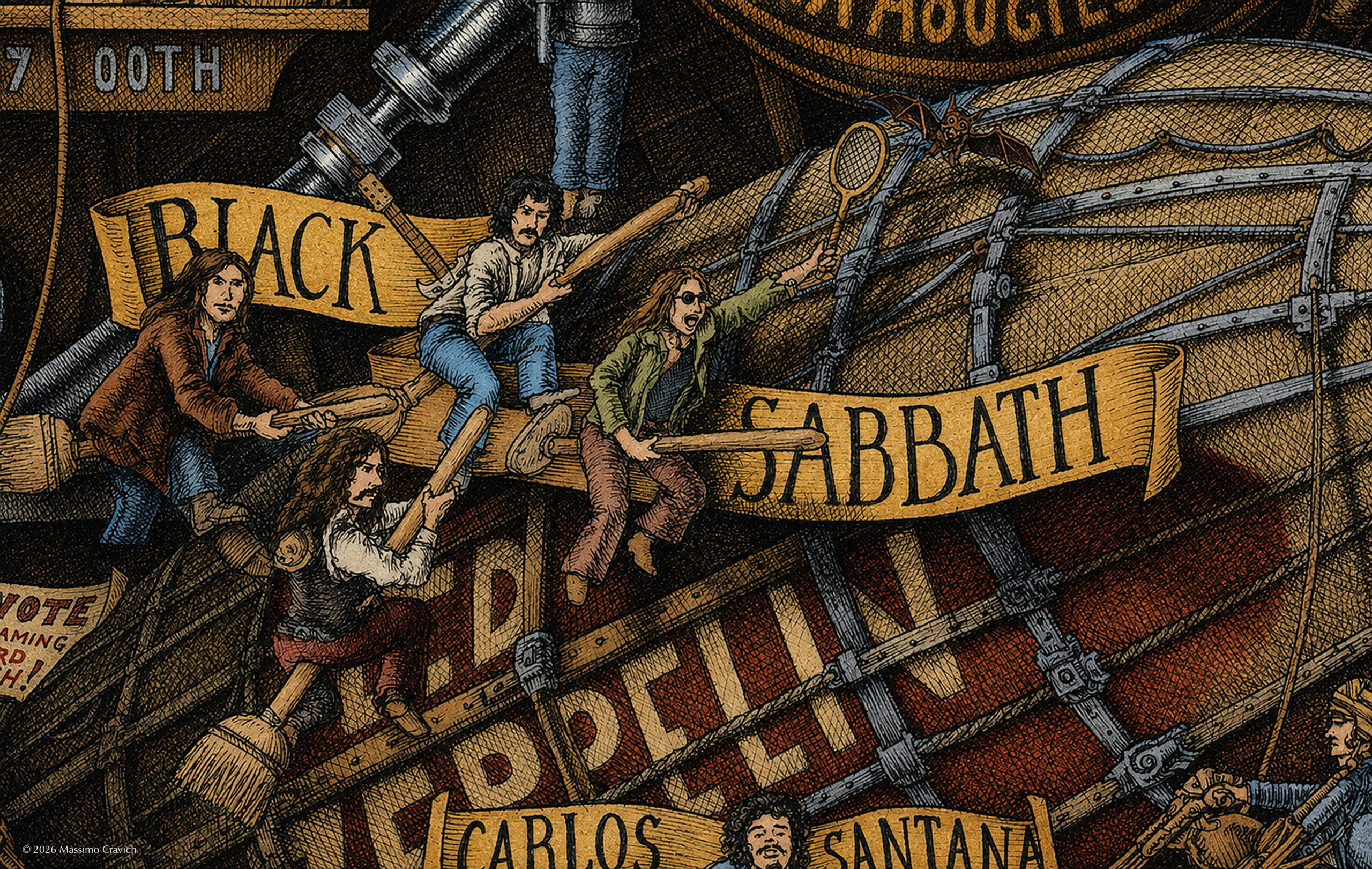
Albums such as Black Sabbath, Paranoid, Master of Reality and Vol. 4 transformed blues rock into a new heavy and dark grammar, making Black Sabbath a foundational source for heavy metal, doom metal, stoner rock and sludge.
Within The Great Rock and Roll History, Black Sabbath occupy an essential genealogical junction: American blues -> British blues -> hard rock and psychedelia -> Black Sabbath -> heavy metal -> doom, stoner, sludge and later generations of metal.
Influenced by
- Blues rock and Cream
- Horror cinema
- Working-class Birmingham reality
- Jazz drumming traditions
- Psychedelic experimentation
Influent For
- Metallica
- Doom metal generations
- Grunge bands
- Industrial metal scenes
- Stoner rock groups

Related Artists
- Led Zeppelin
- Deep Purple
- Judas Priest
- Motorhead
- Alice in Chains
- Ronnie James Dio
- Ozzy Ozbourne Solo
- Candlemass
Get Your Rock Icon
Selected artworks from Rock Icons and Stories are available as high-quality framed art prints. Printed on premium 230 gsm matte paper with excellent detail and colour reproduction, each print is professionally framed and delivered ready to hang.A carefully selected, high-quality alternative to the museum-grade Fine Art Giclée editions, offering an accessible way to own and display a reproduction of the original artwork. Printing, framing and worldwide fulfilment are handled by our specialist printing partner.

SOURCES
• https://www.rockhall.com/inductees/black-sabbath
• https://www.allmusic.com/artist/black-sabbath-mn0000768038
• Mick Wall – Symptom of the Universe
• Geezer Butler – Into the Void
In the genealogy of rock, Black Sabbath represent the moment when heaviness stopped being merely a sonic characteristic and became an autonomous language. Tony Iommi’s riffs, Geezer Butler’s bass, Bill Ward’s mobile drumming and Ozzy Osbourne’s voice transformed blues rock into something slower, more threatening and more radical. From that combination came one of rock’s major branches: heavy metal, with a lineage continuing through doom, stoner, sludge and countless later forms of metal.