
The Incredible String Band emerged from the British folk revival of the 1960s but quickly transformed that starting point into something far less classifiable. Traditional ballads, instruments from different cultures, psychedelia, modal forms and deliberately irregular songwriting coexisted without being reduced to a single style. This profile places the Incredible String Band withinThe Great Rock and Roll History, tracing the movement from the Scottish folk revival toward an acoustic and cosmopolitan form of psychedelia, parallel to but fundamentally different from the electric folk rock of groups such as Fairport Convention.
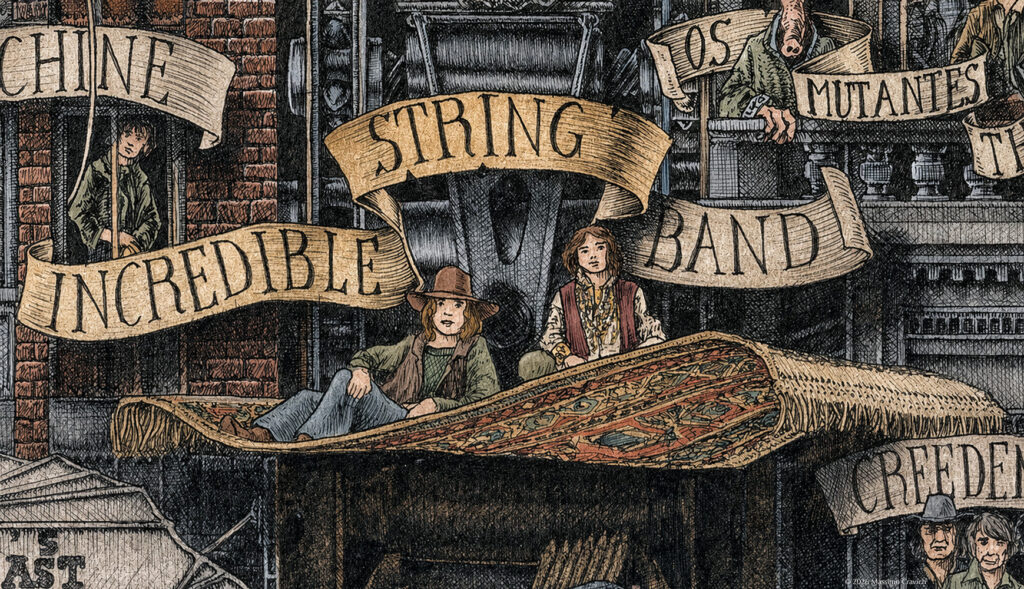
Rock Icons: Incredible String Band
The band combined folk traditions with experimental composition, creating a distinctive form of psychedelic folk that expanded the boundaries of acoustic music.

Folk moves beyond its own boundaries without needing to become electric rock. From Edinburgh’s folk scene to The 5000 Spirits or the Layers of the Onion, The Hangman’s Beautiful Daughter and Wee Tam and the Big Huge, the Incredible String Band combined British folk, non-Western instruments, modal forms and psychedelic imagery in acoustic music resistant to any single genre.
Founded: 1966, Scotland / UK
Status: disbanded (occasional reunions, last in 2006
Genres: Psychedelic folk, acid folk, experimental folk, proto–world folk
LISTEN
The Minotaur’s Song
Koeeoaddi There
More to discover…
The Roots of Psychedelic Folk
The Incredible String Band is one of the strangest, freest, and most unique organizations in the history of Western popular music. They’re not simply a psychedelic folk group: they’re a laboratory of sonic imagination in which tradition, childhood, mysticism, nonsense, improvisation, and global culture blend without hierarchies. If counterculture ever had a truly innocent, visionary, and radical soundtrack, it’s probably this one.
The Incredible String Band approached music as a fluid and exploratory process, incorporating a wide range of instruments and influences from different cultures.
Robin Williamson, Mike Heron and Clive Palmer came from the Scottish folk-revival circuit, where traditional repertoire, blues and new compositions could already coexist. After the first album and Palmer’s departure, Williamson and Heron radically widened the sound world. British folk remained one foundation, but guitars and fiddles were joined by sitar, gimbri, oud, flutes, percussion and other instruments encountered through travel and listening beyond Europe. These elements were not organized as scholarly reconstruction: they entered the songs as timbral possibilities, altering melodies, tunings and structures.
The Incredible String Band’s psychedelia therefore developed differently from that of electric rock groups. It depended less on volume, feedback or studio manipulation than on placing distant materials beside one another, shifting meters and forms capable of changing direction as a song unfolds. The Hangman’s Beautiful Daughter makes the method particularly clear: a song can contain fragments of balladry, visionary imagery, non-Western instruments and near-ritual passages without establishing a hierarchy among them. Even the boundary between inherited tradition and original composition becomes less stable.
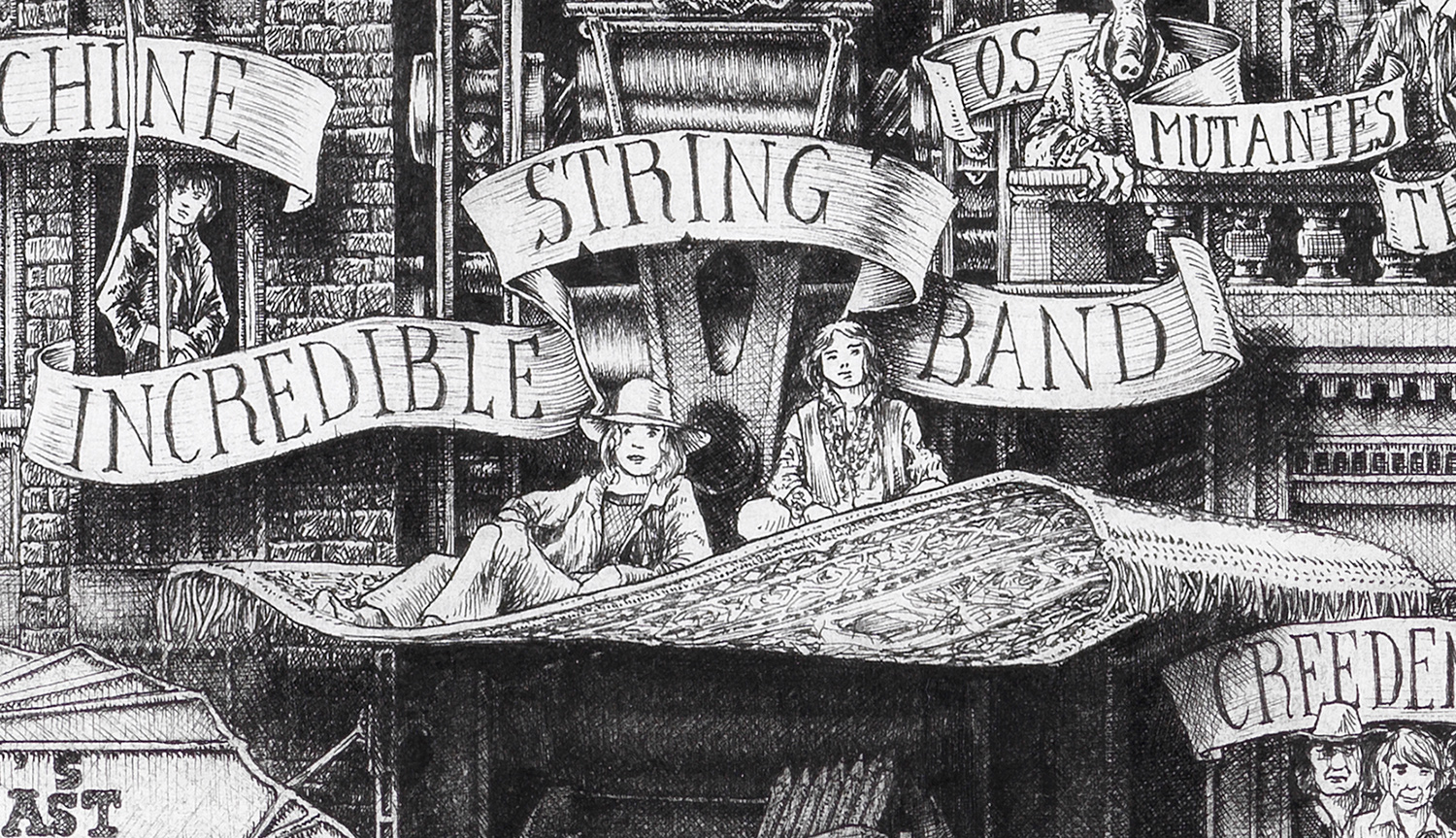
Genealogically, the group therefore occupies a different position from Fairport Convention. Fairport brought British balladry into the structure of an electric band; the Incredible String Band instead opened acoustic folk toward psychedelia, cross-cultural instrumentation and formal experimentation. Its influence is less easily reduced to one genre and resurfaces across acid folk, psychedelic folk, freak folk and various forms of unorthodox acoustic songwriting. The line can be read as traditional folk + folk revival -> Incredible String Band -> psychedelic/acid folk -> acoustic experimentation and later freak folk.
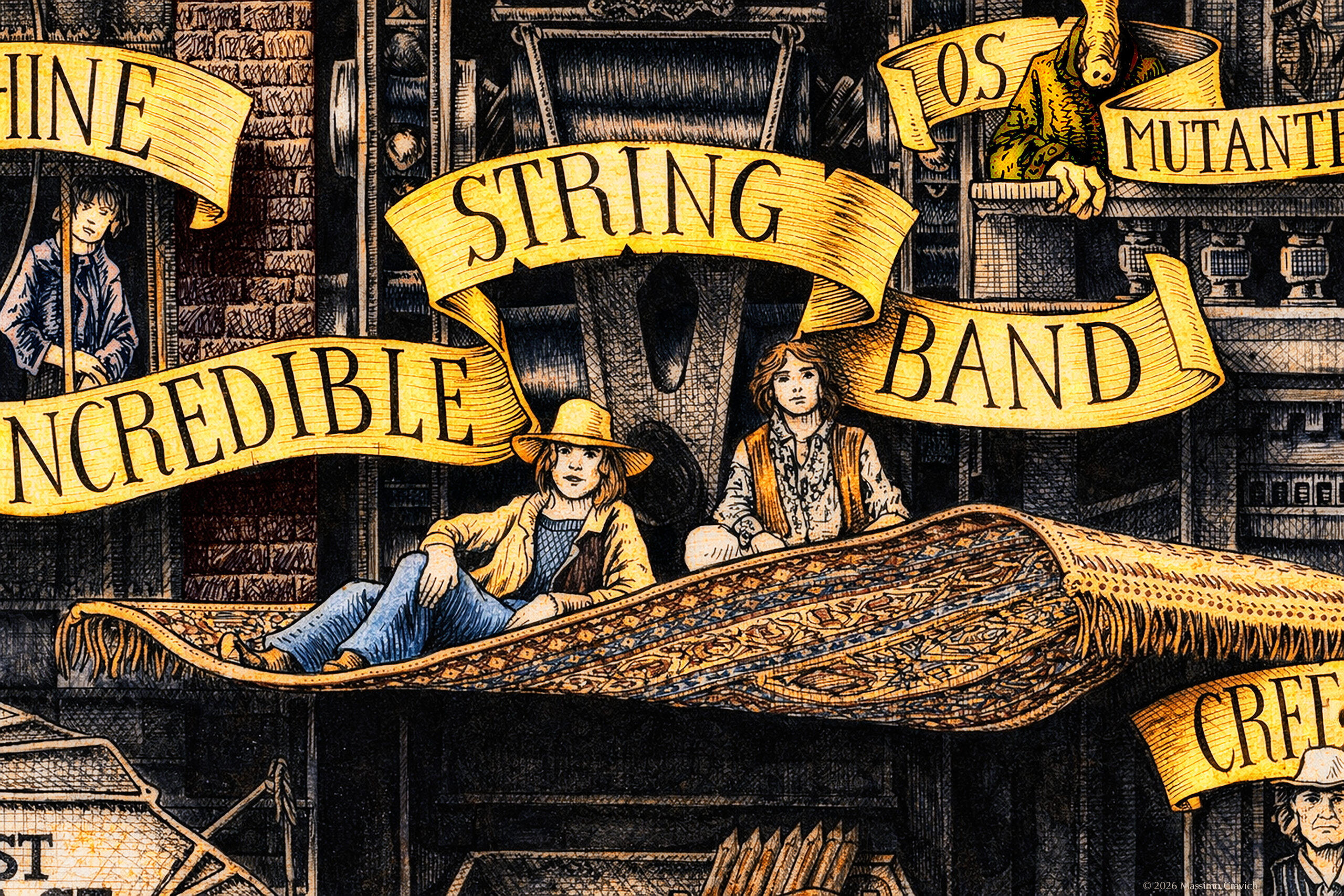
With albums such as The 5000 Spirits or the Layers of the Onion and The Hangman’s Beautiful Daughter, the Incredible String Band expanded British folk through non-Western instruments, shifting structures and psychedelic sensibility without depending on the language of the electric rock band.
Within The Great Rock and Roll History, the Incredible String Band connect traditional folk and the British folk revival -> psychedelic expansion and non-Western instrumentation -> acid and psychedelic folk -> later acoustic experimentation and freak folk.
Influenced by
- Traditional British folk
- Traditional Middle Eastern and African music
- Psychedelia and 1960s spirituality
Influent For
- Led Zeppelin (openness to mystical folk)
- Contemporary psychedelic folk
- Neo-folk and freak folk
- World-folk and acoustic influences
- European experimental singer-songwriters
Related Artists
Get Your Rock Icon
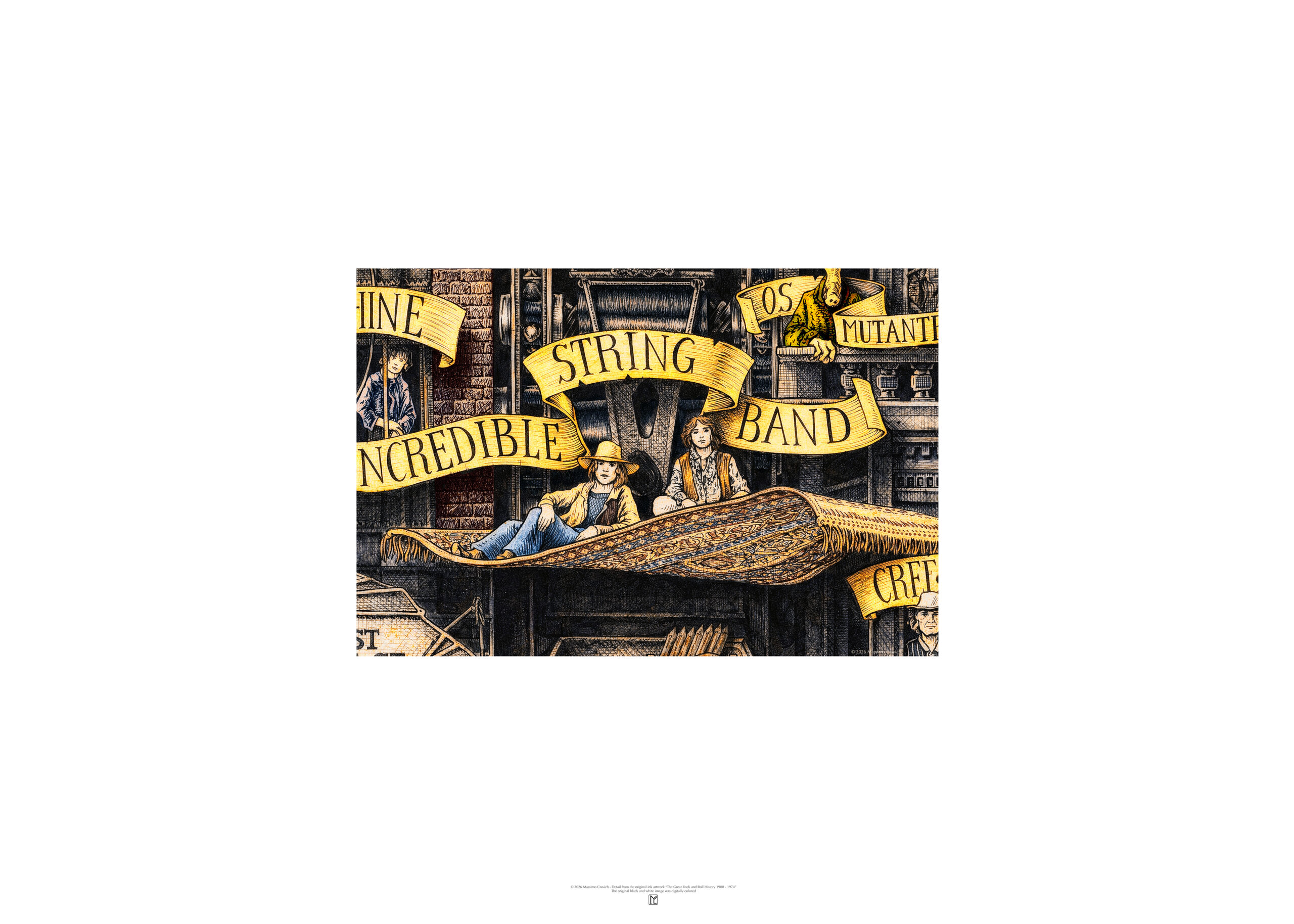
Selected artworks from Rock Icons and Stories are available as high-quality framed art prints. Printed on premium 230 gsm matte paper with excellent detail and colour reproduction, each print is professionally framed and delivered ready to hang.A carefully selected, high-quality alternative to the museum-grade Fine Art Giclée editions, offering an accessible way to own and display a reproduction of the original artwork. Printing, framing and worldwide fulfilment are handled by our specialist printing partner.

SOURCES (selected)
Incredible String Band — general profile (Wikipedia).
Interviews with Robin Williamson and Mike Heron.
BBC Folk Archives.
Review in Mojo, Uncut, The Guardian.
Within the broader narrative of rock history, The Incredible String Band represent a unique expansion of folk music into experimental and conceptual territory. Their influence extends beyond traditional genres, shaping psychedelic, progressive and alternative approaches to acoustic music.